


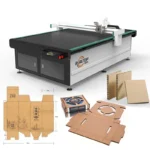
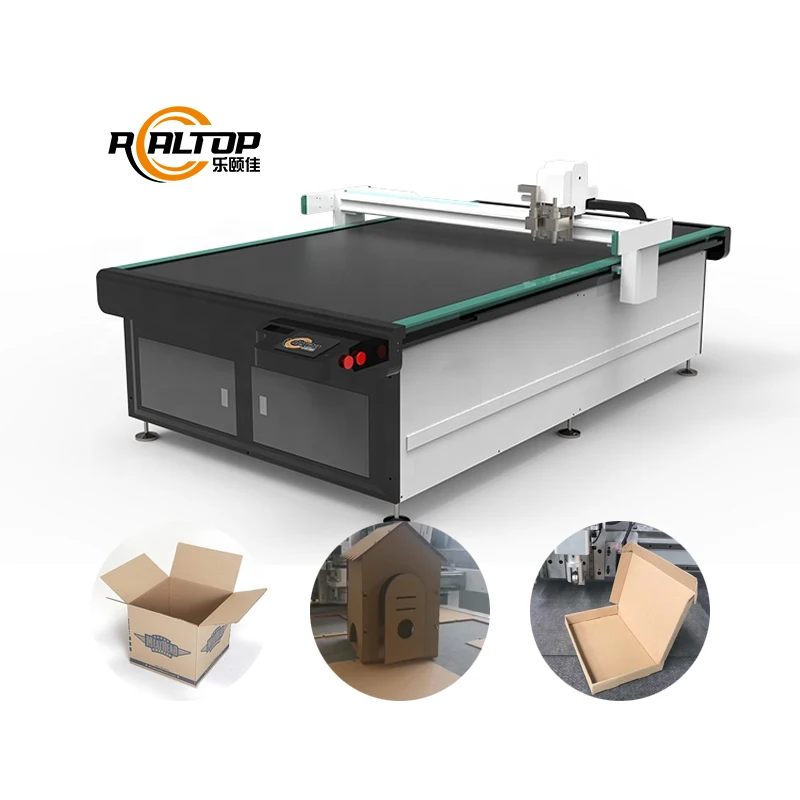
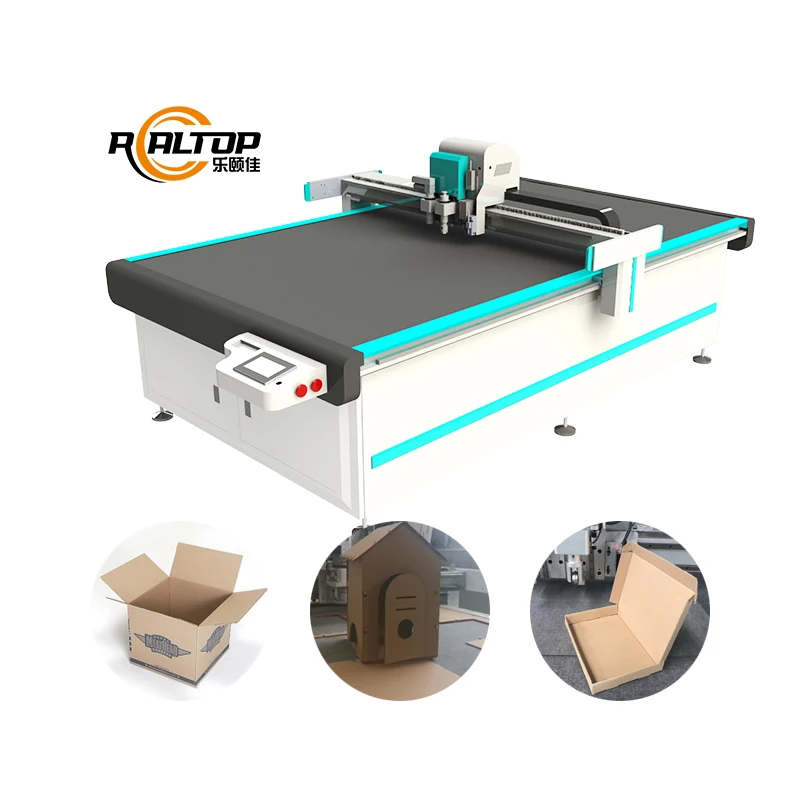
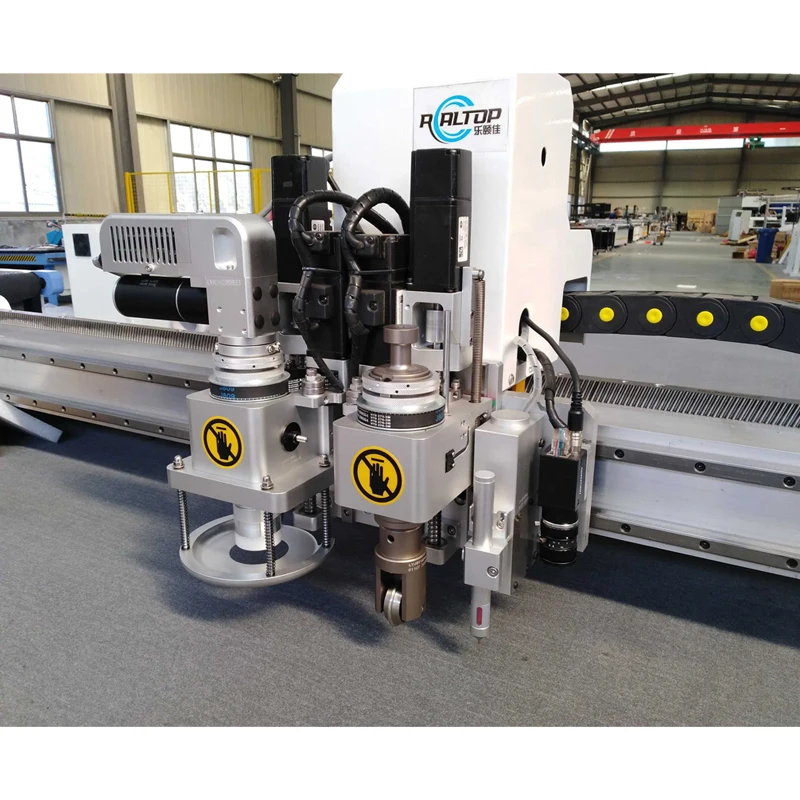
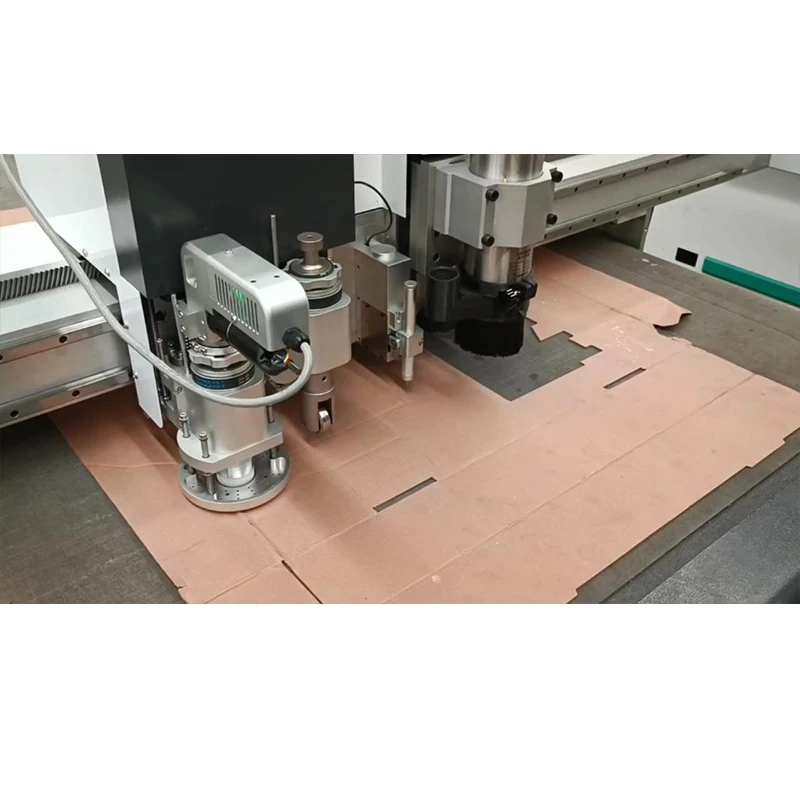
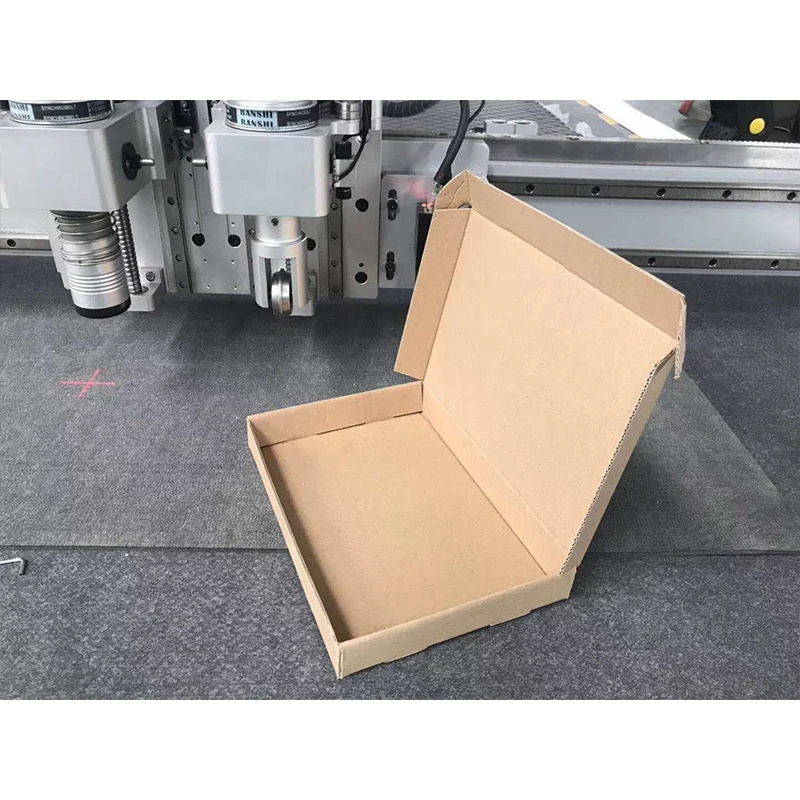
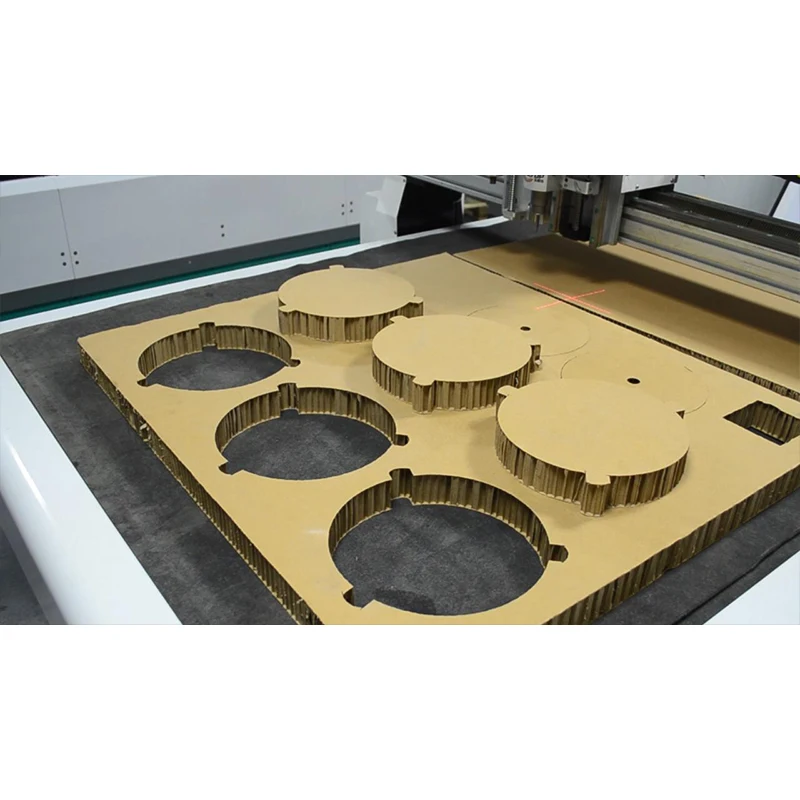

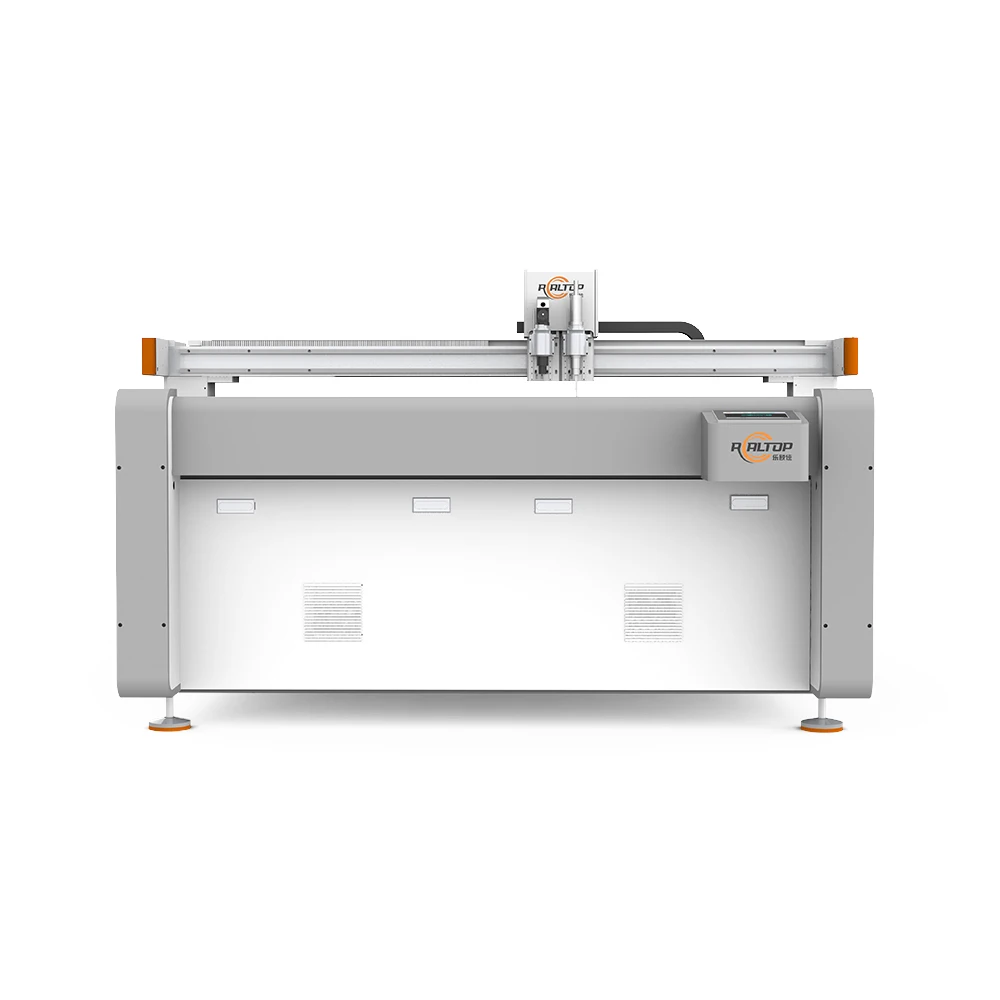
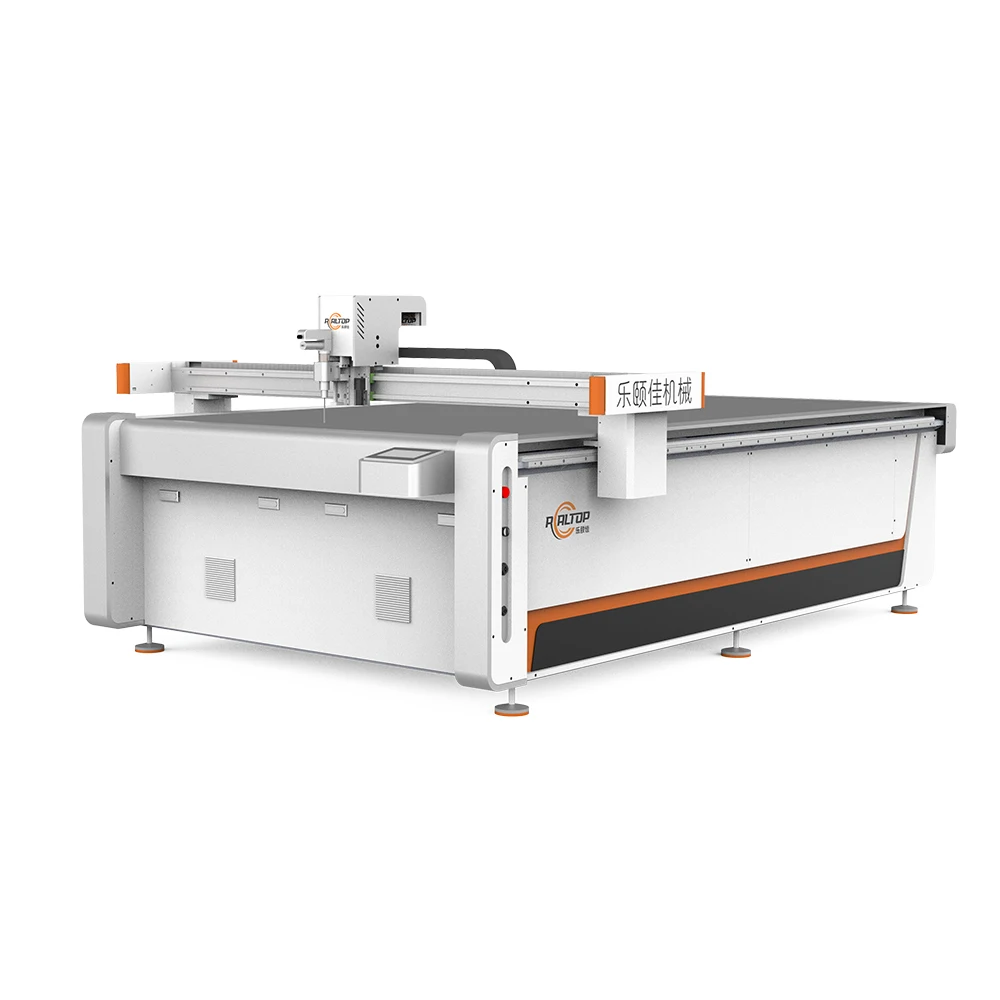
Zoned Vacuum & Multi-Tool Workflow — This CNC oscillating knife cutting machine for corrugated cardboard production line integrates creasing, kiss-cutting, and full cutting within a single setup, eliminating manual tool changes for packaging sample makers.
Technical Specifications
| Parameter | Value |
|---|---|
| Product Type | CNC Oscillating Knife Digital Cutting Machine |
| Working Area | 2500×1300mm or 1600×2500mm |
| Machine Footprint | 3550×1910×1400mm or 3450×2300×1250mm |
| Tool Head Options | Oscillating knife, Creasing wheel, Kiss-cut knife, Round punch |
| Rated Power | 9 kW |
| Vacuum Pump | 7.5 kW |
| Cutting Thickness | ≤18mm (basis to be confirmed) |
| Fixing Method | Zoned vacuum adsorption on aluminum honeycomb table |
| Repeated Accuracy | <0.05mm |
| Servo Drive | Dongling or Delta servo motor |
| Guide Rail | Taiwan Hiwin linear rail |
| Transmission | Ethernet port |
| Safety Device | Infrared sensors, emergency stop |
| Felt Belt | Wear-resistant anti-pull composite fiber (tension strength increased by 35% – source value — verify) |
| Voltage | 380V (frequency to be confirmed) |
| Supported File Formats | DXF, OLT, PDF, AI |
| Software | Professional carton nesting software included |
| Blade Supply | 10 oscillating blades included |
| Warranty | 1 year (excluding felt and knife blades) |
| Delivery Time | <30 working days |
Application Suitability
| Application | Material or Output |
|---|---|
| Corrugated packaging sample making | E-flute, B-flute, BC double wall corrugated board |
| Express logistics paper boxes | Single and double wall corrugated cardboard |
| High-end gift box prototyping | Grey board, coated specialty paper |
| Sticker and label contour cutting | Vinyl, PP paper, adhesive-backed stock |
| POS display and shelf talkers | Foam board, honeycomb paper board |
| Large electrical appliance cartons | Heavy-duty triple wall corrugated |
Why Crease Quality Fails on the First Sheet
A creasing wheel set for standard E-flute will crush F-flute or coated stock, producing ragged fold lines that ruin the sample before the run even starts.
Many packaging producers receive a cutting table tested only on common board grades, then discover that their actual production materials — high-moisture corrugated, specialty coated papers, or micro-flute stock — require entirely different tool pressure, oscillation frequency, and travel speed. The first sheet comes off with crushed flutes, delaminated edges, or crease lines that crack on folding. Production stops while operators recalibrate parameters that should have been dialed in before the machine left the factory [NEED_CITE: common corrugated board grade variations and their mechanical properties].
Matching Tool Head to Flute Profile
The oscillating knife frequency and blade geometry must align with the specific flute profile being processed. E-flute requires different vibration amplitude than BC double wall, and coated stocks demand sharper blade angles to prevent edge tearing. A single fixed-frequency setup will compromise edge quality across mixed board inventories, which is why this system supports tool head swapping between oscillating knife, creasing wheel, and kiss-cut configurations depending on the day’s production schedule.
Vacuum Zoning That Follows the Cut Path
Small carton blanks and intricate die-cut shapes tend to lift off flat tables during high-speed knife travel, causing misregistration and ragged edges. The aluminum alloy honeycomb vacuum table divides into zones that activate only beneath the active cutting area, holding workpieces flat without requiring full-table vacuum draw. This zoned adsorption approach maintains consistent material registration during creasing and kiss-cut passes, particularly on lightweight or narrow stock where full-table suction would be inefficient [NEED_CITE: vacuum table zoning principles for CNC cutting tables].
How Frame Rigidity Affects Cut Repeatability
The welded thick square seamless steel structure undergoes high-temperature stress relief treatment, which reduces long-term dimensional drift under continuous vibration loads. Taiwan Hiwin linear rails paired with servo drive maintain repeated accuracy below 0.05mm across the full 2500mm travel range. For packaging sample makers running dozens of unique designs daily, this stability prevents cumulative registration errors that would otherwise force manual re-calibration between jobs.
The Cost of Skipping Material-Specific Calibration
When a cutting table ships with parameters set only for generic board stock, the buyer faces immediate downtime upon commissioning. Knife pressure too high crushes flute structure, weakening box compression strength. Creasing wheel depth set wrong produces fold lines that crack or fail to hold a 90-degree bend. Kiss-cut settings that miss the release liner leave adhesive residue on the belt or fail to separate cleanly. These issues compound across production runs, forcing operators into trial-and-error cycles that consume material and delay deliveries [NEED_CITE: typical corrugated board cutting defects and their root causes].
Why Source From a Builder That Cuts Your Board First
In-house design covers both knife and laser cutting methods, so buyers match the process to material rather than forcing one technology. Each tool head and table configuration is specified against the buyer’s actual board grade, flute type, and production volume before order confirmation. Sample cutting runs on the buyer’s own material verify edge quality, crease definition, and throughput before commitment. Software compatibility is confirmed to ensure DXF, AI, and PDF imports feed directly into the nesting workflow. Voltage, plug type, and control language are locked in with electrical schematics before production begins.
Documentation & Verification
- Machine specification sheet listing tool head, vacuum zone layout, and board thickness range
- Electrical schematic confirming voltage, frequency, and plug type for destination market
- Sample cutting report on buyer’s corrugated grade showing edge and crease quality
- Software licence with file format compatibility note for DXF, OLT, PDF, and AI
- Factory test record with dimensional accuracy measurement before dispatch
- Spare parts list with oscillating blade and felt belt replacement intervals
Installation, Commissioning & Support
- Foundation leveling for 3550×1910mm footprint with vibration isolation pads under frame feet
- Dedicated 380V circuit with breaker rated above 9 kW total draw including 7.5 kW vacuum pump
- Machine arrives with tool heads pre-mounted; belt tensioning and vacuum seal check on site
- First-run parameter tuning on buyer’s actual corrugated stock with operator present
- Nesting software training covering file import, auto-layout, and cut path sequencing
- Blade replacement procedure and felt belt tension adjustment covered in operation manual
What to Share Before Requesting a Quote
Provide the specific corrugated flute profile and board thickness you run most frequently, along with typical sheet dimensions and daily output volume. Confirm your facility’s voltage and frequency standard, preferred control language, and whether your design files originate from specific packaging CAD systems. If you work with coated or high-moisture stock, send material samples so cutting parameters can be validated before order.
Frequently Asked Questions
Q: How do you set oscillating knife frequency for different corrugated flute types?
A: Knife frequency and blade angle are adjusted based on flute height and board density. E-flute micro-corrugated requires higher frequency with shallower amplitude, while BC double wall needs lower frequency with great*s. Parameters are validated on your actual board samples before shipment.
Q: Can the CCD system track registration marks on glossy coated stock?
A: Printed contour recognition depends on mark contrast and surface reflectivity. Glossy lamination can cause glare that interferes with camera tracking at production speed. We test recognition reliability on your specific printed material during sample cutting to confirm the system maintains registration accuracy throughout the run.
Q: How does vacuum zoning prevent small carton parts from lifting?
A: The honeycomb table divides into independent zones that activate only under the active cutting head. This localized suction holds small blanks and narrow strips flat without requiring full-table vacuum, which would waste energy and potentially pull lightweight stock out of position during rapid traverse moves.
Q: Will the nesting software import files from my existing packaging CAD system?
A: The included software accepts DXF, OLT, PDF, and AI formats. Before order confirmation, we verify that your specific file export settings import cleanly and that automatic nesting produces acceptable material yield on your standard sheet sizes. Any format incompatibility is identified and resolved during the pre-sales sample phase.




商品评价
Clear filtersThere are no reviews yet.