


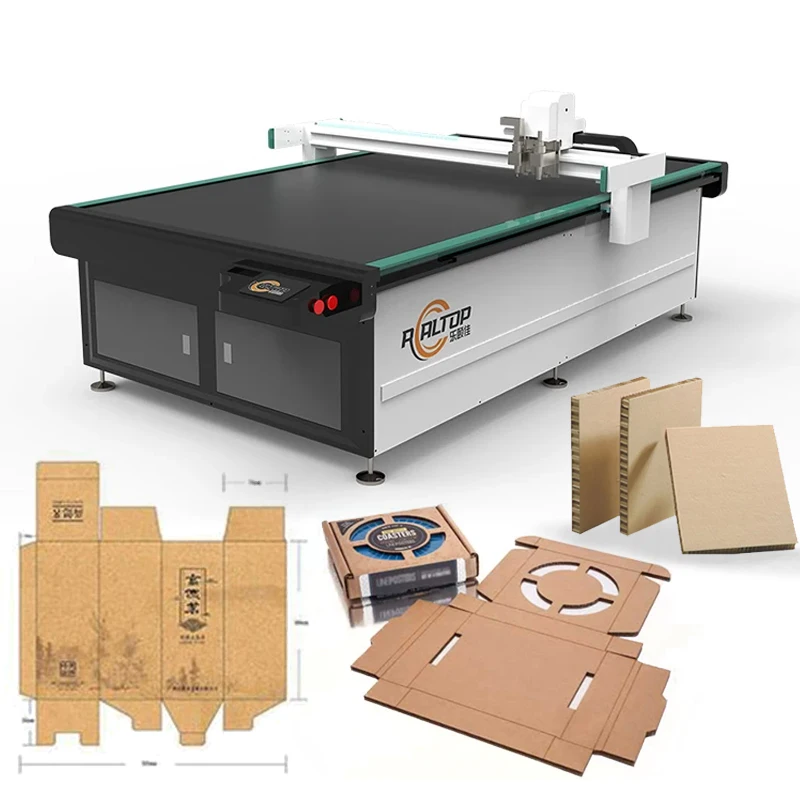
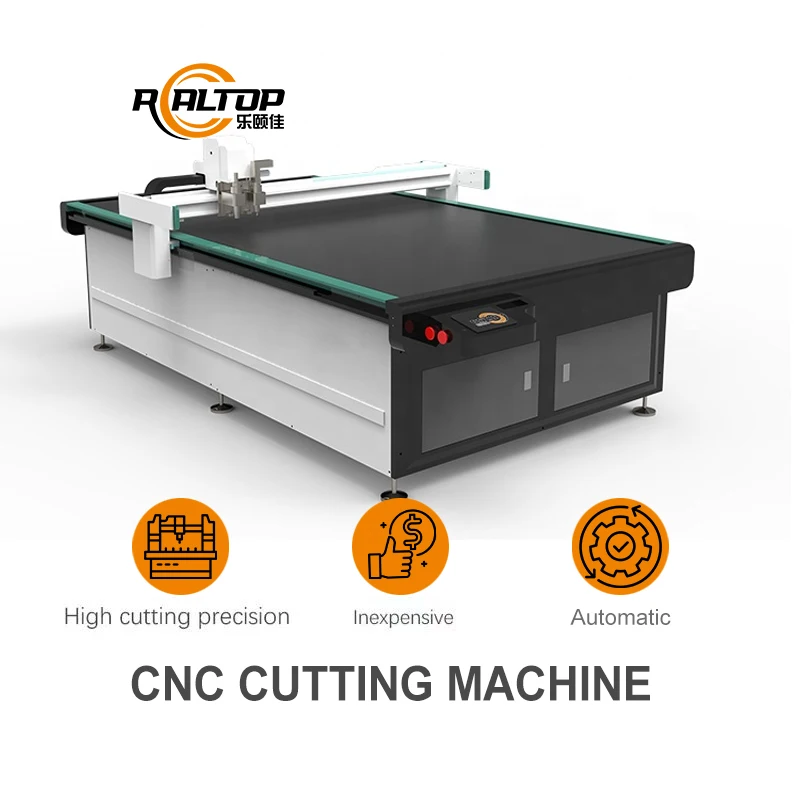
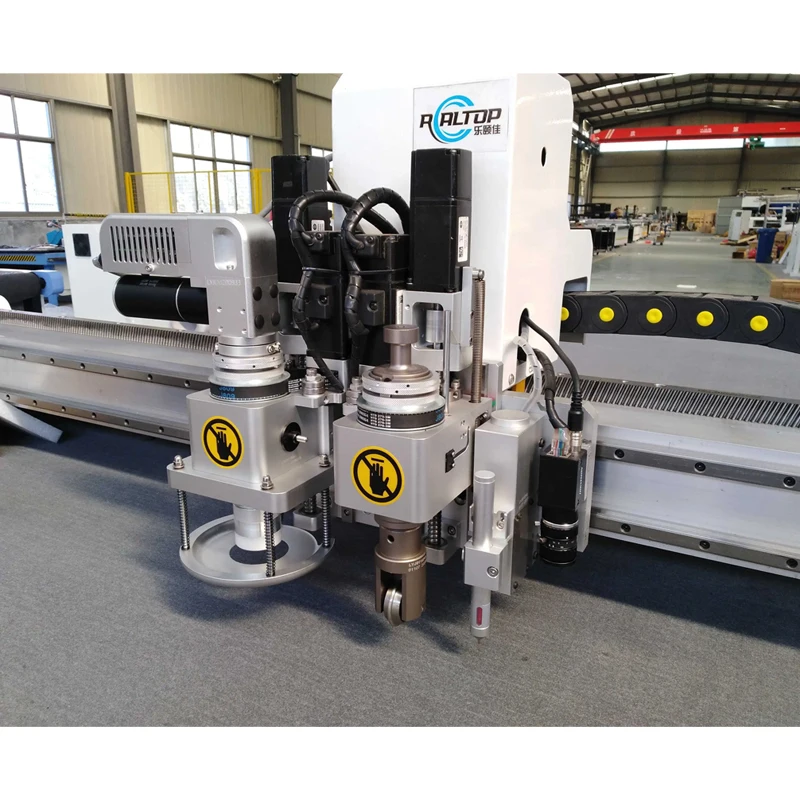
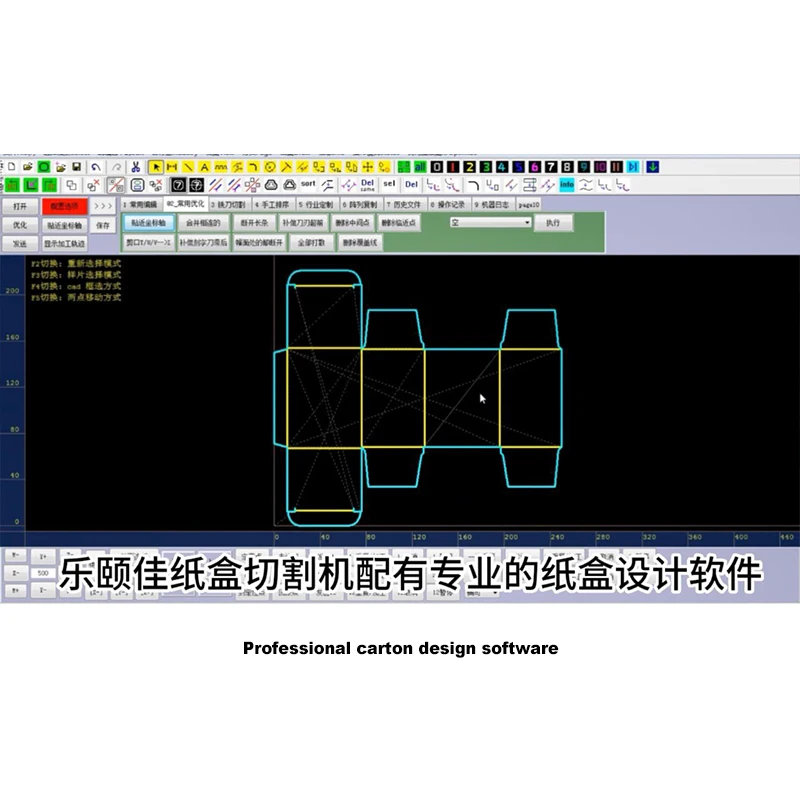
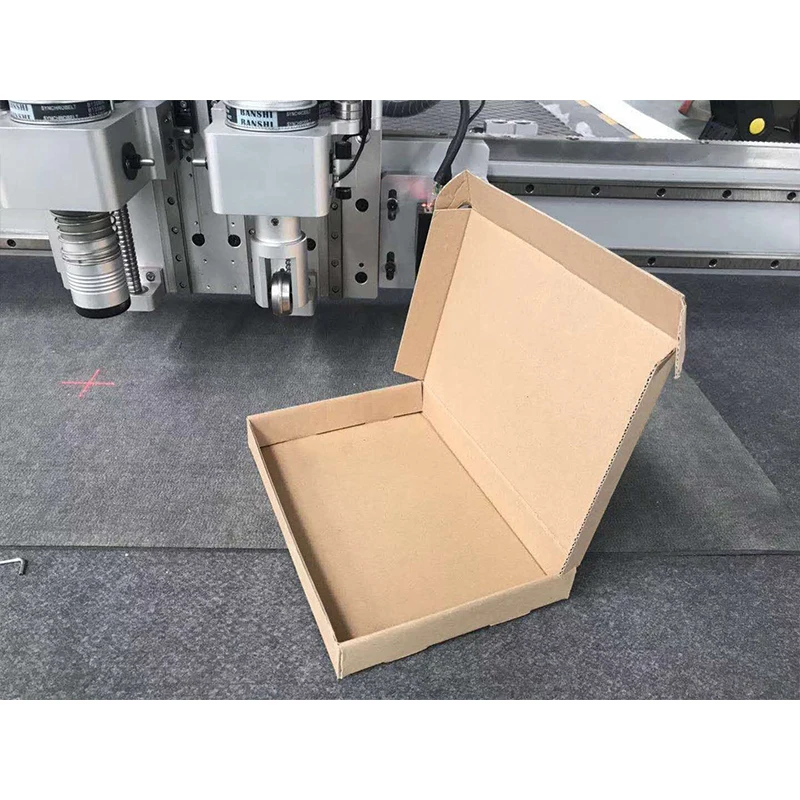
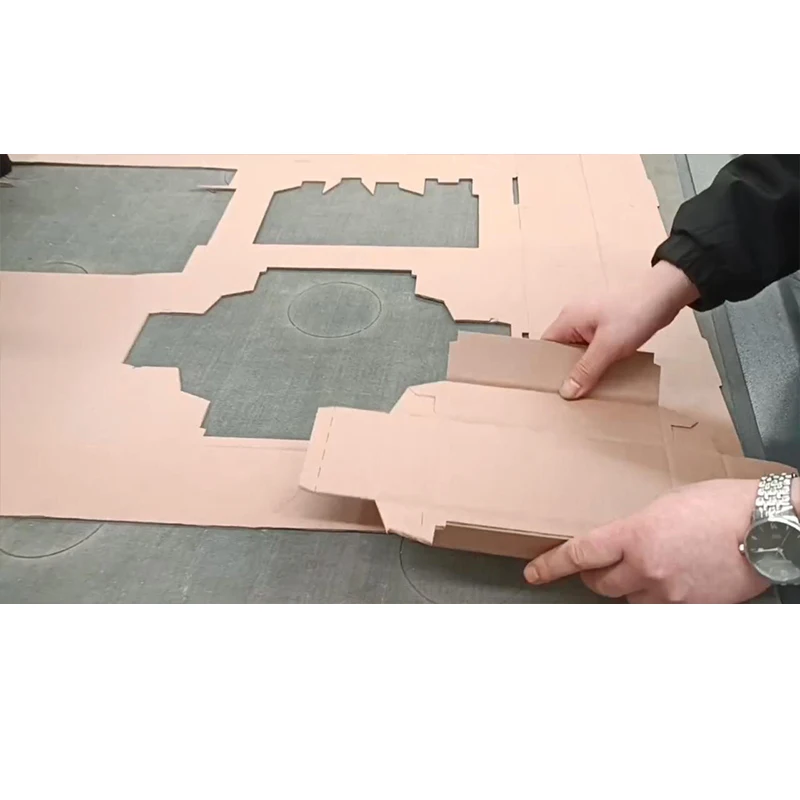

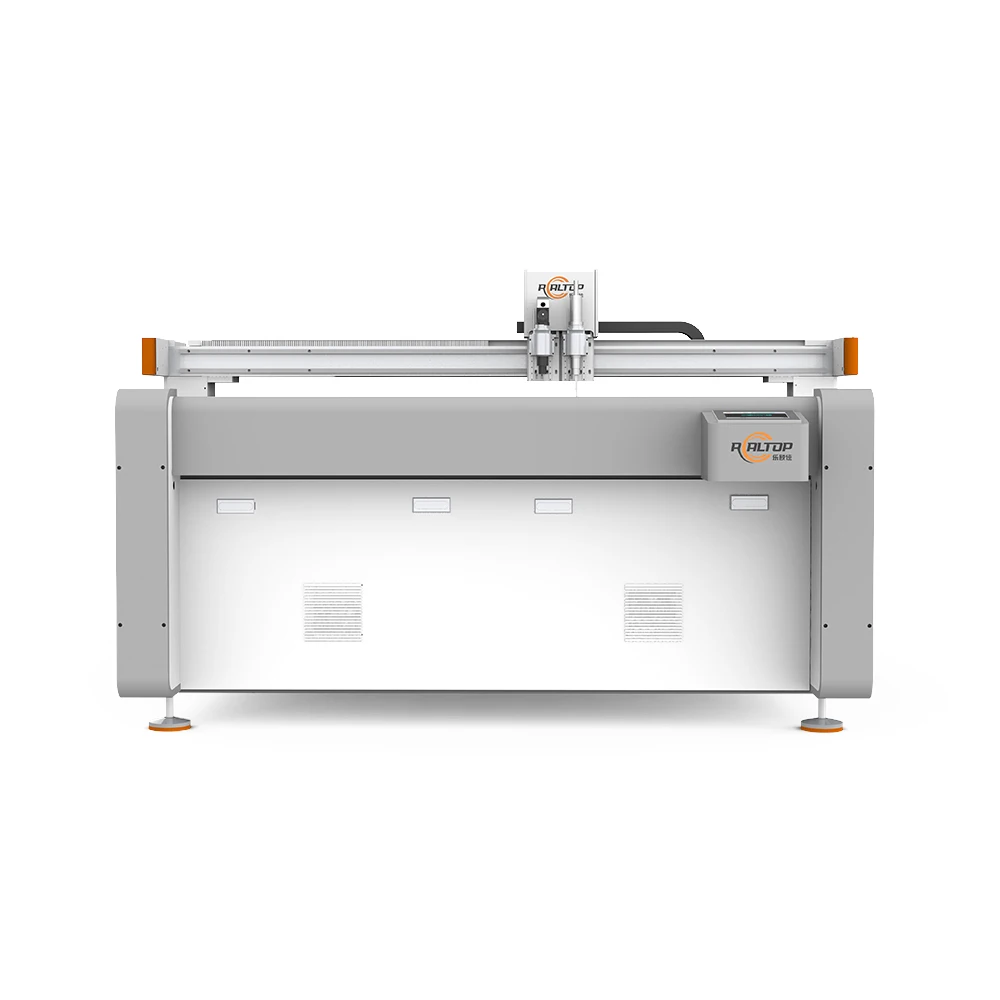
Multi-tool head configuration — oscillating knife, creasing wheel, kiss-cut and punch tools run in a single cycle to produce fold-ready carton blanks without die tooling on this CNC oscillating knife cutting machine production line.
Technical Specifications
| Parameter | Value |
|---|---|
| Product Type | CNC Oscillating Knife Cutting Machine |
| Working Area | 2500×1300 mm (RT–R2513) / 1600×2500 mm (RT-D2516 / RT-S2516) |
| Machine Size | 3550×1910×1400 mm (RT–R2513) / 3450×2300×1250 mm (RT-D2516 / RT-S2516) |
| Cutting Tools | Oscillating knife, Creasing tool, Kiss-Cut Knife Tool, Round punch |
| Fixing Method | Vacuum system |
| Table Structure | Aluminum alloy honeycomb vacuum adsorption platform |
| Rated Power | 9 kW |
| Cutting Thickness | ≤18 mm (basis to be confirmed against specific board grade and flute type) |
| Repeated Accuracy | <0.05 mm |
| Profile Format | DXF, OLT, PDF, AI |
| Transmission Method | Ethernet port |
| Transmission | Straight guide rail, rack transmission |
| Servo | Dongling servo (Delta servo motor available as option) |
| Safety Device | Infrared sensors |
| Voltage | 380 V |
| Control Language | Customizable (English, Russian, Italian, Chinese) |
| Blade Supply | 10 pieces of oscillating blades included |
| Delivery Time | <30 working days |
| Certification | CE |
Application Suitability
| Application | Material or Output |
|---|---|
| Carton sample making | Corrugated board, single-wall and multi-wall flute profiles, folding carton stock |
| Short-run packaging prototypes | Coated and uncoated cardboard, laminated board with EPE or foam layers |
| Sticker and label contour cutting | Self-adhesive vinyl, PP paper, printed label stock on release liner |
| Express and snack food box formats | Micro-flute corrugated, kraft liner, printed and unprinted carton blanks |
| Gift box and business card production | Thin board, card stock, specialty paper with kiss-cut and crease lines |
Why Specifying Board Grade Matters More Than Working Area
Cutting depth on corrugated board depends on flute type and laminate layup, not just a single millimetre figure.
A buyer who sources a flatbed cutter based on table size alone often discovers weeks after commissioning that the machine struggles with five-layer corrugated board or laminated EPE-corrugated combinations. The listed cutting thickness of 18 mm may hold for single-wall B-flute but falls short when the layup changes. That mismatch shows up as incomplete cuts through the bottom liner or crushed flute structure where the blade exits the material [NEED_CITE: cutting depth verification methods for corrugated board grades]. Production managers then face a choice between slowing the machine down to force full-depth cuts or sending the board through a second pass, both of which erode the throughput advantage of digital cutting over die-based methods. The CNC oscillating knife cutting machine production line must be validated against the buyer’s actual board grade before the order is locked.
One-Pass Crease and Cut Workflow for Carton Blanks
A packaging sample maker switching between box formats needs more than cutting speed — the entire tooling cycle must complete in one pass. On this CNC oscillating knife cutting machine production line, the oscillating knife handles the outer contour while the creasing tool scores fold lines and the kiss-cut knife addresses window cutouts or partial-depth features. A round punch removes registration holes or ventilation slots in the same run. This eliminates the need to shuttle the blank between a creaser and a cutter, reducing handling damage on printed surfaces and keeping registration tight across multiple tool engagements within the same job.
Vacuum Zoning Across the Honeycomb Platform
Holding corrugated board flat during cutting sounds straightforward until small nested carton parts begin lifting off the table mid-cycle. The aluminum alloy honeycomb vacuum adsorption platform provides distributed suction across the full bed area rather than concentrating pull in a few large zones. For packaging converters running nested layouts of mixed carton sizes, this means small flap sections and narrow divider strips stay registered to the table even when the cutting head passes at full speed. The uniform hold-down matters particularly on laminated board where trapped air between layers can act as a cushion and defeat single-zone vacuum [NEED_CITE: vacuum hold-down requirements for nested packaging layouts].
Reading the Parameter Sheet Against Your Production Reality
The <0.05 mm repeated accuracy figure tells a carton sample maker that printed graphics will register correctly across long production runs where the head travels the full 2500 mm axis length multiple times per job. The 9 kW rated power covers simultaneous operation of the oscillating knife motor, vacuum pump and servo drives without tripping the breaker on a standard industrial circuit. Straight guide rail and rack transmission deliver the positional stability needed for tight corner cuts on thick corrugated where belt-driven systems tend to deflect. Profile format support for DXF, AI, PDF and OLT means packaging designers can feed files directly from standard CAD tools without an intermediate conversion step that might distort bezier curves on complex carton templates.
The Cost of Skipping the Sample Cut Step
Creasing wheels specified for single-wall board will chip their edges within months when run on five-layer corrugated with EPE laminate, producing ragged scores on every sample and requiring unplanned tooling replacement [NEED_CITE: creasing wheel wear patterns on laminated corrugated board]. Insufficient vacuum zoning on nested layouts causes small carton parts to shift during the final pass, leaving mismatched fold lines that make the finished box impossible to assemble cleanly. Software that cannot import the buyer’s existing OLT or AI nesting files forces the design team to redraw templates, adding lead time to every new format changeover. These are not theoretical risks — they appear routinely in post-installation support tickets where the machine was ordered from a spec sheet without a material-specific test.
Why Production Managers Source This Configuration
The tool head list is built around the buyer’s actual board layup rather than a default set, so a converter running laminated micro-flute gets creasing wheels matched to that specific thickness and flute direction. Software file format compatibility is confirmed in writing before the order ships, eliminating the discovery that the nesting workflow requires an unsupported import format. Voltage, plug type and control language are locked to the destination workshop so the machine does not arrive needing a transformer or an interpreter. Sample cutting on the buyer’s own material produces a documented report showing edge quality and crease depth before commitment, rather than relying on generic demo stock. An in-house design team covers both the mechanical tooling configuration and the software integration, so accountability for the complete workflow sits with one manufacturer.
Documentation & Verification
- Machine specification sheet listing confirmed tool head and table configuration per your board grade
- Electrical schematic with voltage and frequency matching your workshop supply before dispatch
- Sample cutting report on your own corrugated or label stock showing edge and crease quality
- Software licence and file format compatibility note covering DXF, AI, PDF and OLT imports
- Factory test record documenting repeated accuracy and vacuum hold on your material thickness
- Packing photographs showing machine condition and blade supply count before crating
Installation, Commissioning & Support
- Foundation must support the 3550×1910 mm footprint of the RT–R2513 with level tolerance for the honeycomb platform
- Dedicated 380 V circuit sized for the 9 kW rated load plus vacuum pump startup surge
- Machine ships fully assembled with infrared safety sensors calibrated at the factory
- First-run commissioning includes vacuum zoning adjustment for your specific board format
- Operator training covers tool head changeover between oscillating knife, creasing and kiss-cut tools
- Spare blade stock of 10 oscillating blades included; consumable felt and blades excluded from warranty
What to Include With Your Enquiry
Share the exact board grade, flute type and laminate layup you run most often so the tool head configuration can be matched before quotation. Confirm your local voltage and frequency, preferred control language and the file formats your packaging design team currently uses. If you are running mixed carton formats on nested layouts, note the smallest part dimension so vacuum zoning can be sized accordingly.
Frequently Asked Questions
Q: How do I verify the 18 mm cutting thickness against my specific corrugated board?
A: Request a sample cutting report run on your own board at full production thickness. The report documents edge quality, cut completeness through the bottom liner and whether the oscillating knife maintains speed without deflection. If your layup includes EPE or foam laminate, that must be part of the test rather than assumed compatible.
Q: Will small carton parts stay flat during nested cutting layouts?
A: The aluminum honeycomb vacuum platform distributes suction across the bed rather than concentrating it in large zones. For nested patterns with small flap sections, confirm the zoning map with the manufacturer based on your typical nesting template so suction reaches every part boundary.
Q: Which creasing wheel should I specify for my board thickness range?
A: Creasing wheel diameter and profile must match your board caliper and fold direction. A wheel sized for single-wall B-flute will produce shallow or ragged scores on double-wall stock. Provide your thickest and thinnest board grades so the tool head list includes the correct wheel options.
Q: Does the software integrate with our existing packaging CAD workflow?
A: The system imports DXF, AI, PDF and OLT files directly. Before ordering, share a sample production file from your current CAD software so the manufacturer can confirm that curves, crease lines and layer assignments import correctly without manual redrawing.
Q: How long does format changeover take between different carton templates?
A: Template changeover is handled in software with no physical die swap required. The time depends on how many tool heads are active in the new job — a simple rectangular carton with one crease line loads faster than a complex format requiring all four tools in sequence.




商品评价
Clear filtersThere are no reviews yet.