




Production-Job Fit — every tool head, vacuum zone and nesting format is specified around the buyer’s actual fabric stack, not a generic demo sheet.
Technical Specifications
| Parameter | Value |
|---|---|
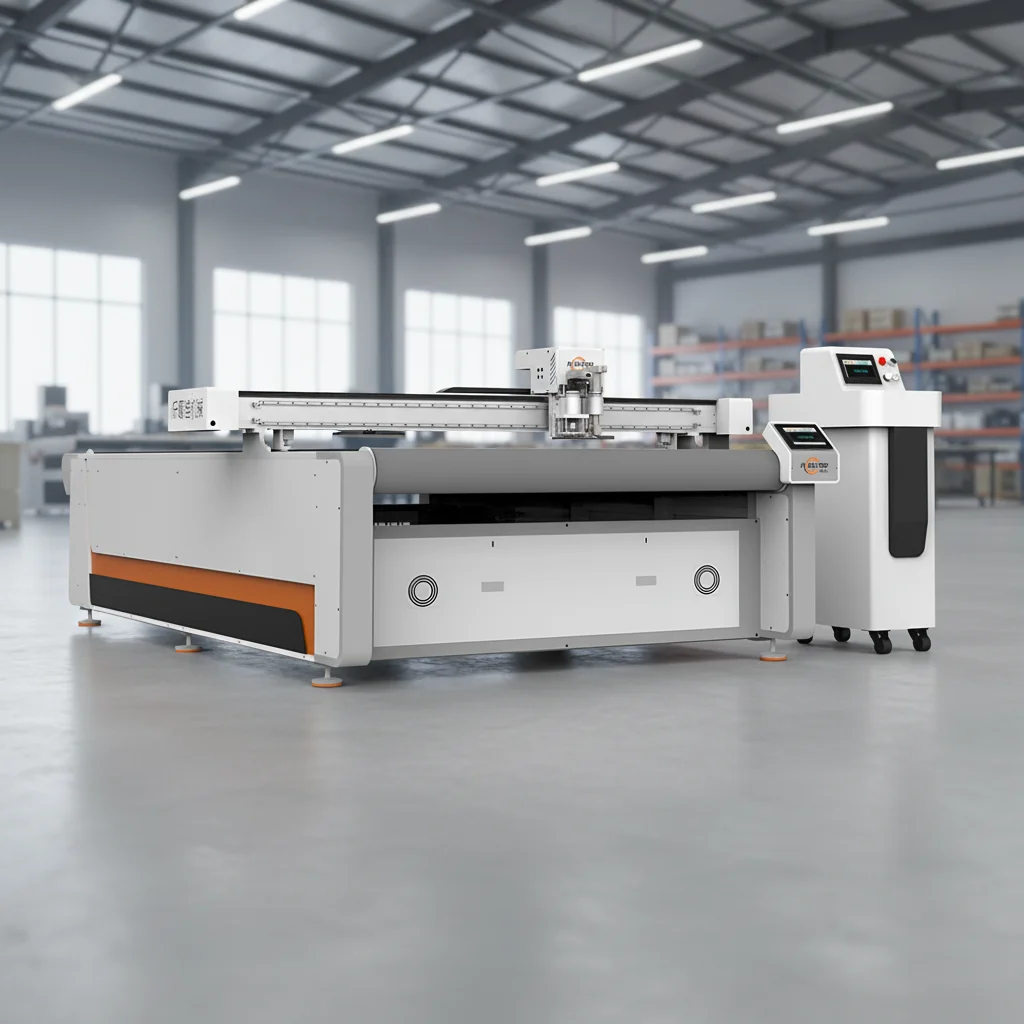
| Product Type | CNC Digital Textile Cutting Machine |
| Working Area | 1600 × 2500 mm |
| Machine Size | 3450 × 2300 × 1250 mm |
| Rated Power | 9 kW |
| Vacuum Pump | 7.5 kW |
| Table Type | Flat working table or auto-feeding table (configurable) |
| Multifunctional Head | Swiss-imported knife with vibration full cutting, half cutting and cursor location |
| Tool Head Options | Oscillating knife, pneumatic knife, high-power vibrating knife, circular knife, V-cutting knife, drag knife, creasing wheel, dotted-line knife, punching, brush |
| Translational Velocity | 800–2000 mm/s |
| Cutting Speed | 200–800 mm/s (varies by material and layer count) |
| Repeated Accuracy | ≤ 0.1 mm |
| Transmission System | Digital servo motor, linear guide, synchronous belt, imported ball screw |
| Servo Motor | Delta (optional Panasonic) |
| Rail | Taiwan Hiwin |
| Conveyor Belt | Germany imported |
| Platform | Aluminum air-box adsorption platform (integrated or split box option) |
| Vacuum Table Zoning | Configurable by application (basis to be confirmed per buyer part geometry) |
| CCD Camera | Visual positioning options: small CCD mark point, panoramic camera, projection (scope to be confirmed per model build) |
| Cutting Thickness | Up to 100 mm depending on material density (basis to be confirmed per fabric stack) |
| Instruction System | HP-GL compatible format |
| Software | Auto typesetting; supports PLT, DXF, AI formats |
| Control Panel | Touch screen, multi-language (English, Russian, Italian, Chinese, customizable) |
| Voltage | 380 V ± 10 % |
| Safety Devices | Infrared sensors, anti-collision, emergency stop |
Application Suitability
| Application | Material or Output |
|---|---|
| Garment pattern cutting | Multi-layer woven, knit and stretch sportswear fabric stacks |
| Footwear upper blanking | Synthetic leather, genuine leather, PU, EVA foam sheets |
| Soft home furnishing | Upholstery textile, curtain cloth, sponge-composite leather |
| Automotive interior trim | Non-woven fabric, composite gasket material, carpet layers |
| Carpet and floor mat | Large-format contour cuts on carpet, rubber and EVA |
| Sports and outdoor gear | Technical fabric, nylon, XPE foam, PTFE-coated textile |
| Graphic advertising and printing | Printed banner, sticker film, corrugated cardboard with CCD contour option |
Why "Cutting Speed" on a Spec Sheet Rarely Tells the Whole Story
A cloth CNC cutting machine only runs at its rated speed when the vacuum hold-down, tool oscillation frequency and fabric friction are all matched to the stack on the bed.
I once watched a sportswear producer lay up eighty plies of four-way-stretch lycra, hit start at the machine’s top translational velocity, and see the bottom layers drift a full centimetre before the knife even reached the second pattern piece. The operator slowed the feed, but by then half the morning’s panels were off-grain and the cutting room had to re-lay the plies by hand [NEED_CITE: fabric ply shift during high-speed knife cutting]. The lesson stuck with me: when buyers evaluate a cloth CNC cutting machine for industry application, the meaningful number is not the maximum carriage speed but the throughput the system sustains once vacuum zoning, knife amplitude and fabric coefficient are dialled in for the actual production material.
Vacuum Hold-Down and Small-Pattern Stability
In garment and footwear cutting, a large share of the pattern pieces are small and irregular — collar inserts, gussets, heel counters — and they are the first to lift when the knife exits the ply stack. The aluminum air-box adsorption platform on this cloth CNC cutting machine is offered in either integrated or split-box configuration, so producers cutting predominantly small parts can request multiple independent vacuum zones rather than a single full-bed pull. The difference matters: a single-zone table has to draw air across 1600 × 2500 mm to hold a 50 mm gusset, whereas a split box concentrates suction only where the material actually sits.
Tool-Head Matching Across Fabric Families
An oscillating knife handles woven cotton and canvas at high ply counts because the rapid vertical stroke separates the fibres cleanly; the same stroke on a thin PTFE-coated technical fabric tends to push the ply rather than cut it, where a drag knife or a circular knife gives a smoother edge. This cloth CNC cutting machine lists ten tool-head options from high-power vibrating knife to creasing wheel, and the correct selection is never obvious from the fabric name alone — a sponge-composite leather used in automotive headliners behaves differently from a single-layer PU of the same nominal thickness [NEED_CITE: oscillating versus drag knife edge quality on composite textiles]. That is why a sample cutting report on the buyer’s own roll is the only reliable basis for locking the tool-head configuration before the order goes to production.
Reading the Specs That Actually Affect Your Floor
The 1600 × 2500 mm working area covers most garment marker lengths in a single lay, reducing the number of feed cycles per shift. Delta servo motors paired with Taiwan Hiwin linear rails and an imported ball screw give the carriage the positional authority to hold repeated accuracy within 0.1 mm, which matters when nesting software is placing pattern pieces with 2–3 mm gaps to optimise fabric yield. The HP-GL compatible instruction system and auto-typesetting software that accepts PLT, DXF and AI files mean most garment CAD packages — Gerber, Lectra-compatible exporters, Optitex, and local nesting tools — can feed the machine without a secondary conversion step. A 380 V ± 10 % supply with a 7.5 kW vacuum pump and 9 kW rated machine power points to a dedicated three-phase circuit; buyers in markets with 220 V or 415 V nominal grids should confirm transformer or drive configuration before the unit ships [NEED_CITE: three-phase voltage tolerance for CNC cutting installations].
The Cost of a Configuration Decision Made Too Early
When a buyer signs off on the tool head and vacuum zoning from a catalogue photograph rather than a test cut on their own fabric, the first week of production usually reveals the gap. Small pattern pieces lift at the end of the cut and jam under the knife, forcing the operator to stop and clear the bed every few markers. The oscillation amplitude that sliced cleanly through the demo canvas tears through the buyer’s thin stretch material, leaving ragged edges that the sewing room rejects. On multi-layer lay-ups, the bottom ply drifts because the vacuum zoning was sized for a full-bed pull instead of concentrated small-part hold-down, and the cutting room quietly drops the ply count to compensate [NEED_CITE: ply drift compensation reducing effective throughput in textile cutting rooms]. None of these failures show up as a machine fault — they are configuration mismatches, and they cost shifts of lost output before anyone traces them back to the original spec sheet.
Why Sourcing This Cutter from REALTOP
REALTOP designs and builds both knife and laser cutting platforms in-house, so the same engineering team can advise whether an oscillating knife or a CO2 laser suits a specific fabric, rather than pushing the only technology they manufacture. Every cloth CNC cutting machine leaves the Jinan factory with a tool-head and table configuration list written around the buyer’s confirmed material and part geometry, not a default package. The design team runs a sample cutting report on the buyer’s actual roll before the order is locked, documenting edge quality, achievable ply count and cycle time under the proposed configuration. Voltage, plug type, control-panel language and software nesting format are confirmed in writing before production begins, eliminating the shipment-day surprises that strand machines on a factory floor for weeks. A full documentation pack — machine specification sheet, electrical schematic, factory test record, software licence note and spare-parts list — travels with the crate so the installation team can commission the cutter against a known baseline.
Documentation & Verification
- Machine specification sheet listing every confirmed tool head and vacuum zone for your configuration.
- Electrical schematic with voltage and frequency marked to match your factory supply.
- Sample cutting report on your fabric roll, documenting edge quality and ply count.
- Factory test record showing repeated accuracy and cycle timing before dispatch.
- Software licence and file-format compatibility note for your nesting workflow.
- Spare-parts list with oscillating knife blades, conveyor belt segments and vacuum filters.
Installation, Commissioning & Support
- The 3450 × 2300 × 1250 mm footprint requires a level floor with clearance on three sides for material feed and off-cut removal.
- A dedicated three-phase 380 V ± 10 % circuit with separate breaker for the 7.5 kW vacuum pump is recommended.
- Machine ships with auto-feeding table and conveyor belt pre-assembled; final rail alignment is verified on site.
- Touch-screen control panel is configured in your chosen language before dispatch, with on-site parameter tuning at first power-up.
- Operators are trained on tool-head changeover, vacuum-zone adjustment and nesting-software import for PLT, DXF and AI files.
- First-order spare kit includes Swiss-imported oscillating knife blades, drag knife tips and vacuum-table filter cartridges.
Tell Us About the Production Job, Not Just the Working Area
To size the correct cloth CNC cutting machine for your floor, we need the fabric type, typical ply count, the smallest pattern piece dimension and your daily marker volume. Share the voltage and frequency at your plant, the control-panel language your operators use, and whether your nesting workflow runs PLT, DXF or AI files. If you can send a roll sample or a short length of your production fabric, we will run a sample cut and return the edge-quality report, ply-count confirmation and configuration recommendation before you commit to an order.
Frequently Asked Questions
Q: How many layers of my specific fabric can this cloth CNC cutting machine cut per lay?
A: Layer count depends on fabric weight, surface friction and compressibility, not just thickness. A heavy woven canvas may run at a different ply height than a slippery four-way-stretch knit of the same nominal gauge. We confirm achievable ply count and edge quality through a sample cutting report on your own roll before the machine configuration is finalised, so the figure you plan production around is based on your material, not a generic demo fabric.
Q: Which tool head should I use for my material — oscillating knife, circular knife or drag knife?
A: Oscillating knives suit multi-layer woven and composite fabrics where a rapid vertical stroke separates fibres cleanly. Circular knives work well on single- or low-ply knit and non-woven rolls where a continuous rolling edge avoids ply shift. Drag knives are chosen for thin films, stickers and single-ply technical textiles. The correct choice is confirmed only after a test cut on your actual material, and the tool-head configuration list that travels with your machine records the decision.
Q: Will the vacuum table hold down small pattern pieces during high-speed multi-layer cutting?
A: Small and irregular pieces — gussets, collar inserts, heel counters — are the most likely to lift as the knife exits the stack. The aluminum air-box platform is available in a split-box configuration with independent vacuum zones, concentrating suction under the active cutting area rather than pulling across the full 1600 × 2500 mm bed. The zoning layout is specified around your typical pattern geometry so that small-part hold-down is engineered in, not left to chance.
Q: Does the software import my existing PLT, DXF and AI files without conversion loss?
A: The auto-typesetting software accepts PLT, DXF and AI formats natively, and the HP-GL compatible instruction system integrates with most garment and footwear CAD packages. Before the order is confirmed, we verify that your specific nesting files import correctly and that kerf compensation, grain-line markers and notch codes translate without manual rework, documented in a file-format compatibility note that ships with the machine.
Q: What cutting speed can I realistically expect on my material?
A: The carriage translational velocity is rated at 800–2000 mm/s and cutting speed at 200–800 mm/s, but the sustained production speed on your fabric depends on ply count, knife type and vacuum hold-down. We record the achievable cutting speed and cycle time during the sample cutting report on your material, giving you a realistic throughput figure for shift planning rather than a catalogue maximum that assumes ideal conditions.




商品评价
Clear filtersThere are no reviews yet.