




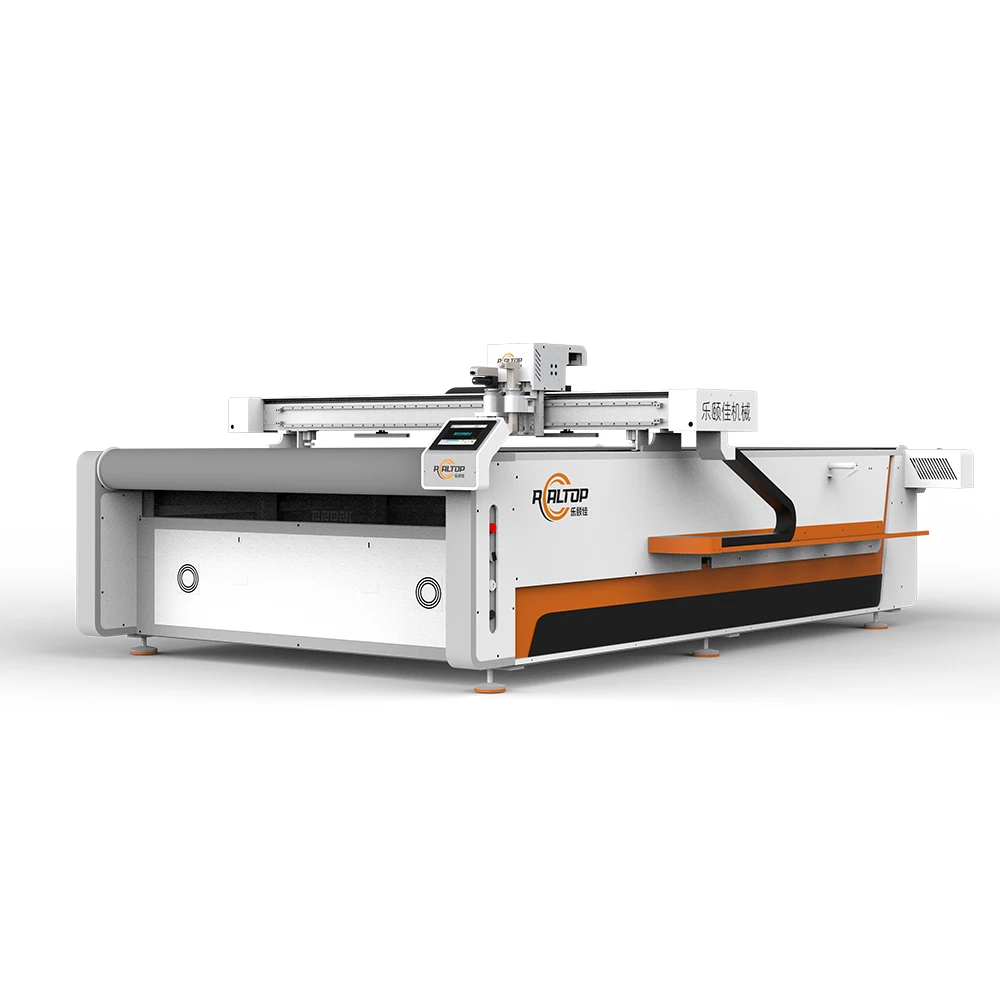
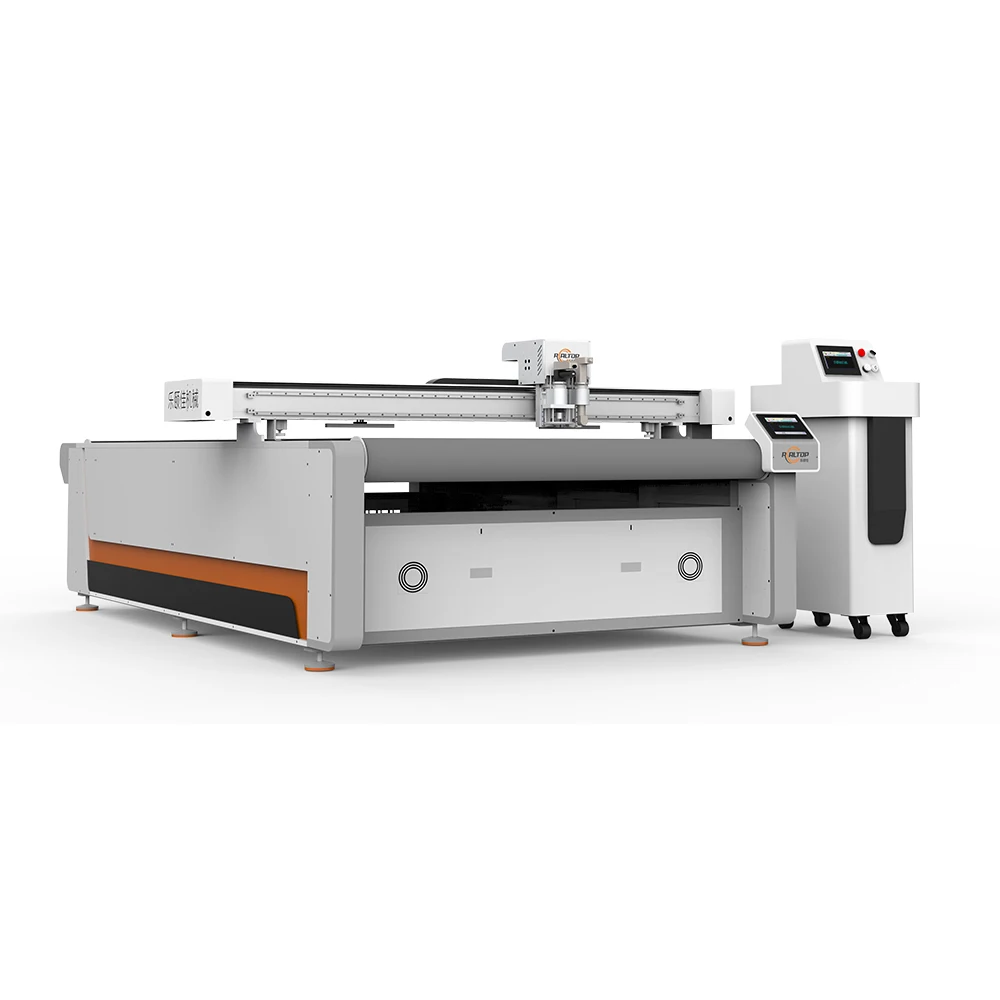
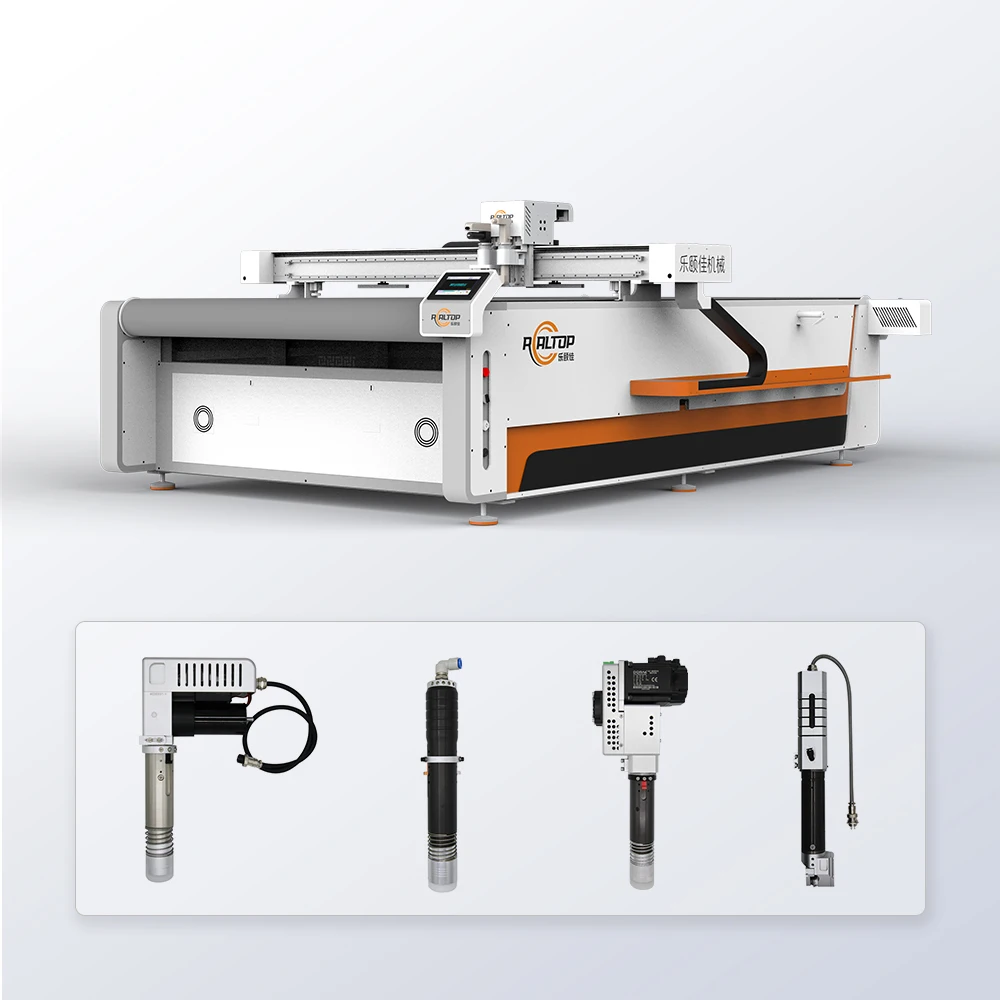
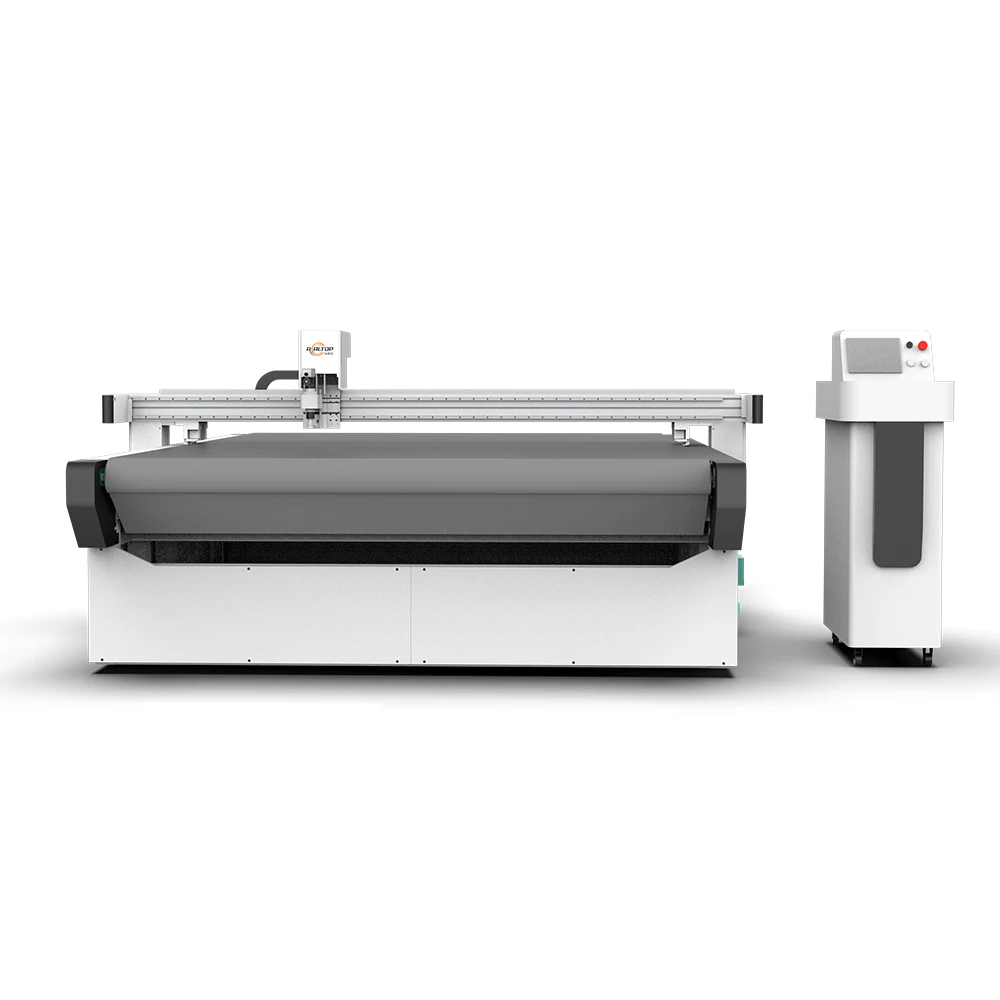


Material-matched tooling — every oscillating knife and vacuum zone is specified against your nonwoven density and thickness before the machine is built, not after it arrives.
Technical Specifications
| Parameter | Value |
|---|---|
| Product Type | CNC Oscillating Knife Cutting Machine |
| Working Area | 1600 × 2500 mm |
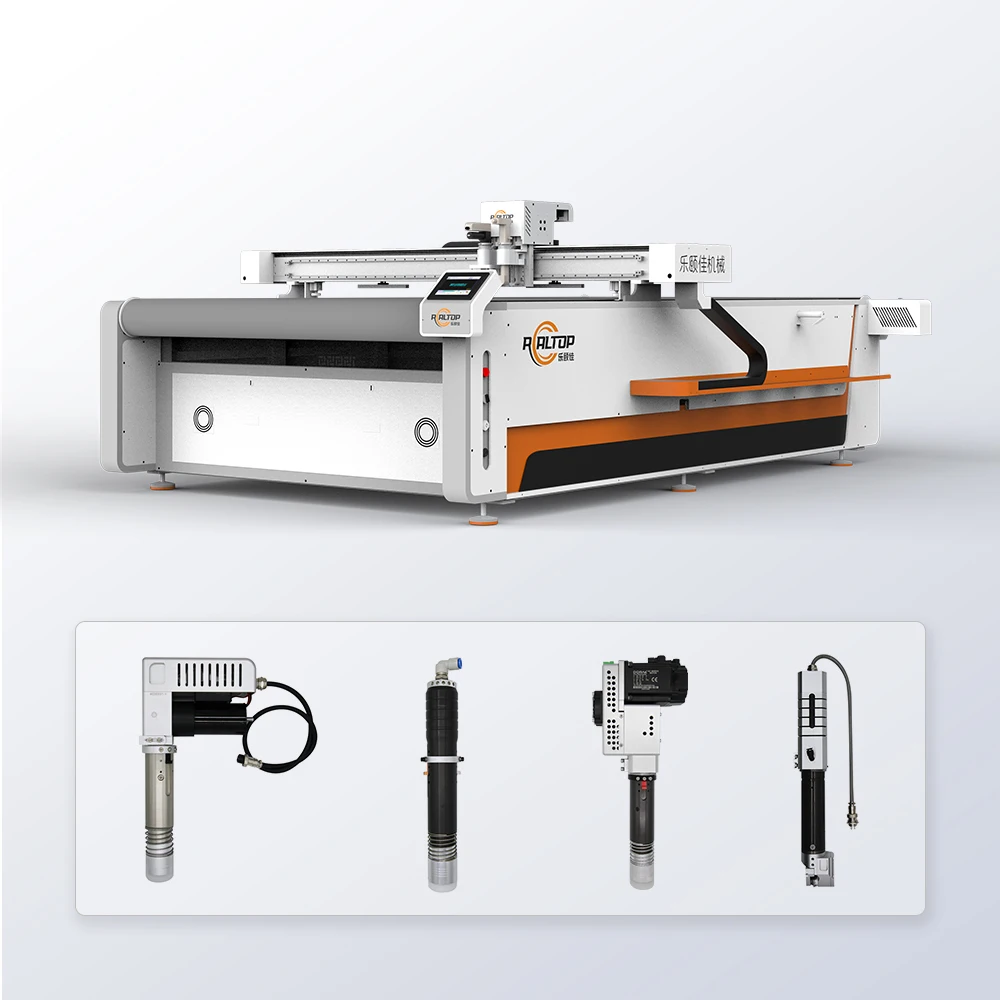
| Tool Head Options | Oscillating knife, driven rotary knife, creasing wheel, kiss cutting tool, pneumatic knife, milling tool, V groove knife |
| Applicable Materials | Fabric, cardboard, carton, mats, PVC, EVA, leather, acrylic, foam, PTFE, rubber |
| Cutting Speed | 0–2000 mm/s (basis not stated in source — confirm material type / thickness) |
| Cutting Thickness | ≤ 30 mm (basis not stated in source — confirm material type) |
| Cutting Accuracy | ±0.1 mm |
| Vacuum Pump | 9 kW |
| Vacuum Table | Aluminum bellows vacuum table |
| Machine Frame | Heavy-duty frame with precision-ground surface |
| Servo Motor Options | Panasonic, Delta, Dorna |
| Control Panel | PLC control panel with optional display languages |
| Voltage Options | 110 V, 220 V, 380 V |
| File Formats Supported | PLT, DXF, AI, PDF |
| Safety Device | Infrared sensor device and emergency stop device |
| Machine Dimensions | 3300 × 2100 × 1350 mm |
| Software Language Options | English, Russian, Italian, Chinese (custom languages available) |
| Certification | CE |
Application Suitability
| Application | Material or Output |
|---|---|
| Hygiene and medical nonwoven converting | Polypropylene rolls cut into shaped pads, filters and absorbent components |
| Apparel and home textile production | Multi-layer knit, woven and plush fabrics for sofa upholstery, curtains and rugs |
| Automotive interior trimming | Seat fabrics, carpets and PVC mats requiring burr-free edges at production pace |
| Composite material processing | Carbon fiber prepreg, aramid weaves and specialty reinforcement layers |
Why "2000 mm/s" Means Nothing Without the Material Context
The cutting speed on the spec sheet is a mechanical ceiling, not a production guarantee — your real throughput depends on nonwoven density, layer count and knife frequency.
I spent years on the assembly floor before moving into technical sales, and the single most common argument I hear after a machine is installed is about speed. A buyer sees 2000 mm/s on a CNC Oscillating Knife Cutting Machine for fabric and nonwoven production and assumes that number applies to their exact roll. In reality, a lightweight spunbond polypropylene at single-layer will let the head travel near the upper range, while a needle-punched geotextile or a glass-fiber-reinforced composite forces the speed down to maintain edge quality and protect the blade. [NEED_CITE: relationship between oscillating knife frequency and material density in nonwoven cutting]
When we quote a cycle time, we tie it to a specific material sample, thickness and lay-up. Anything less is guesswork.
Matching the Tool Head to the Nonwoven Structure
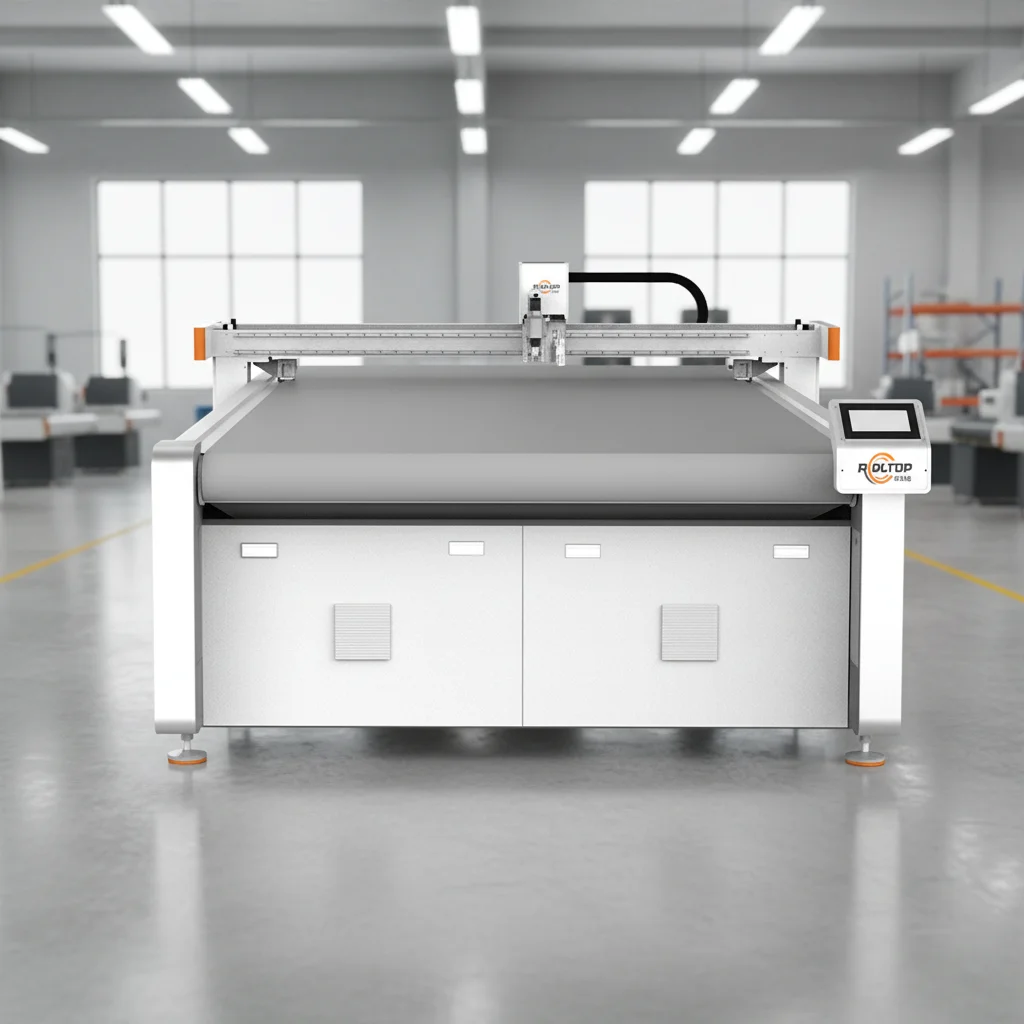
Polypropylene nonwoven is not one material — it ranges from thin spunbond webs used in medical disposables to thick needle-punched felts for automotive sound insulation. An oscillating knife handles most mid-weight rolls cleanly, but a driven rotary knife may be specified for continuous long cuts on lighter webs where edge fraying is the primary concern. A pneumatic knife enters the picture when the material is compressible and needs downward hold during the stroke. The CNC Oscillating Knife Cutting Machine for fabric and nonwoven production offered here carries all three options on a single gantry, so the tool head is selected after your material is identified rather than guessed at the quotation stage.
Vacuum Zoning That Holds Small Pieces Without Masking
Nonwoven converters frequently cut dozens of small components from a single lay-up — filter pockets, pad inserts, gasket blanks. A full-sheet vacuum pull works fine until the part footprint drops below a certain area, at which point the edge lifts and the knife drags the piece off position. The aluminum bellows vacuum table on this system is divided into zones that the operator activates only under the active cutting region. This concentrated adsorption holds small polypropylene parts flat without wasting pump capacity on empty table space. [NEED_CITE: vacuum table zoning practices for small-part digital cutting]
Reading the Specifications Against Your Actual Production
The 1600 × 2500 mm working area accommodates standard nonwoven roll widths and allows nested layouts that reduce waste on multi-piece jobs. The ±0.1 mm cutting accuracy matters most when downstream assembly relies on registration — think automotive headliner inserts or medical drape fenestrations where a millimeter of drift causes a reject. The 9 kW vacuum pump delivers sufficient negative pressure for dense, air-permeable nonwovens that would bleed suction on a lighter system. Servo motor selection from Panasonic, Delta or Dorna lets the buyer align with local service availability, because a servo failure in a region where only one brand has a distributor can halt production for days. File format support for PLT, DXF, AI and PDF means your existing nesting software exports path data directly, eliminating a re-drawing step that introduces human error.
The Hidden Cost of Skipping the Sample Cut
A buyer once sent us a data sheet listing polypropylene nonwoven at 80 gsm, and we configured a standard oscillating knife with a mid-frequency stroke. The machine arrived, and the operator loaded a roll that was actually a laminated composite — 80 gsm spunbond bonded to a scrim reinforcement layer. The blade dulled within a shift, edges frayed, and the line stopped. [NEED_CITE: effect of hidden laminate layers on oscillating knife wear in nonwoven cutting] A sample cut on the buyer’s actual roll stock, shipped to our factory before the order is confirmed, exposes these surprises early. We run the material, document the tool head, stroke frequency, speed and edge result, and send the report back so the configuration is locked to reality.
Why Source This Cutter From REALTOP
In-house design covers both knife and laser cutting processes, so if your nonwoven application later requires sealed edges on synthetic blends, the conversation stays under one roof rather than bouncing between vendors. The tool head and vacuum table configuration is documented per material type and daily volume, giving you a written baseline for reorders and spare blade forecasting. Software compatibility is confirmed against your existing nesting files before the purchase order is signed, preventing a situation where the machine arrives and cannot read your production artwork. Voltage, plug type and control panel language are agreed in writing so the electrician on your floor is not improvising on delivery day. Every machine leaves the factory with a test record run on material equivalent to yours, not a generic blank-sheet proof.
Documentation & Verification
- Machine specification sheet listing the exact tool heads and vacuum zones configured for your nonwoven
- Electrical schematic and voltage confirmation matching your facility supply before dispatch
- Sample cutting report produced on your polypropylene material with edge and speed documentation
- Software licence and file format compatibility note covering PLT, DXF, AI and PDF workflows
- Factory test record showing cutting accuracy verification on the configured working area
- Spare parts list with blade types and tool head wear components identified by part number
Installation, Commissioning & Support
- Floor space planning based on the 3300 × 2100 × 1350 mm machine envelope plus operator clearance
- Dedicated circuit requirement confirmed against your selected 110 V, 220 V or 220/380 V supply and 9 kW vacuum pump load
- Assembly and leveling of the heavy-duty frame on-site with precision-ground surface verification
- PLC control panel language set to operator preference during commissioning, with English, Russian, Italian or Chinese available
- First-run calibration using your nonwoven roll stock to validate cutting accuracy and vacuum zone settings
- Blade replacement schedule and spare tool head components supplied with part numbers for local reorder
What We Need From You to Build the Right Configuration
Send us the exact nonwoven type — spunbond, meltblown, needle-punched or laminated — along with roll width, gram weight and the maximum lay-up thickness you plan to cut. Tell us the daily output target and the dimensions of the finished pieces so we can calculate nesting efficiency and recommend the vacuum zone layout. Confirm your factory voltage and frequency, and let us know which language your operators need on the PLC interface. If you already run nesting software, share a sample export file so we verify format compatibility before the order is placed.
Frequently Asked Questions
Q: How is cutting speed verified for my specific nonwoven material?
A: We run a sample cut on your actual roll stock before the order is confirmed. The report documents the material type, gram weight, layer count, knife stroke frequency and achieved speed. The 0–2000 mm/s range on the spec sheet is a mechanical limit; your production speed is the value proven on your own polypropylene or composite during the sample test.
Q: Which tool head is specified for polypropylene nonwoven versus woven fabric?
A: Spunbond and meltblown polypropylene typically use a standard oscillating knife at a frequency matched to the web density. Heavier needle-punched felts may require a lower stroke rate and a reinforced blade. Woven fabrics with loose weave structure sometimes need a driven rotary knife to prevent fraying. The selection is confirmed after the sample cut.
Q: How does vacuum table zoning prevent small nonwoven parts from lifting?
A: The aluminum bellows table is divided into independently controlled zones. The operator activates only the zones beneath the current cutting area, concentrating suction on small parts such as filter inserts or pad blanks. This prevents edge lift without requiring the full table to be covered by material, maintaining pump efficiency throughout the shift.
Q: Can the control software import my existing nesting files?
A: The system accepts PLT, DXF, AI and PDF formats. Before the order is finalized, we request a sample file from your current nesting workflow and run it through the software to confirm path generation, tool assignment and cut sequence. Any translation issues are resolved before the machine is shipped.
Q: What voltage and language are confirmed before the machine leaves the factory?
A: Your facility voltage and frequency — 110 V, 220 V or 380 V — are written into the order specification along with the plug type required in your country. The PLC control panel language is set to your operator preference from the available options, and both details appear on the electrical schematic sent to you for sign-off before production begins.





商品评价
Clear filtersThere are no reviews yet.