




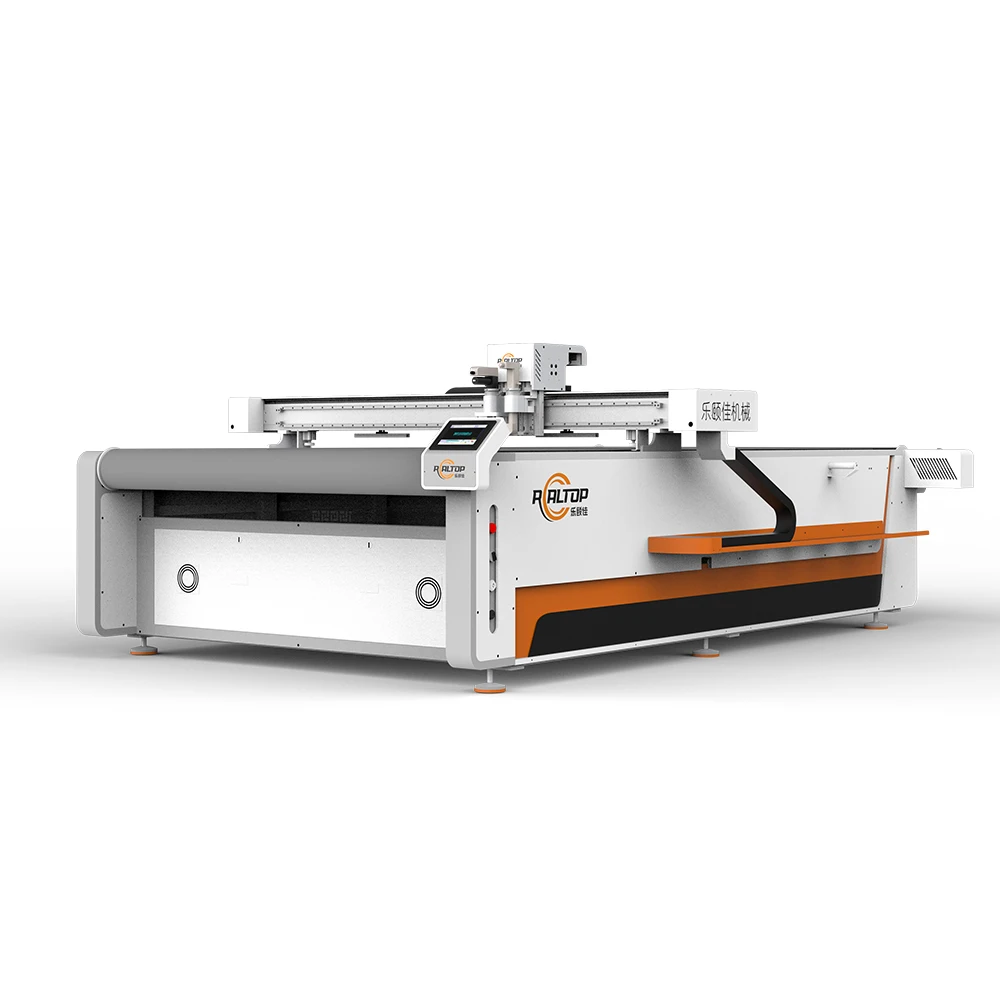

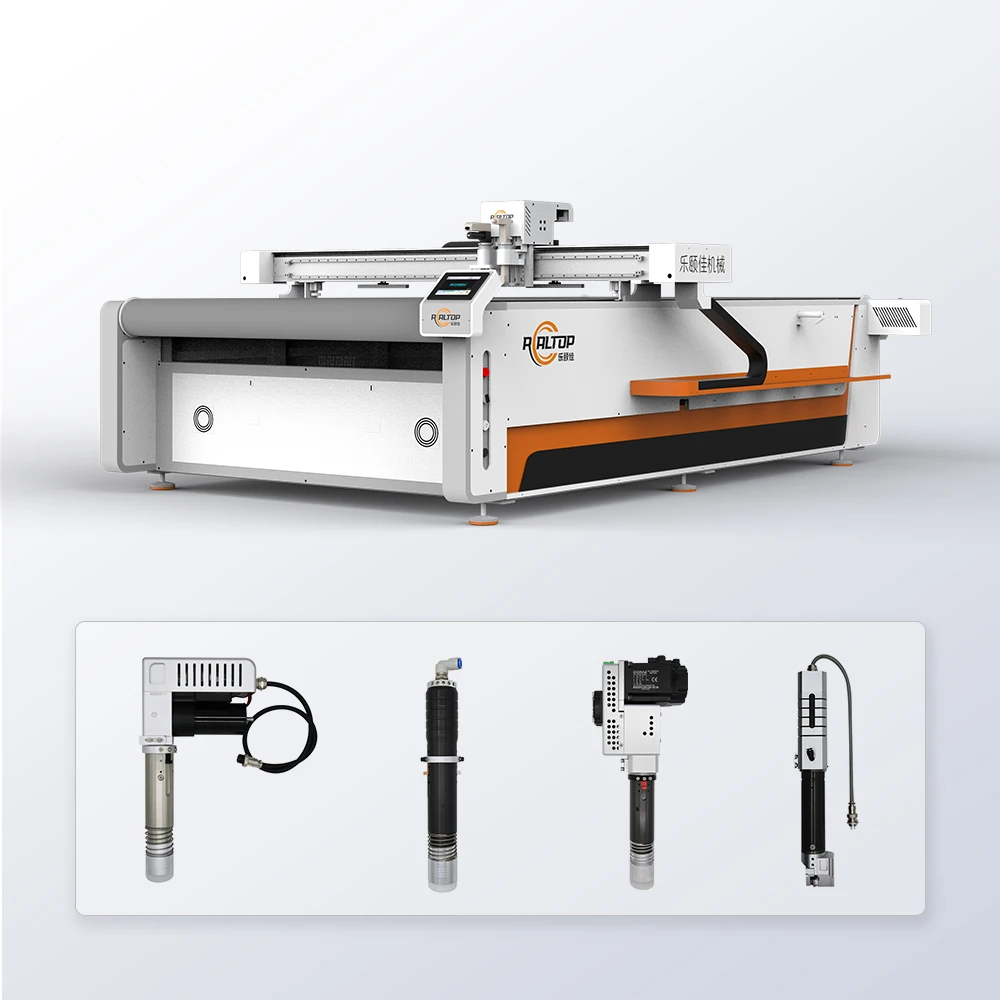

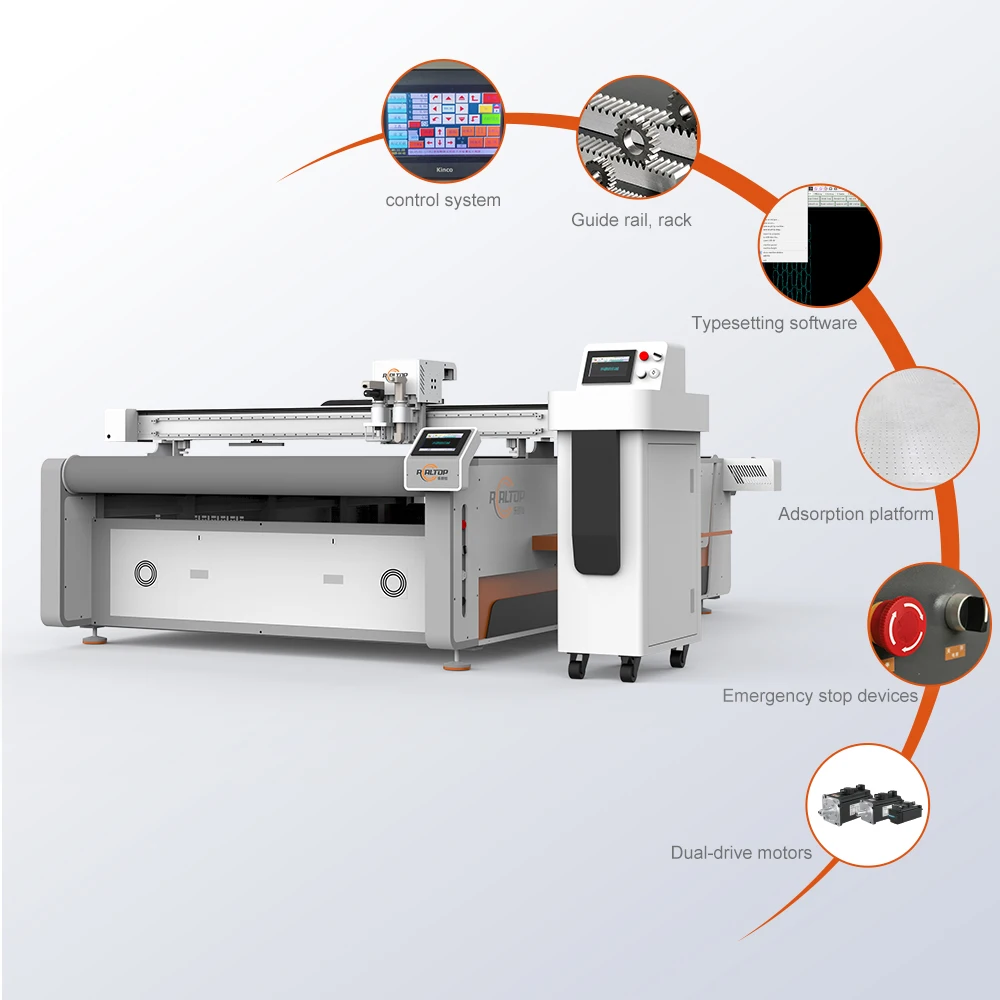


Knife and laser cutting integration — REALTOP matches the cutting method to your specific fabric weight and composition rather than forcing a single technology across every material.
Technical Specifications
| Parameter | Value |
|---|---|
| Product Type | CNC Flatbed Digital Fabric Cutting Machine |
| Model | 1625 |
| Working Area | 1600 × 2500 mm |
| Cutting Speed | 0–2000 mm/s |
| Cutting Thickness | ≤ 30 mm (basis not stated in source — confirm specific fabric type) |
| Cutting Accuracy | ±0.1 mm |
| Vacuum Pump Power | 9 kW |
| Vacuum Table | Aluminum bellows vacuum table |
| Tool Head Options | Oscillating knife, Driven rotary knife, Creasing wheel, Kiss cutting tool, Pneumatic knife, Milling tool, V groove knife |
| Control System | PLC control panel with intuitive interface |
| Voltage Options | 110V, 220V, 380V |
| Servo Motor Options | Panasonic, Delta, Dorna |
| Profile Formats | PLT, DXF, AI, PDF |
| Safety Device | Infrared sensor device and emergency stop device |
| Machine Dimensions | 3300 × 2100 × 1350 mm |
| Language Options | English, Russian, Italian, Chinese (custom available) |
Application Suitability
| Application | Material or Output |
|---|---|
| Apparel Manufacturing | Suits, knitwear, lace, complex woven and blended fabrics |
| Automotive Interiors | Seat fabrics, carpets, PVC floor mats |
| Home Textiles | Sofa upholstery fabrics, curtains, rugs |
| Composite Processing | Carbon fiber prepreg, aramid, specialty layered materials |
What a "1625 Working Area" Specification Leaves Out
Cutting area alone does not guarantee clean edges on your specific fabric type and layup thickness.
I have seen garment factories in the Pearl River Delta order flatbed cutters based purely on bed dimensions, only to discover the default oscillating knife head tears through coated composite textiles, leaving frayed edges across an entire layup. The 1625 covers 1600 × 2500 mm, which handles most standard fabric roll widths, but the tool head selection and vacuum zoning determine whether the machine actually produces saleable garment panels or scrap [NEED_CITE: tool head selection criteria for coated and composite textiles]. A cloth CNC cutting machine manufacturer that only quotes working area without confirming tool configuration is leaving the most critical decision to chance.
Matching Tool Heads to Fabric Behavior
Different textiles respond to cutting forces in entirely different ways. Loosely woven knits and stretch fabrics tend to pull and distort under a drag knife, while dense technical materials like aramid or carbon fiber prepreg require the aggressive vertical stroke of a high-frequency oscillating knife. The 1625 platform supports oscillating knife, driven rotary knife, pneumatic knife, kiss cutting tool, and milling tool configurations, meaning the cloth CNC cutting machine manufacturer can spec the correct head for your exact material stack before the machine is built. Driven rotary knives handle continuous single-ply cutting on lightweight linings, while the oscillating knife tackles multi-ply layups of heavier suiting or upholstery cloth.
Vacuum Holding and Material Flatness
Fabric cutting accuracy depends on how well the material stays flat and immobile during the knife pass. The aluminum bellows vacuum table on the 1625 provides consistent suction across the working surface, holding lightweight and slippery fabrics in place without adhesive sprays or mechanical clamps. On smaller pattern pieces nested tightly together, vacuum zoning becomes important to prevent individual cut parts from lifting as the knife exits [NEED_CITE: vacuum table zoning effects on small nested fabric parts]. The 9 kW vacuum pump provides sufficient draw for multi-ply layups typical in automotive seat fabric and home textile production, where a single lifted layer can compromise the dimensional accuracy of every piece in the stack.
Reading the Specs Beyond the Brochure
The ±0.1 mm cutting accuracy figure matters most when pattern pieces must align precisely during sewing or lamination, such as collar pieces, cuff panels, or automotive headliner blanks. Cutting speed rated at 0–2000 mm/s reflects the maximum travel rate of the head assembly, though actual production speed depends on the contour complexity of the nesting layout and the thickness of the layup. The PLC control panel with configurable language options — English, Russian, Italian, Chinese, and custom languages — means operators in different export markets can run the cloth CNC cutting machine manufacturer equipment without relying on bilingual supervisors. File format support for PLT, DXF, AI, and PDF covers the workflow of most pattern-making and CAD software used in garment and automotive textile production.
The Cost of a Misconfigured Tool and Table Setup
Choosing the wrong knife type for a given fabric does not just produce bad edges — it wastes material and delays shipments. A driven rotary knife on thick foam-backed automotive carpet will crush the backing layer, producing a beveled edge that fails quality inspection. Insufficient vacuum on loosely woven lace allows the fabric to shift mid-cut, ruining nesting yield and forcing a complete re-cut. These problems surface only after the machine arrives and the first production run begins, which is why sample cutting on the buyer’s actual material before order confirmation is the only reliable verification [NEED_CITE: material sample testing protocols before machine commitment].
Why Source the 1625 Through This Channel
The 1625 is produced by a manufacturer that builds both knife and laser cutting systems in-house, so the cutting method recommendation is based on material science rather than a limited product line. Tool head and table configuration is specified per fabric type and daily volume, not chosen from a default catalog page. Software file format compatibility — DXF, PLT, AI, PDF — is confirmed before the order is finalized, preventing format conversion problems at first startup. Voltage options across 110V, 220V, and 380V are verified against the buyer’s local supply standard before shipment, avoiding transformer costs and wiring delays on arrival. Every machine ships with sample cutting reports run on the buyer’s own fabric, providing a physical record of edge quality and dimensional accuracy before the equipment leaves the factory.
Documentation & Verification
- Machine specification sheet confirming tool head, vacuum table configuration, and servo motor brand selection
- Electrical schematic and voltage confirmation matched to target market supply standards
- Sample cutting report on buyer’s own fabric, documenting edge quality and dimensional tolerance
- Software licence and file format compatibility note covering PLT, DXF, AI, and PDF workflows
- Operation and maintenance manual in confirmed language with tool changeover procedures
- Spare parts list identifying consumable blades, knife holders, and vacuum table seals
Installation, Commissioning & Support
- Machine footprint of 3300 × 2100 × 1350 mm requires level concrete floor with clearance for material feed and offload sides
- Dedicated electrical circuit matching confirmed voltage option — 110V, 220V, or 380V — with correct breaker rating for 9 kW vacuum pump
- Aluminum bellows vacuum table sections assembled and sealed on-site with vacuum integrity test before first cut
- PLC control panel parameters set for confirmed language and file format workflow during commissioning
- Operator training covers tool head changeover between oscillating knife, rotary knife, and other configured tools
- Infrared safety sensor and emergency stop tested under power before production approval
Starting the Specification Conversation
To move from catalogue review to a confirmed 1625 configuration, the most useful information a buyer can provide includes the primary fabric types, typical layup thickness in millimeters or number of plies, and the standard fabric roll width being processed. Daily cutting volume in linear meters or number of pattern pieces helps determine whether single-head or conveyor-fed operation is appropriate. Confirming the local voltage and frequency standard, along with the preferred control language, ensures the electrical cabinet and PLC interface are correct before the machine enters production.
Frequently Asked Questions
Q: How do I choose between oscillating knife and driven rotary knife for my fabric?
A: Oscillating knives handle multi-ply layups and thicker technical textiles with a vertical reciprocating stroke that prevents material distortion. Driven rotary knives suit continuous single-ply cutting on lightweight linings and thin wovens where speed matters more than ply depth. The correct choice depends on your specific fabric weight, composition, and daily production volume, which is why sample cutting on your actual material is recommended before finalizing the tool configuration.
Q: What cutting thickness can the 1625 achieve on different fabric types?
A: The machine is rated for cutting thickness up to 30 mm, though the practical limit depends on material density and tool head selection. Tightly woven suiting fabrics and automotive carpet behave very differently under the knife, and maximum clean cutting depth on plush or foam-backed materials is typically lower than on flat woven textiles. A sample cutting test on your specific fabric confirms the achievable thickness before commitment.
Q: How does the 1600 × 2500 mm working area map to standard fabric roll widths?
A: The 1600 mm width accommodates most standard apparel and home textile roll widths when the fabric is spread flat across the table. For automotive carpet and wider technical textiles, the 2500 mm length allows longer pattern pieces to be nested without repositioning. Buyers processing rolls wider than 1600 mm should confirm spreading strategy and whether a conveyor-fed configuration is more appropriate for their workflow.
Q: Is CCD camera contour recognition available across the machine range?
A: CCD camera positioning for printed contour cutting is available as a configuration option, allowing the machine to track registration marks on printed fabrics and cut along pre-defined outlines. This is particularly relevant for signage textile and printed apparel applications. Availability and camera specifications should be confirmed during the quotation stage to ensure compatibility with your print registration mark format and production speed requirements.
Q: Which servo motor option is recommended for high-precision garment cutting?
A: The 1625 supports Panasonic, Delta, and Dorna servo motor options, each offering different performance characteristics in positioning response and torque delivery. For garment manufacturing where ±0.1 mm accuracy on collar and cuff pieces is critical, the servo specification should be matched to the cutting speed and contour complexity of your typical nesting layouts. This decision is part of the machine configuration discussion rather than a standalone selection.


商品评价
Clear filtersThere are no reviews yet.