




Cold Cutting Precision — preserving resin integrity across carbon fiber prepreg and aramid honeycomb without thermal degradation or delamination.
Technical Specifications
| Parameter | Value |
|---|---|
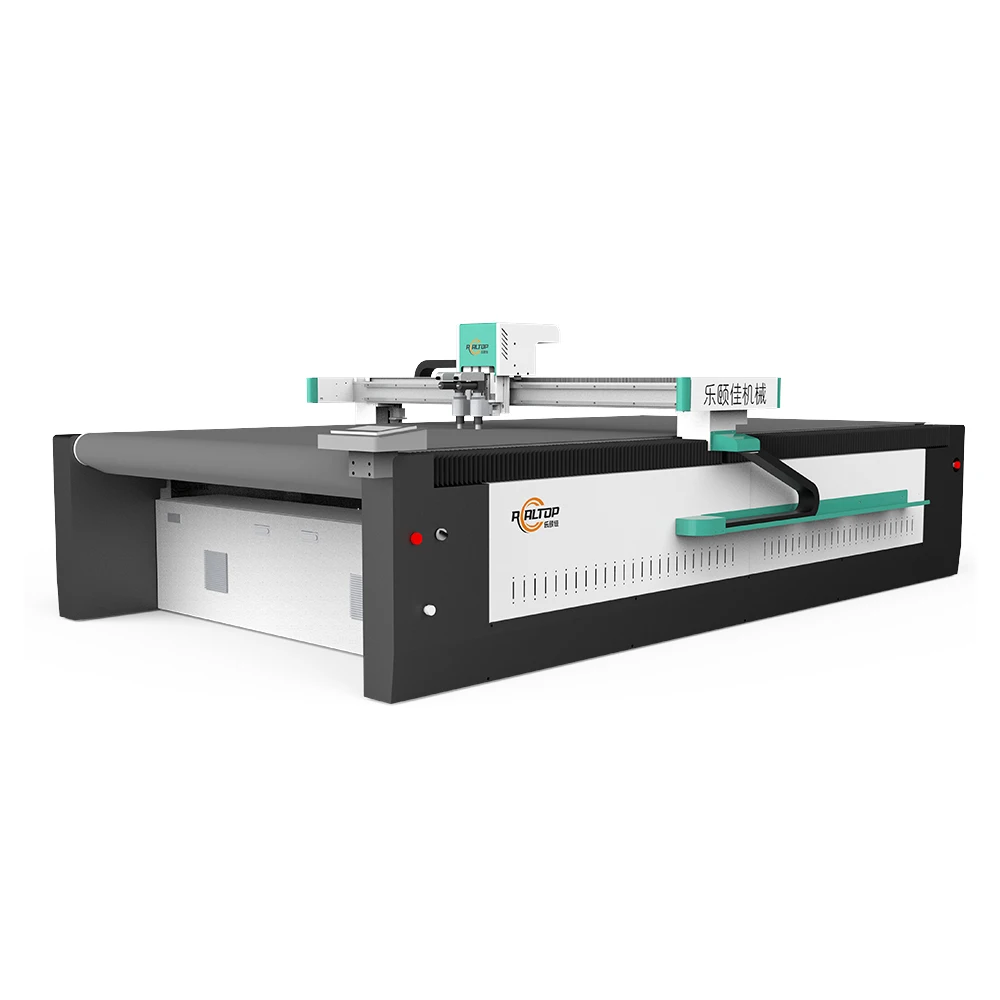
| Product Type | CNC Oscillating Knife Cutting Machine |
| Working Area | 1600 × 2500 mm |
| Cutting Thickness | Up to 30 mm (basis to be confirmed) |
| Cutting Accuracy | ±0.1 mm |
| Cutting Speed | 0 – 2000 mm/s |
| Tool Head Options | Oscillating knife, driven rotary knife, creasing wheel, kiss cutting tool, pneumatic knife, milling tool, V-groove knife |
| Vacuum Table | Aluminum bellows vacuum table |
| Vacuum Pump | 9 kW |
| Machine Size | 3300 × 2100 × 1350 mm |
| Voltage Options | 110V, 220V, 380V (configurable) |
| Control System | PLC control panel with intuitive interface |
| Profile Formats | PLT, DXF, AI, PDF |
| Language Options | English, Russian, Italian, Chinese (custom languages available) |
| Safety Devices | Infrared sensor device and emergency stop |
Application Suitability
| Application | Material or Output |
|---|---|
| Aerospace interior and structural trimming | Carbon fiber prepreg, aramid honeycomb, thermal and acoustic insulation foam |
| Automotive lightweight body and cabin parts | Carbon fiber covers, FRP panels, headliners, floor carpets, damping pads |
| Wind energy blade preforms | Large-format fiberglass cloth, carbon fiber cloth, vacuum infusion mesh, PET and PVC foam cores |
| Sporting goods fabrication | Carbon fiber sheets, Kevlar fabric, high-performance composite foams |
| General industrial gasket and seal production | PTFE, rubber, EVA, closed-cell foam sheets |
Why Cold Cutting Eliminates the Biggest Risk in Composite Fabrics
A Composites CNC Cutting Machine production line that uses thermal methods on resin-impregnated materials produces melted edges, toxic fumes, and weakened fiber bonds. Oscillating knife technology severs the fibers mechanically, leaving the resin matrix untouched.
I once walked into a shop cutting carbon fiber prepreg with a laser. The edge was sealed but the surrounding resin had caramelized, and the downstream autoclave cycle revealed micro-delamination along every cut line. The entire batch of wing skin panels was scrapped. With high-frequency mechanical oscillation, that thermal damage simply does not occur. The blade vibrates thousands of times per minute, slicing through the weave without generating enough friction to alter the curing chemistry [NEED_CITE: thermal degradation thresholds in prepreg composite cutting].
How Oscillation Frequency Interacts with Resin Content
When you cut dry fiberglass cloth, almost any blade angle and frequency will produce a clean edge. Carbon fiber prepreg is a different problem. The resin is tacky, the fibers are abrasive, and the material wants to lift off the table the moment the blade exits the cut. The oscillating knife on this Composites CNC Cutting Machine production line addresses all three issues through adjustable stroke frequency and blade geometry.
The aluminum bellows vacuum table provides continuous adsorption across the entire 1600 × 2500 mm work area. This is not a zoned system that only holds large sheets — the bellows design maintains suction even when cutting small gasket profiles or narrow strips, which is where lift and drift cause the most scrap in composite shops.
Matching the Tool Head to the Laminate Stack
A single blade type cannot handle the full range of composite materials a production facility encounters. The driven rotary knife handles thicker, more rigid panels like cured FRP and honeycomb cores where the oscillating knife would deflect. The pneumatic knife cuts through multi-layer stacks of insulation felt and damping pads used in automotive headliners and door panels. The V-groove knife scores fold lines in composite sandwich panels for interior trim assemblies.
Switching between these tools is part of the configuration decision before the machine ships, not a field modification. The tool head list is confirmed against the buyer’s material samples during the pre-order cutting test, so there is no guesswork about which blade angle and frequency produce acceptable edges on that specific laminate [NEED_CITE: tool head selection criteria for composite laminate stacks].
Reading the Specs That Actually Matter on the Floor
The ±0.1 mm cutting accuracy figure is meaningful only when paired with the vacuum table’s ability to hold the material flat. A flexible composite fabric that wrinkles or shifts during cutting will not hold that tolerance regardless of the servo system. The 9 kW vacuum pump paired with the bellows table addresses this by maintaining consistent negative pressure across the work surface, even as the cutting head moves at speeds up to 2000 mm/s.
The PLC control panel accepts PLT, DXF, AI, and PDF file formats, which covers the nesting output from most composite-specific CAD systems. If your shop runs a proprietary nesting solution that exports in a format outside this list, that needs to be confirmed before the order is placed — software compatibility is one of the most common sources of commissioning delays in composite cutting installations.
The machine is available configured for 110V, 220V, or 380V power supplies. This is not a trivial selection. Running a 380V unit on a 220V supply will destroy the servo motors and the vacuum pump within hours, and this mismatch is more common than it should be in export markets where voltage standards vary between regions.
What Happens When the Tool Head Is Wrong for the Material
A buyer specifies a machine for cutting aramid honeycomb and receives it with a standard oscillating knife configured for fabric. The honeycomb cells crush instead of cutting cleanly, leaving a ragged edge that requires secondary trimming on every piece. That secondary operation was not in the production plan, and now throughput is cut in half while labor costs on the floor double.
Another scenario: the vacuum table is specified with large zones designed for full-sheet cutting, but the production mix includes small gasket profiles and narrow insulation strips. The parts lift during the final passes, the blade catches the edge, and you get frayed corners on every piece. Neither of these failures is a machine defect — they are specification failures that occur when the buyer’s material and production mix are not verified before the order is confirmed [NEED_CITE: consequences of incorrect tool head specification in composite cutting].
Why This Configuration Exists
The machine is built around an in-house design team that covers both knife and laser cutting technologies, so the recommendation for composite materials is based on which method actually suits the resin system rather than which machine is in stock.
Tool head and table configuration are specified per material type and production volume during the pre-order sample cutting. The buyer’s own carbon fiber prepreg, fiberglass cloth, or honeycomb core is run on the machine before the quotation is finalized.
Software compatibility is confirmed against the buyer’s existing nesting workflow and file format library, eliminating the most common commissioning delay.
Voltage, control language, and documentation are customized for the destination market, so the PLC panel reads in the operator’s language and the electrical schematic matches local standards.
Sample cutting reports are generated on the buyer’s actual material with documented edge quality, dimensional accuracy, and cutting parameters before commitment.
Documentation & Verification
- Machine specification sheet matching confirmed tool head and vacuum table configuration
- Electrical schematic with voltage and frequency matched to destination market grid
- Sample cutting report on buyer’s specific composite material with edge and tolerance data
- Tool head and blade configuration list tied to each material in the production mix
- Software license and file format compatibility note for PLT, DXF, AI, and PDF workflows
- Factory test record demonstrating cutting performance on buyer material before dispatch
Installation, Commissioning & Support
- Machine arrives factory assembled at 3300 × 2100 × 1350 mm; floor must support this footprint with level access
- Dedicated power circuit required matching confirmed voltage (110V, 220V, or 380V) and the 9 kW vacuum pump draw
- PLC control panel configured to confirmed operator language before first power-on and calibration
- Vacuum table adsorption tested across full 1600 × 2500 mm area with buyer’s heaviest composite sheet
- Blade replacement interval and spare parts list provided for oscillating, rotary, and pneumatic knife heads
- Safety system check including infrared sensor perimeter and emergency stop response before operator training
What to Include in Your Inquiry
Send the specific composite materials you are cutting — prepreg type, resin system, fabric weight, honeycomb cell size, or foam density — along with maximum sheet dimensions and the thickness range across your production mix. Confirm your facility voltage and frequency, the language your operators need on the PLC panel, and whether your nesting software exports in PLT, DXF, AI, or PDF. If you have a current production file, include it so a sample cutting test can be run on your actual material before any configuration is locked in.
Frequently Asked Questions
Q: How do I verify cutting quality on my specific composite material before committing to the order?
A: Your actual material — carbon fiber prepreg, aramid honeycomb, or fiberglass cloth — is shipped to the factory for a sample cutting test. A report is generated documenting edge quality, dimensional accuracy against your file, and the blade and frequency settings used. You review this report before the machine configuration is finalized and production begins.
Q: Can the voltage and control language be customized for our facility?
A: The machine is configurable for 110V, 220V, or 380V power supplies, and the PLC control panel supports English, Russian, Italian, and Chinese as standard options. Additional languages can be customized. The electrical schematic and voltage confirmation are documented before shipment to match your local grid requirements.
Q: How is the correct tool head selected for different composite materials?
A: The tool head configuration is determined during the pre-order sample cutting on your material. Oscillating knife, driven rotary knife, pneumatic knife, and V-groove knife options are evaluated against your specific laminate stack, thickness, and edge quality requirement. The selected configuration is documented in the specification sheet before production.
Q: Will the vacuum table hold small composite parts without lifting during cutting?
A: The aluminum bellows vacuum table maintains adsorption across the full work area, including small profiles and narrow strips that would lift on a zoned table system. The 9 kW vacuum pump provides continuous suction that is verified during the factory test with your material’s weight and surface characteristics.
Q: What file formats does the software accept for nesting and cutting?
A: The control system imports PLT, DXF, AI, and PDF files directly. If your nesting software outputs in one of these formats, the workflow is confirmed before the order is placed. A software license and file format compatibility note is included in the documentation package to record this verification.





商品评价
Clear filtersThere are no reviews yet.