




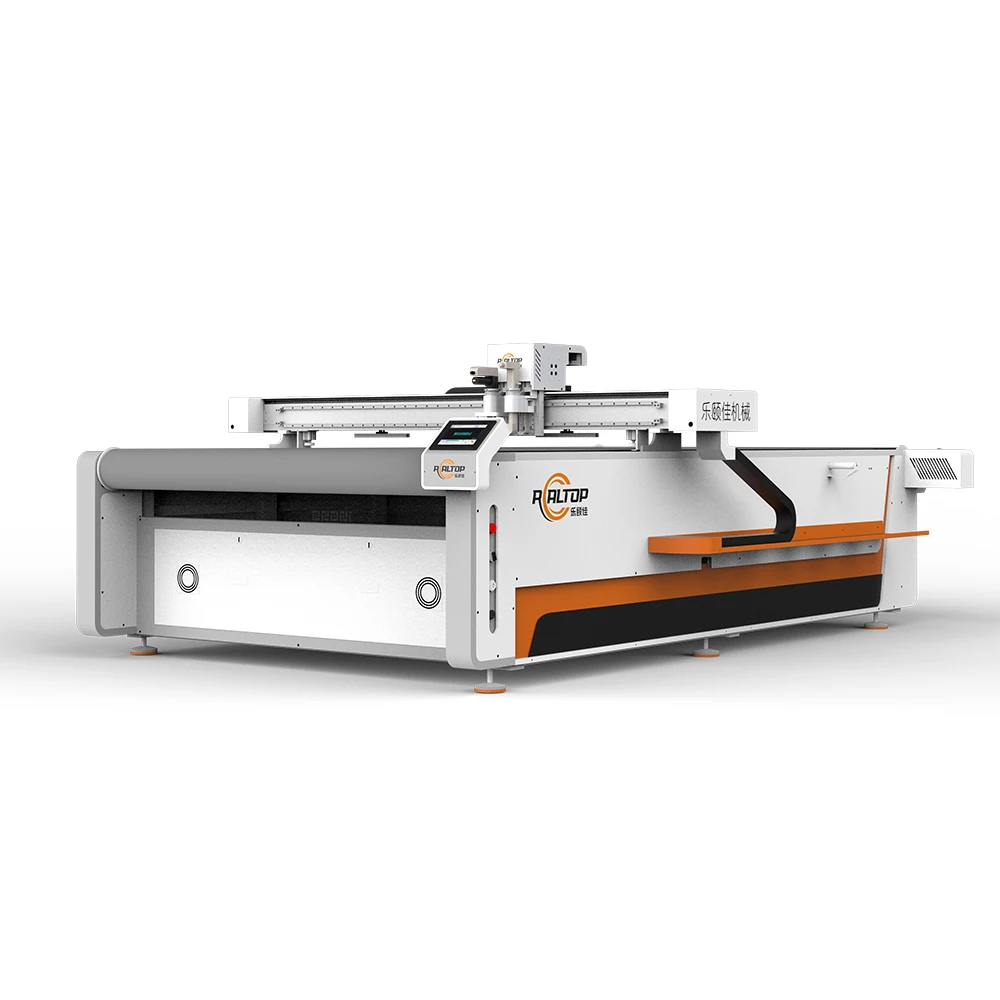
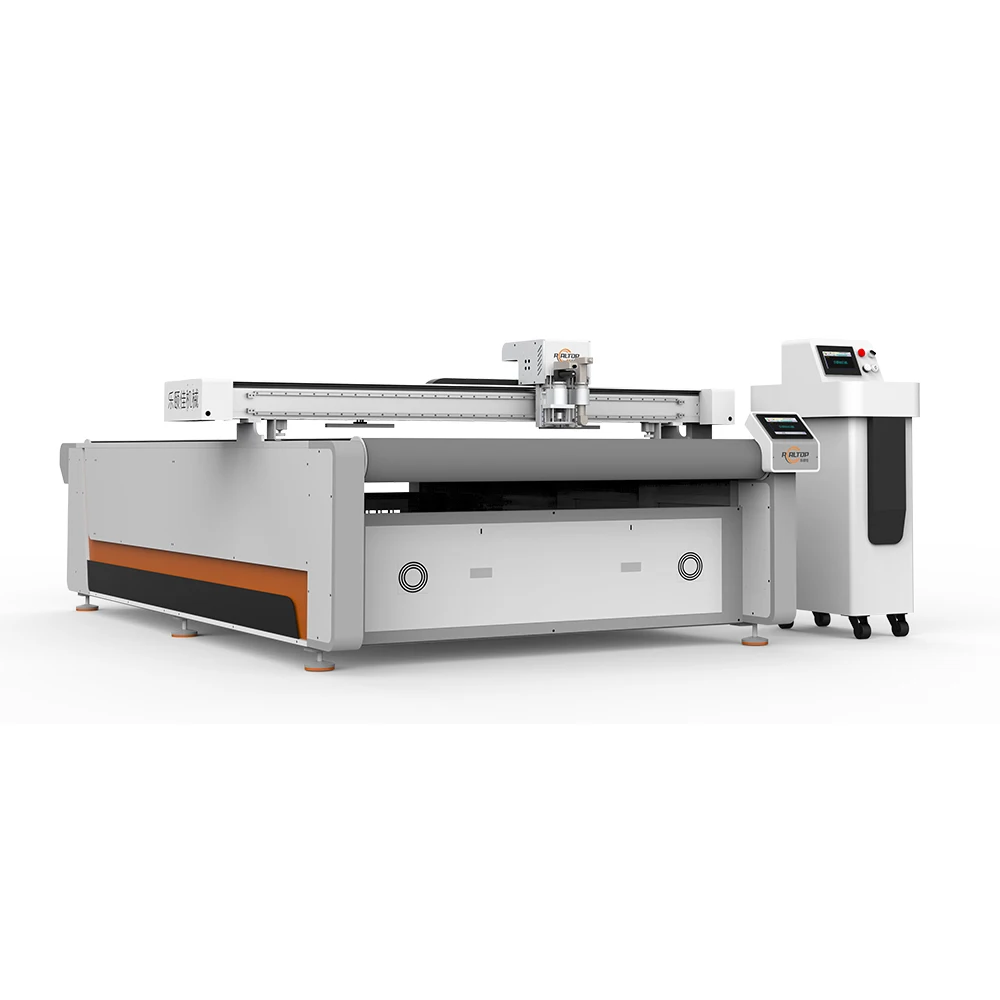
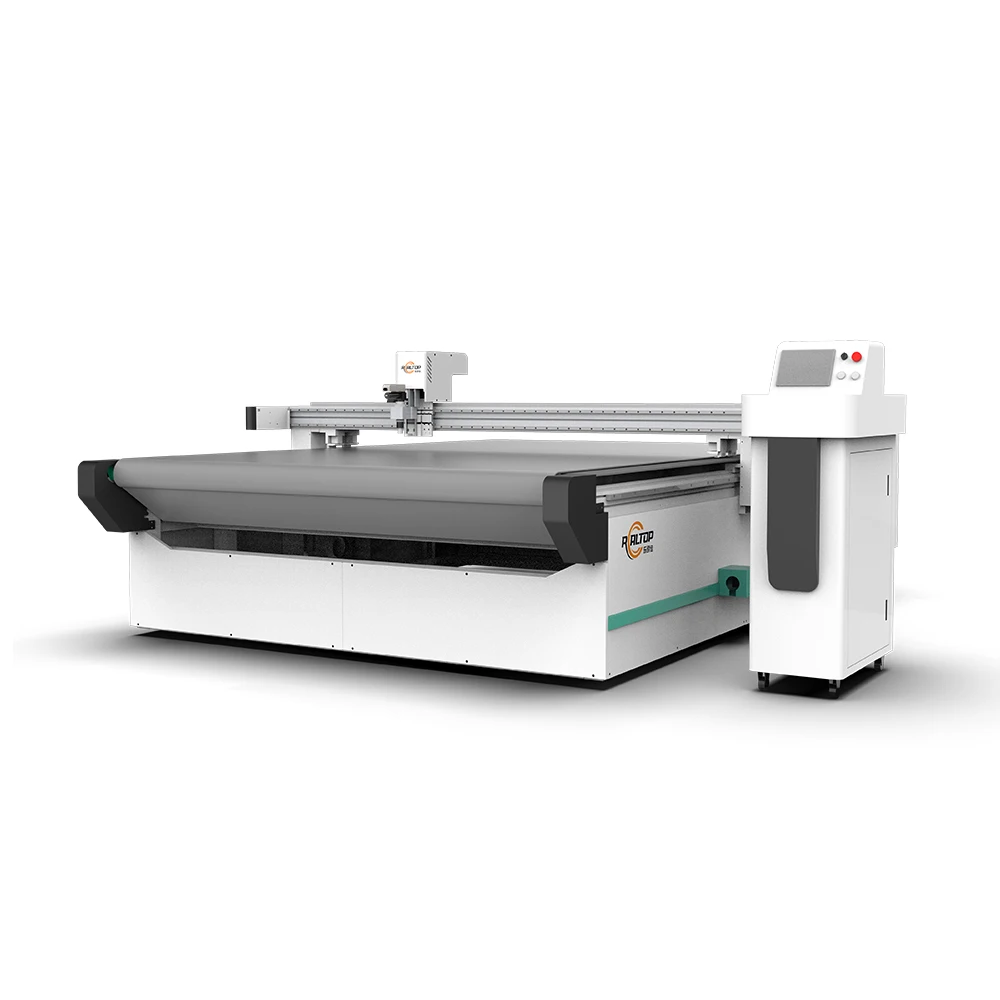
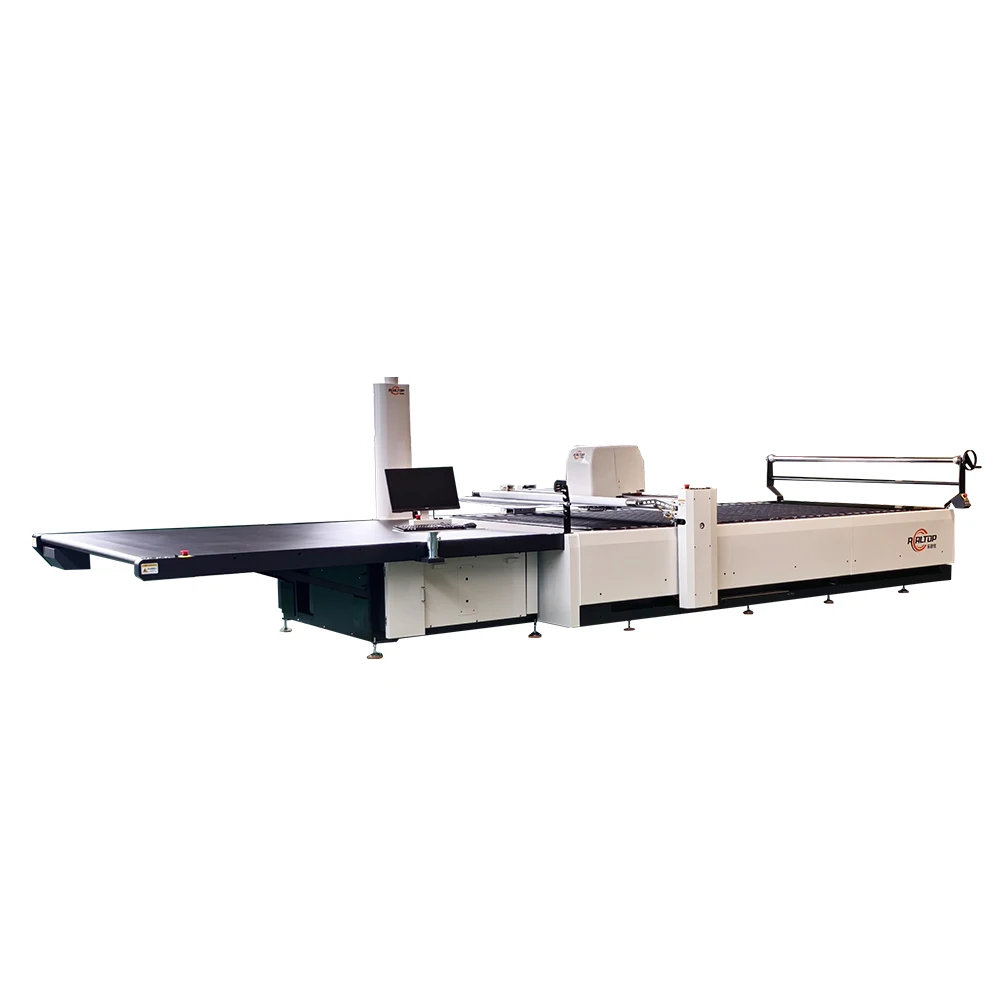

Zoned Vacuum Platform — Magnesium-aluminum alloy table with PVDF coating and anodic oxidation delivers targeted suction across the cutting area to secure small fabric parts without material lift at production speed.
Technical Specifications
| Parameter | Value |
|---|---|
| Model | RT-D2516/RT-S2516 |
| Product Type | CNC Oscillating Knife Cutting Machine with Auto Feeding |
| Working Area | 1600 × 2500 mm |
| Machine Dimensions | 3450 × 2300 × 1250 mm |
| Rated Power | 9 kW |
| Vacuum Pump | 7.5 kW |
| Translational Velocity | 800–2000 mm/s |
| Cutting Speed | 200–800 mm/s (varies by material type and thickness) |
| Repeated Accuracy | ≤ 0.1 mm |
| Transmission System | Digital servo motor, linear guide, synchronous belt, ball screw |
| Servo Motor Option | Delta (Taiwan) or Panasonic (Japan) |
| Linear Rail | Taiwan Hiwin |
| Vacuum Table Surface | Magnesium-aluminum alloy, fluorocarbon PVDF powder spraying, anodic oxidation |
| Conveyor Belt | Germany imported |
| Tool Head Options | Oscillating knife, pneumatic knife, high-power vibrating knife, circular knife, V cutting knife, drag knife, creasing wheel, dotted line knife, punching, brush |
| Visual Positioning Options | Small CCD camera mark point positioning, panoramic camera recognition, projection positioning |
| Instruction Format | HP-GL compatible |
| Software Compatibility | PLT, DXF, AI formats with auto typesetting and nesting |
| Control Panel | Touch screen, multiple language supported |
| Voltage | 380V ± 10% |
| Safety Device | Infrared sensors with auto-pause on obstacle detection |
| Frame Construction | Thick-walled seamless steel structure, high-temperature tempering, CNC machining center finished |
| Language Options | English, Russian, Italian, Chinese (customizable) |
| Certification | CE |
Application Suitability
| Application | Material or Output |
|---|---|
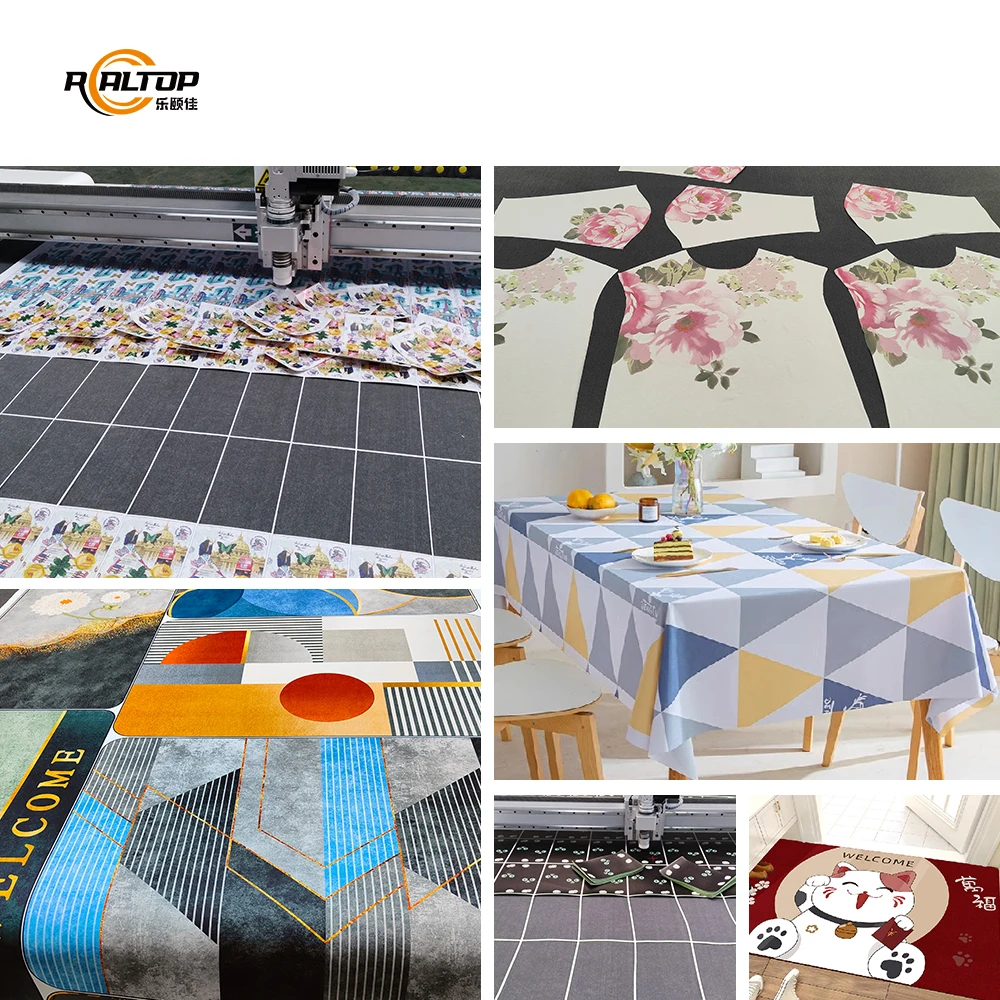
| Garment and footwear production | Multi-layer clothing cloth, shoe material, non-woven fabric, PU, EVA |
| Automotive interior manufacturing | Seat cover fabric, headliner textile, carpet and floor mat composites |
| Soft furnishing and home textile | Curtain fabric, upholstery cloth, carpet, sponge, foam layers |
| Luggage and bag production | PVC, PE, PP, leather, composite layered materials |
| Advertising and signage | Sticker, film, corrugated cardboard, plastic box substrates |
| Gasket and sealing fabrication | PTFE, ETFE, rubber, fiberglass, XPE sealing materials |
| Sports and outdoor equipment | Composite fabrics, foam padding, coated textile layers |
Why Small Fabric Parts Lift Off the Table During High-Speed Cutting
A zoned vacuum platform with calibrated suction distribution is what keeps lightweight and small-profile fabric sections pinned to the table surface when the oscillating knife head changes direction at full translational speed.
When a buyer evaluates a CNC oscillating knife cutting machine production line based on working area alone, the vacuum holding capacity for small nested parts rarely enters the conversation until the first production run. Small garment pattern pieces, intricate automotive interior contours, and narrow gasket profiles are exactly the shapes most likely to shift or lift when vacuum zoning is not matched to the nesting layout. The cutting knife catches a lifted edge, the part is ruined, and the operator stops the machine to reposition — repeating this cycle across a full shift erodes throughput in ways that no specification sheet will quantify in advance [NEED_CITE: vacuum zoning requirements for nested small-part fabric cutting].
Continuous Roll-to-Cut Workflow for Fabric Production Lines
The auto-feeding conveyor with Germany-imported belt moves fabric rolls through the cutting zone in a continuous cycle, eliminating the manual load-and-align step between each sheet. For garment manufacturers running hundreds of nested pattern pieces per shift, and automotive interior producers cutting seat cover textiles from roll stock, this conveyor-fed approach keeps the CNC oscillating knife cutting machine production line running without pause between cuts.
The flat working table and auto-feeding table options allow buyers to configure the system for either sheet-fed or roll-fed workflows depending on their material supply format.
Contour Recognition for Printed Fabric at Production Speed
Printed fabric with registered marks requires the cutting path to align with the printed graphic, not just the file geometry. The available small CCD camera mark point positioning, panoramic camera recognition, and projection positioning options each serve different production scenarios. Panoramic vision suits large-format printed textiles where multiple marks must be read across a wide sheet. Projection positioning supports operators who need visual cut-line confirmation before the knife engages. Matching the positioning system to the buyer’s actual print registration method is a decision that must happen before the order is confirmed, not after installation.
Material Hold-Down and Edge Quality Across Fabric Types
The 7.5 kW vacuum pump paired with the magnesium-aluminum alloy table surface provides the suction foundation, but the table zoning determines whether that suction reaches the specific area where a small part sits. Fluorocarbon PVDF powder spraying and anodic oxidation on the table surface reduce friction drag on coated fabrics like PVC and PU while resisting adhesive buildup from sticker and film materials.
The oscillating knife tool head with Swiss-imported blade components executes full-cut and half-cut operations in the same pass. For multi-layer fabric stacks common in garment cutting, the high-power vibrating knife option provides the stroke amplitude needed to penetrate through several plies cleanly. Cutting speed ranges from 200 to 800 mm/s depending on the material density and layer count — a specification that only becomes meaningful once the buyer’s actual fabric sample has been tested under production conditions [NEED_CITE: relationship between oscillating knife stroke frequency and multi-layer fabric cutting depth].
Repeated accuracy of ≤ 0.1 mm ensures that nested pattern pieces cut consecutively maintain dimensional consistency, which matters directly when those pieces move to sewing or assembly stations downstream.
How Frame Rigidity and Drive Components Affect Cut Consistency
The thick-walled seamless steel frame undergoes high-temperature tempering and is finished on a CNC machining center, which establishes the flatness baseline for the entire working area. A frame that warps under vacuum load or vibrational resonance will show up as inconsistent cut depth across the table — the center cuts clean while the edges leave fibers connected. Taiwan Hiwin linear rails guide the gantry with the positional precision that the servo system demands, and the choice between Delta and Panasonic servo motors affects the responsiveness of directional changes during intricate contour paths.
The digital servo motor and synchronous belt transmission translate the control system’s HP-GL compatible instructions into physical knife movement. When cutting tight-radius curves on shoe material or luggage patterns, the servo response speed determines whether the knife follows the programmed path or overshoots at direction changes. The 9 kW rated power covers the combined demand of the servo drives, vacuum pump, and conveyor motor during simultaneous operation.
When the Wrong Tool Head Meets Your Fabric
Choosing a drag knife for woven fabric that requires an oscillating knife produces frayed edges that the sewing department must trim by hand. Selecting a standard oscillating knife for dense multi-layer foam without the high-power vibrating knife option results in incomplete cuts through the bottom ply. These mismatches typically surface during the first production shift, not during the factory acceptance test on standard sample material [NEED_CITE: tool head selection criteria for technical textile cutting applications].
The consequence extends beyond edge quality. A tool head struggling against material resistance places sustained lateral load on the knife holder, accelerating wear on the bearing and guide components. Replacement frequency increases, unplanned downtime accumulates, and the production schedule slips in ways that trace back to a configuration decision made before the material sample was ever reviewed.
Production Floor Realities That Shape the Configuration
This equipment is designed and produced in-house covering both knife cutting technologies and table configurations, allowing the cutting method to match the fabric type rather than forcing one approach across all materials. Tool head and vacuum table configuration are specified per material and production volume based on the buyer’s sample testing.
CCD camera positioning systems are confirmed against the buyer’s actual printed registration marks before order confirmation, avoiding the situation where the vision system cannot track marks at the speed the production line requires. Software compatibility with the buyer’s existing PLT, DXF, or AI nesting files is verified during the pre-order phase. Voltage and control language customization is confirmed for the destination market, and sample cutting on the buyer’s own material provides the baseline cutting speed and edge quality data before commitment.
Documentation & Verification
- Machine specification sheet listing confirmed tool head and vacuum table configuration for your material
- Electrical schematic with voltage and frequency matched to your factory power supply
- Sample cutting report on your fabric type documenting edge quality and cutting speed parameters
- Factory test record showing repeated accuracy measurement across the full working area before dispatch
- Software licence and file format compatibility note confirming integration with your nesting workflow
- Spare parts list with recommended consumables for your selected tool head configuration
Installation, Commissioning & Support
- Floor space of approximately 3450 × 2300 mm footprint with clearance for conveyor infeed and operator access on both sides
- Dedicated 380V ± 10% circuit rated for the 9 kW machine load plus 7.5 kW vacuum pump startup surge
- Machine arrives with frame and gantry assembled; conveyor belt tensioning and vacuum hose connection completed on-site
- First-run parameter tuning using your actual fabric rolls to establish cutting speed and vacuum zone settings
- Touch screen control panel training in your selected language covering nesting import, tool offset, and fault recovery
- Swiss-imported knife blade and Germany-imported conveyor belt identified as primary wear items with stocking recommendations
What We Need to Configure Your Line Accurately
Provide the specific fabric types, coating compositions, and layer counts you plan to cut, along with your typical roll width and daily part volume. Share your existing nesting file format and any upstream printing or marking systems already in your workflow. Confirm your factory voltage and frequency, preferred control language, and whether your production space requires the auto-feeding conveyor layout or a flat table sheet-fed setup.
Frequently Asked Questions
Q: How do I match the tool head to my fabric type and layer count?
A: Tool head selection depends on fabric weave density, coating type, and the number of layers in your cutting stack. Woven fabrics without coating typically run on the standard oscillating knife, while PVC-coated or dense composite materials require the high-power vibrating knife option. We confirm the correct head by running sample cuts on your actual material at your target layer count, documenting edge quality and cutting speed before finalizing the configuration.
Q: Can the CCD system track printed marks at full production speed on my fabric?
A: The panoramic camera recognition option reads multiple registration marks across wide-format printed textiles, while the small CCD camera suits single-mark positioning on smaller sheets. Tracking reliability at production speed depends on mark contrast, fabric surface texture, and ambient lighting conditions in your facility. We test the vision system against your printed material samples to confirm mark detection accuracy before the machine ships.
Q: How do I confirm daily throughput based on my part complexity and sheet size?
A: Cutting speed ranges from 200 to 800 mm/s depending on material type, and actual throughput depends on your nesting density, part contour complexity, and the auto-feeding cycle time for your roll width. We calculate expected cycle times using your specific DXF or PLT nesting files during the pre-order sample cutting phase, providing a throughput estimate based on your real production patterns rather than generic benchmark shapes.
Q: Will the voltage and control language match my factory before shipment?
A: Voltage is confirmed at 380V ± 10% as standard, with customization available for destination market requirements. The touch screen control panel supports English, Russian, Italian, and Chinese, with additional language options configurable at order. We confirm the electrical schematic, plug type, and interface language with you during the specification review phase so no adjustments are needed when the machine arrives at your facility.
Q: What is the replacement lead time for the conveyor belt and knife blades?
A: The Germany-imported conveyor belt and Swiss-imported oscillating knife blades are documented in the spare parts list provided with your machine. Stocking recommendations are based on your production volume and material abrasiveness. We advise maintaining a baseline stock of consumables on-site, and replacement lead times for ordered spares are confirmed in the documentation package before your machine ships.



商品评价
Clear filtersThere are no reviews yet.