





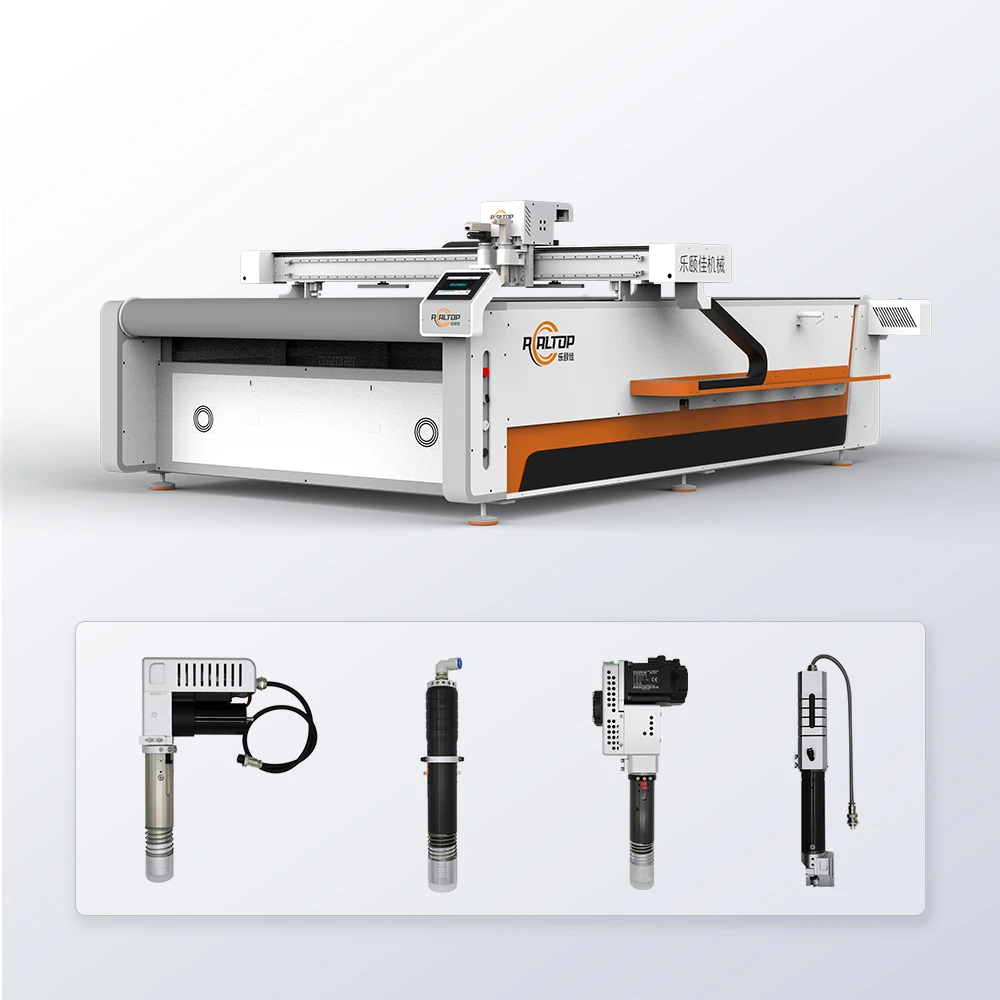
Material-Matched Cutting Configuration — oscillating, rotary, and pneumatic knife heads specified to fabric weight and ply count rather than defaulting to a single tool setup.
Technical Specifications
| Parameter | Value |
|---|---|
| Product Type | CNC Oscillating Knife Cutting Machine |
| Working Area | 1600 × 2500 mm |
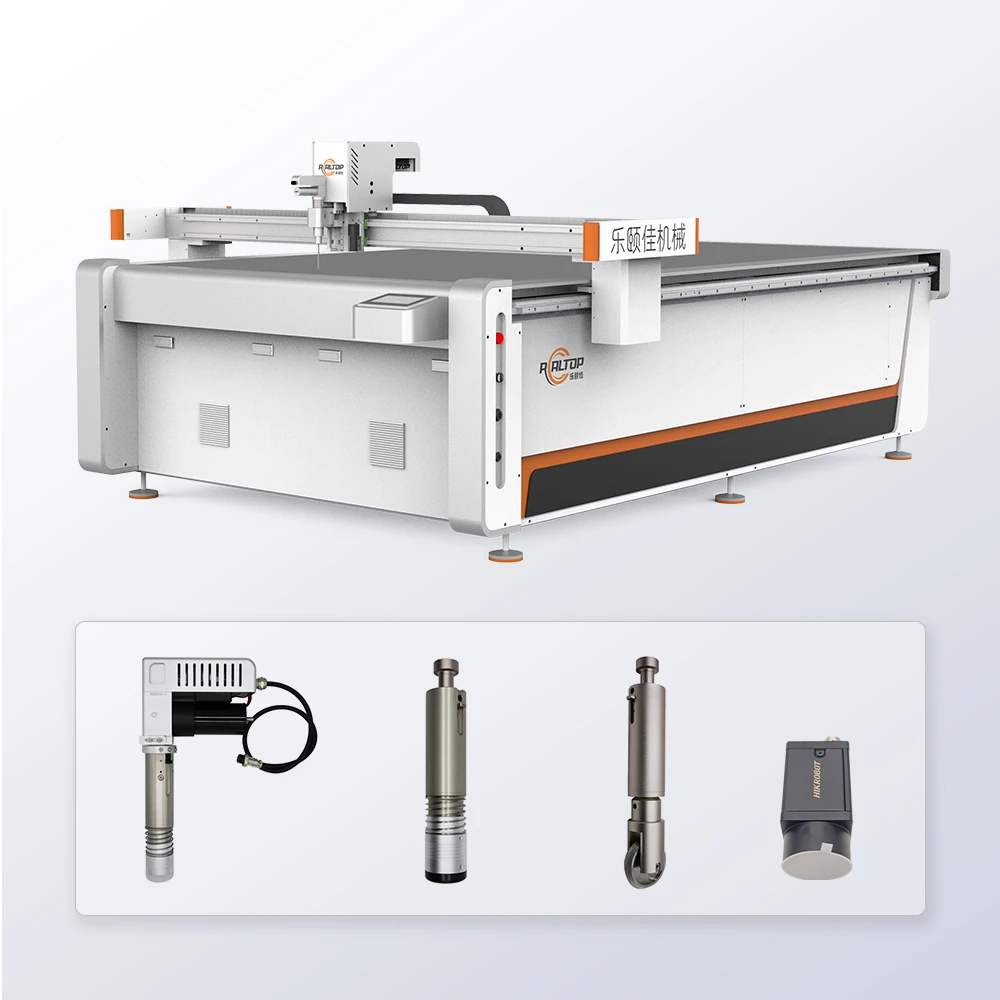
| Tool Head Options | Oscillating knife, Driven rotary knife, Creasing wheel, Kiss cutting tool, Pneumatic knife, Milling tool, V groove knife |
| Cutting Speed | 0 – 2000 mm/s |
| Cutting Thickness Capacity | ≤ 30 mm (basis not stated in source — confirm material type and layer count) |
| Positioning Accuracy | ±0.1 mm |
| Vacuum Pump Power | 9 kW |
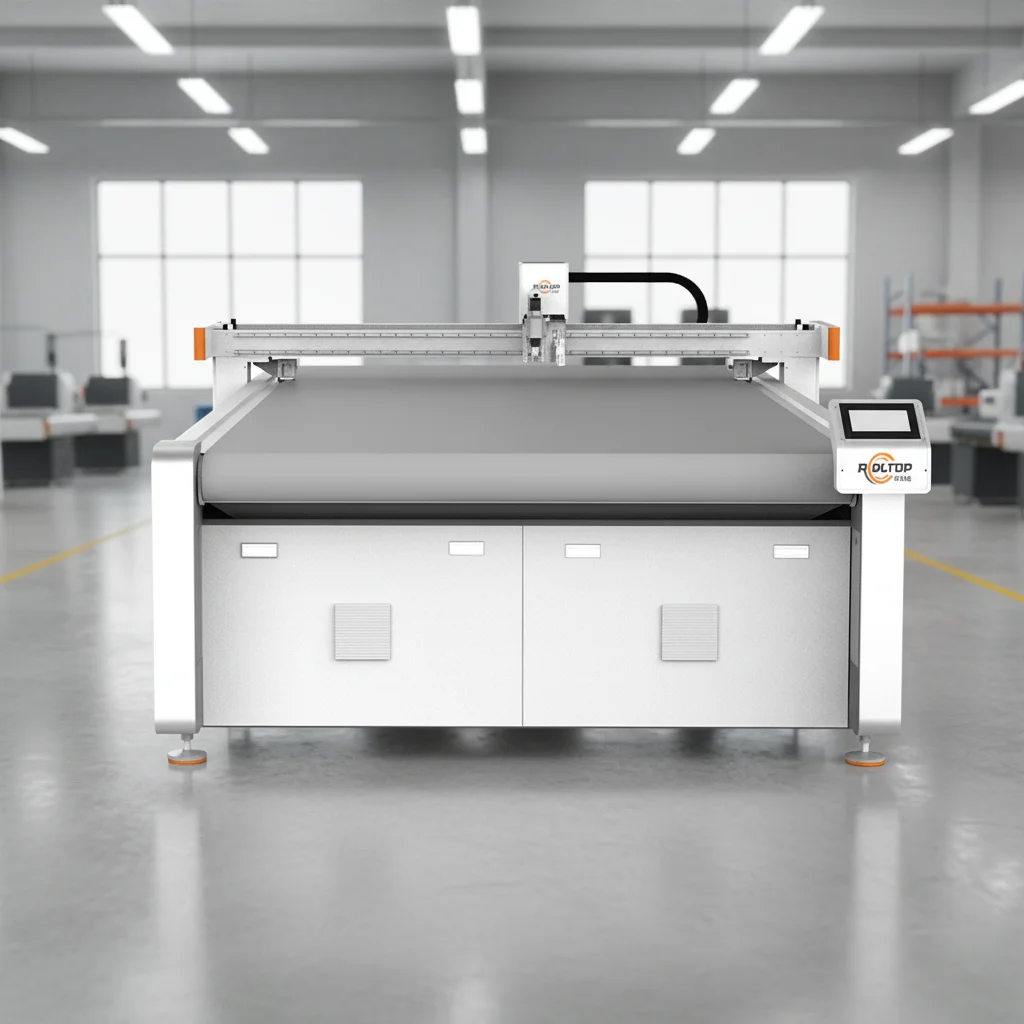
| Vacuum Table Type | Aluminum bellows vacuum table |
| Voltage Options | 110V / 220V / 380V |
| Servo Drive Options | Panasonic, Delta, Dorna |
| Control System | PLC with configurable display languages |
| File Format Compatibility | PLT, DXF, AI, PDF |
| Safety Devices | Infrared sensor, Emergency stop |
| Machine Dimensions | 3300 × 2100 × 1350 mm |
| Language Options | English, Russian, Italian, Chinese (custom available) |
| Standards | CE |
Application Suitability
| Application | Material or Output |
|---|---|
| Apparel manufacturing | Suits, knitwear, lace, complex woven and knitted fabrics |
| Automotive interiors | Seat fabrics, carpets, PVC mats |
| Home textiles | Sofa upholstery fabrics, curtains, rugs |
| Composite material processing | Carbon fiber prepreg, aramid fabrics, specialty technical textiles |
| Footwear and leather goods | Natural leather, synthetic leather, foam insoles |
| Packaging sample making | Cardboard, carton, corrugated board |
When a Cloth CNC Cutting Machine Fails on the Production Floor
A machine specified only by working area will almost always disappoint when the real test is cutting depth, edge quality, and small-part holding.
The conversation usually starts with table size. Buyers request a 1600 × 2500 mm cloth CNC cutting machine because it fits their lay-up width. Weeks after installation, the first multi-layer batch of 20 mm foam-backed automotive carpet shows ragged edges at full speed, or small collar pieces lift off the table mid-cut because vacuum zoning was never discussed. I have stood in factories in South Asia watching operators hand-weight pattern edges with steel rulers because the vacuum pump was undersized for the fabric type [NEED_CITE: vacuum hold-down requirements by fabric weight and permeability]. The root cause is rarely the machine itself — it is the gap between a specification sheet built around table dimensions and a configuration built around the actual material.
Matching Tool Head to Fabric Weight and Ply
The oscillating knife handles most single-ply and light multi-ply woven and knitted fabrics with clean, fused-free edges. For heavier technical textiles — automotive seat foam laminates, dense carpet, or aramid composite prepreg — a pneumatic knife delivers the downward force that a standard oscillating blade cannot sustain across a full 2500 mm stroke. Driven rotary knives sit between the two, suited to continuous long cuts on medium-weight rolls where blade deflection matters more than ply count. Selecting the correct head before the order is confirmed avoids the most common post-installation complaint: ragged or delaminated edges on materials the machine was technically "capable of cutting."
Vacuum Zoning and Small-Part Stability
A 9 kW vacuum pump paired with an aluminum bellows table provides meaningful holding force, but hold-down performance depends on how the table zones are configured relative to the pattern layout. Full-table vacuum across 1600 × 2500 mm works for large panels — automotive headliners or curtain panels — but small apparel pieces like cuffs, collars, and pocket flaps concentrate vacuum loss at the edges of each cut. Zoned vacuum activation keeps suction focused under the active cutting area, preventing part lift at high traversal speeds. I have seen garment factories lose an entire lay to part shifting because the table ran full-zone vacuum on a nest of small pieces [NEED_CITE: vacuum zoning effects on small-part cutting stability].
How Specs Translate to Real Cutting Conditions
Cutting speed rated at 0 – 2000 mm/s describes maximum head travel, not sustained production speed through dense multi-layer lays. On a single ply of suit-weight wool, the head can approach upper travel limits on straight runs. Through 30 mm of layered automotive carpet, sustained cutting speed drops considerably as the blade must penetrate, shear, and withdraw on every oscillation cycle — a factor rarely captured in headline specifications. The ±0.1 mm positioning accuracy matters most in pattern-matching workflows for striped or checked apparel fabrics, where even slight drift across a 2500 mm cut length pushes pattern alignment outside acceptable tolerance at the sewing station. File compatibility with DXF, PLT, AI, and PDF formats lets the cutting table sit downstream of whichever CAD or nesting system the factory already runs, avoiding a forced software migration [NEED_CITE: common CAD file format interoperability in garment and automotive textile workflows].
The Cost of Skipping Material Testing
When a buyer commits to a cloth CNC cutting machine without running sample cuts on their own material, the first failure usually appears within the opening week of production. Edge quality on stretch knits looks acceptable at low speed but frays when throughput is pushed to meet daily volume targets. Foam-backed materials compress under the knife, then spring back, leaving incomplete cuts that require manual trimming — the exact secondary operation the machine was purchased to eliminate. A sample cutting report generated on the buyer’s actual fabric, at the intended layer count and speed, surfaces these issues before the machine leaves the factory.
Why Source This Cutting Table Here
In-house design and production cover both oscillating knife and driven rotary configurations, so the tool head is matched to the material rather than limited to whatever a single-technology supplier stocks. Every order ships with a tool head and table configuration list specifying which heads are included, which are optional, and which material each one addresses. CCD camera positioning is available for printed contour cutting where fabric registration marks must be tracked at production speed. Voltage, plug type, and control language are confirmed against the destination factory’s electrical standard and operator preference before shipment begins. Sample cutting on the buyer’s own material is conducted and documented before the buyer commits to a purchase order, reducing the risk of a mismatch between machine capability and production reality.
Documentation & Verification
- Machine specification sheet listing confirmed tool heads and table zones for your fabric type
- Electrical schematic with voltage and frequency matched to destination country standard
- Sample cutting report run on buyer-supplied material at target layer count
- Factory test record documenting accuracy verification across full working area before dispatch
- Software licence and file format compatibility note for DXF, PLT, AI, and PDF workflows
- Spare parts list with consumable blade specifications and recommended reorder quantities
Installation, Commissioning & Support
- 9 kW vacuum pump requires a dedicated circuit separate from the 380V servo and control supply
- Machine footprint of 3300 × 2100 mm needs clearance on all four sides for material loading and maintenance access
- Aluminum bellows vacuum table ships assembled; field leveling required on concrete floor with verified flatness
- PLC language configured to operator preference — English, Russian, Italian, Chinese, or custom — before power-on
- First-day commissioning includes vacuum zone mapping against buyer’s typical pattern nest layout
- Oscillating and rotary knife blades included in initial spare parts kit; reorder intervals depend on material abrasiveness
What We Need to Quote Accurately
Send us the fabric type, weight in GSM, and whether you cut single-ply or multi-layer — including the intended lay height. Confirm your local voltage and frequency, the control language your operators need, and whether your existing CAD files are in DXF, AI, PLT, or PDF format. If your production includes printed fabrics requiring contour recognition, let us know so the CCD system can be included and tested against your actual print registration marks.
Frequently Asked Questions
Q: How is cutting thickness verified for my specific fabric type and layer count?
A: We run sample cuts on buyer-supplied material at the intended layer height and document edge quality, cycle time, and cut completeness in a written report. This happens before order confirmation, so any tool head or vacuum adjustment is resolved at the factory rather than on your production floor after delivery.
Q: Which tool head is recommended for my material?
A: Oscillating knives suit most single-ply wovens and knits. Driven rotary knives handle medium-weight continuous cuts where blade deflection matters. Pneumatic knives are reserved for dense foam laminates and thick automotive textiles. We specify the head based on your material sample, not a default catalog configuration.
Q: Can the vacuum table hold small pattern pieces without lifting at high speed?
A: The aluminum bellows table with a 9 kW pump supports zoned vacuum activation. For nests with many small pieces — collars, cuffs, pocket components — we map active zones to the pattern layout so suction concentrates under the cutting area rather than dissipating across the full 1600 × 2500 mm surface.
Q: Does the nesting software accept my existing DXF or AI files?
A: The control system imports PLT, DXF, AI, and PDF formats directly. Before shipment we confirm file compatibility with a test import of your production files and verify that nesting output matches your workflow requirements, including grain direction constraints and pattern-matching rules for striped fabrics.
Q: What throughput can I expect for my daily volume?
A: Throughput depends on fabric weight, layer count, pattern complexity, and the tool head in use. We provide a cycle time estimate derived from the sample cutting test on your actual material, not a generic catalog figure. This gives you a production-planning number tied to your specific cutting job.




商品评价
Clear filtersThere are no reviews yet.