




Customized cutting configurations — every tool head and vacuum zone is selected based on your fabric weight, layer count and daily roll throughput before the machine ships.
Technical Specifications
| Parameter | Value |
|---|---|
| Model | RT-D2516/RT-S2516 |
| Product Type | CNC Oscillating Knife Cutting Machine |
| Working Area | 1600×2500 mm |
| Overall Dimensions (L×W×H) | 3450×2300×1250 mm |
| Rated Power | 9 kW |
| Voltage | 380V ±10% (50/60 Hz to be confirmed) |
| Table Type | Flat working table or auto-feeding conveyor |
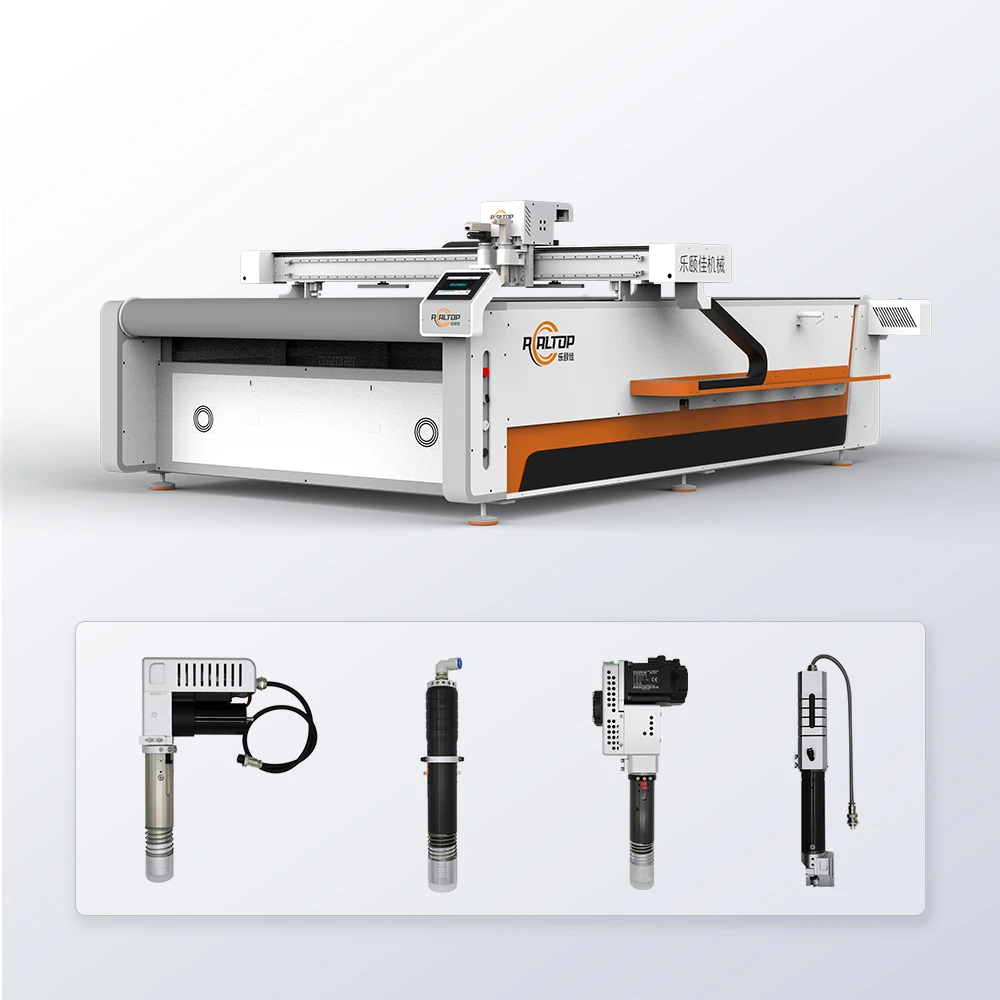
| Tool Head Options | Oscillating knife (Swiss blade), pneumatic knife, high-power vibrating knife, circular knife, V-cutting knife, drag knife, creasing wheel, dotted line knife, punch tool, brush |
| Positioning System | Small CCD camera mark-point, panoramic camera recognition, projection positioning |
| Translational Velocity | 800–2000 mm/s |
| Cutting Speed | 200–800 mm/s (varies by material) |
| Cutting Thickness | Up to 100 mm (material dependent) |
| Repeatability | ≤0.1 mm |
| Transmission System | Digital servo motor (Delta or Panasonic optional), linear guide, synchronous belt, ball screw, Taiwan Hiwin rail |
| Vacuum Table | Magnesium-aluminum alloy with PVDF powder coating and hard oxidation; 7.5 kW integrated aviation aluminum vacuum pump with silencer |
| Control System | CNC with touch screen, multi-language interface |
| Software & File Formats | Auto nesting; PLT, DXF, AI, HP-GL compatible |
| Safety Devices | Infrared induction blocking, anti-collision sensors, emergency stop with in-situ resume |
| Language Options | English, Russian, Italian, Chinese (others customizable) |
| Assembly State | Fully assembled |
| Warranty | 1 year (domestic and international) |
| CE Compliance | Referenced in company documentation (confirm per unit) |
Application Suitability
| Application | Material or Output |
|---|---|
| Garment and footwear production | Clothing cloth, shoe uppers, luggage material, leather, fur, multi-layer fabric rolls |
| Automotive interior trimming | Car interior fabrics, carpet, floor mat textiles, gaskets |
| Soft home furnishing and carpet | Sofa fabrics, non-woven materials, fur, large-format single-layer textiles |
| Packaging and carton sample making | Corrugated cardboard, flat board, sample prototyping |
| Advertising and signage | Sticker, film, vinyl, printed graphic media |
| Composite and foam fabrication | Sponge, PU, EVA, XPE, foam board, PVC, PP, PE, PTFE, ETFE |
| Sealing gasket production | Rubber, silicon, PTFE, carbon fiber sheets |
Why a Flatbed CNC Oscillating Knife Cutting Machine Production Line Fails on Multi-Layer Canvas
The knife must match the exact stack height and weave density, not the brochure headline.
I spent weeks troubleshooting in a Chilean workshop where the operator had a machine rated for fabric cutting but could not penetrate a 12-layer canvas stack cleanly. The tool head was generic, the oscillation frequency too low for heavy weave, and the vacuum zoning left small pattern pieces drifting mid-cut. Ragged edges and crushed layers piled up as waste before we swapped to a high-power vibrating knife and re-zoned the table [NEED_CITE: oscillation frequency and fabric stack compatibility in industrial textile cutting]. A CNC oscillating knife cutting machine production line only earns its name when every configuration decision traces back to the buyer’s actual roll stock and ply count.
Tool Head Logic Across Fabric Weights and Stack Heights
The RT-D2516/RT-S2516 carries a multi-tool head carriage that accepts a Swiss-imported oscillating knife blade alongside pneumatic, circular, V-cutting and drag knife options. This matters because a single-layer silk lining demands a completely different blade profile and stroke rate than a 60 mm stack of automotive carpet. The oscillating knife handles contour cutting on woven and knitted textiles with full-cut, half-cut and cursor-location functions, while the circular knife takes long straight runs on roll-fed material at high travel speed. Swapping between them on the same carriage means a single CNC oscillating knife cutting machine production line can move from prototype sampling to full roll production without re-fixturing.
Holding Lightweight Fabrics Flat Without Crushing Them
The vacuum platform uses a magnesium-aluminum alloy base with PVDF powder coating and hard anodic oxidation, which resists abrasion from repeated fabric loading and prevents surface marks on delicate textiles. The 7.5 kW integrated pump with built-in silencer sponge generates uniform suction across the 1600×2500 mm area. For lightweight non-woven or single-layer film, zoning must isolate active vacuum only under the cutting zone so air does not bleed from uncovered regions [NEED_CITE: vacuum zoning principles for flatbed digital cutting tables]. Without this, thin materials lift at cutting speed and the blade drags the edge, producing the exact defect the machine was bought to eliminate.
Reading the Specs That Actually Determine Cut Quality
The repeatability figure of ≤0.1 mm depends on the Taiwan Hiwin linear rail and digital servo motor combination — Delta or Panasonic units are available depending on the buyer’s service network. The 200–800 mm/s cutting speed range is material-dependent; a dense leather stack runs at the lower end while single-layer vinyl film approaches the upper limit. Translational velocity of 800–2000 mm/s governs non-cutting moves, so the ratio between traverse and cut speed determines overall cycle time on a nested sheet. The CCD camera mark-point and panoramic recognition systems track printed registration marks on dyed or sublimated textiles, which is essential when garment panels must align to a printed pattern rather than a digital outline. Nesting software supporting PLT, DXF, AI and HP-GL formats reduces offcut waste, and file compatibility must be confirmed against the buyer’s existing CAD workflow before order.
The Cost of Skipping the Sample Cut
Every machine I have seen fail on the production floor failed because the configuration was locked before the buyer’s material was tested. Choosing a drag knife for foam produces compressed edges that spring back out of tolerance. Setting vacuum zones too wide for small gasket parts lets them shift under the blade. Promising CCD contour recognition without verifying mark contrast on the actual printed fabric results in missed registrations at full speed [NEED_CITE: material test protocol for CNC digital cutting equipment procurement]. These are not warranty claims — they are configuration errors that no amount of on-site adjustment can fully correct.
Why Source This Machine From REALTOP
The in-house design team covers both knife and laser cutting technologies, so the cutting method is matched to the material rather than forced into one platform. Tool head and table configuration are specified per material type, thickness and production volume, not pulled from a default list. CCD camera positioning is validated on the buyer’s printed contour work before shipment. Software compatibility with the buyer’s file formats and nesting workflow is confirmed at the quotation stage. Voltage, plug type and control panel language are locked down before production begins, and sample cutting on the buyer’s own material is standard practice, not an optional extra.
Documentation & Verification
- Machine specification sheet listing every selected tool head and vacuum zone configuration
- Electrical schematic with voltage and frequency confirmation matching the destination market
- Sample cutting report produced on the buyer’s own fabric or composite material
- Factory test record documenting repeatability and cut quality before dispatch
- Software licence and file format compatibility note for the buyer’s nesting workflow
- Spare parts list with blade, belt and sensor consumables identified by part number
Installation, Commissioning & Support
- Flat foundation required for the 3450×2300 mm footprint with clearance for conveyor feed if configured
- Dedicated 380V ±10% circuit with confirmed frequency and plug type before wiring
- Machine ships fully assembled; positioning and leveling on site only
- First-run parameter setting includes vacuum zone mapping for the buyer’s heaviest material
- Operator training covers tool head changeover, CCD calibration and nesting software import
- Swiss blade consumables and synchronous belt spares stocked for international shipment
- Maintenance schedule based on Hiwin rail lubrication intervals and vacuum pump filter cleaning
What to Share Before Quoting
Provide the fabric or composite type, single-ply weight, maximum stack height and daily roll consumption so the correct tool head and table configuration can be specified. Confirm your local voltage and frequency, preferred control panel language, and whether your workflow relies on roll-fed continuous cutting or flat-sheet batch loading. If your nesting files come from a specific CAD system, share a sample export so we verify format compatibility before the order is placed.
Frequently Asked Questions
Q: How should tool heads be selected for different fabric types and layer counts?
A: The oscillating knife with a Swiss-imported blade suits contour work on woven and knitted textiles up to moderate stack heights. For heavier stacks like multi-layer canvas or automotive carpet, the high-power vibrating knife delivers deeper penetration. The circular knife handles long straight cuts on roll-fed single-layer material. Tool head selection is finalized after sample cutting on the buyer’s actual stock.
Q: How does CCD camera recognition perform on printed textiles at production speed?
A: The system uses mark-point and panoramic camera options to track printed registration marks. Performance depends on mark contrast against the fabric background and the print registration accuracy of the upstream process. We validate tracking on the buyer’s own printed material at target cutting speed before confirming the configuration.
Q: What vacuum table zoning prevents lightweight fabric from lifting?
A: The magnesium-aluminum platform divides suction into addressable zones so vacuum concentrates only under the active cutting area. This prevents air bleed from uncovered regions that would reduce hold-down force on small or lightweight parts. Zone mapping is set during commissioning based on the buyer’s typical nesting layout.
Q: How does the auto-feeding conveyor integrate with roll-fed textile production?
A: The auto-feeding table option advances fabric from a roll across the 1600×2500 mm working area continuously, enabling uninterrupted cutting on long production runs. The conveyor feeds material while the vacuum holds the cutting zone flat, allowing nested panels to be cut sequentially without manual repositioning between sheets.
Q: What material yield improvement does automatic nesting software deliver?
A: The auto typesetting software arranges pattern pieces to minimize offcut waste across the working area. It imports PLT, DXF, AI and HP-GL files directly from the buyer’s CAD system. Actual yield improvement depends on the shape complexity and size mix of the panels being nested compared to manual layout practices.



商品评价
Clear filtersThere are no reviews yet.