




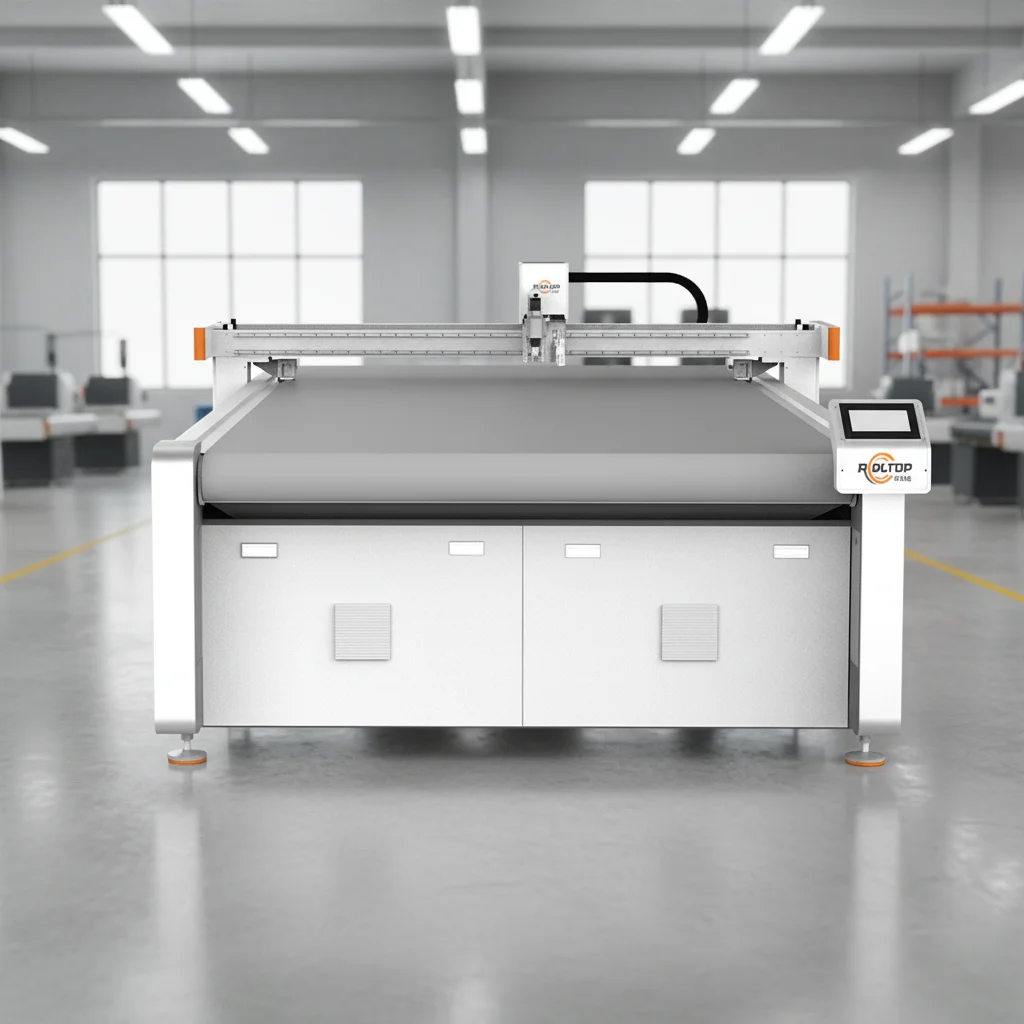
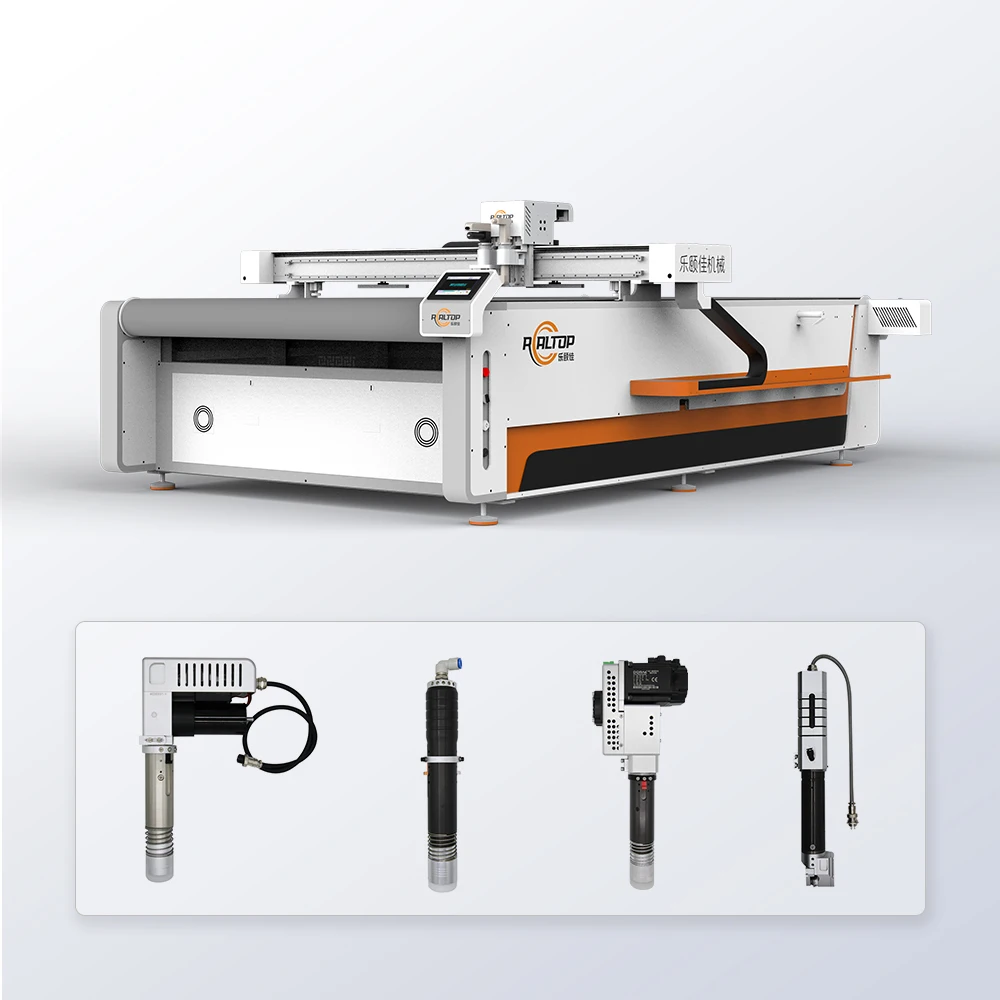
Tool Head Matched Per Fabric Type — The RT-D2516/RT-S2516 is configured with oscillating, drag, circular and V-cutting knife options selected after sample testing on the buyer’s actual cloth weight, ply count and weave rather than quoted on working area alone.
Technical Specifications
| Parameter | Value |
|---|---|
| Model | RT-D2516 / RT-S2516 |
| Product Type | CNC Oscillating Knife Cutting Machine |
| Working Area | 1600 × 2500 mm |
| Overall Dimensions | 3450 × 2300 × 1250 mm |
| Rated Power | 9 kW |
| Voltage | 380V ±10% |
| Table Type | Flat working table / Auto feeding table |
| Vacuum Pump | 7.5 kW |
| Vacuum Table Surface | Magnesium-aluminum alloy, PVDF powder sprayed, anodic & hard oxidation treated |
| Translational Velocity | 800–2000 mm/s |
| Cutting Speed | 200–800 mm/s (varies with material and ply count) |
| Cutting Thickness | ≤100 mm (varies with material density) |
| Repeatability | ≤0.1 mm |
| Transmission System | Digital servo motor, linear guide, synchronous belt, ball screw (Taiwan Hiwin rail) |
| Visual Positioning Options | Small CCD mark point / Panoramic camera / Projection positioning |
| Tool Head Options | Swiss imported oscillating knife, pneumatic knife, high-power vibrating knife, circular knife, V-cutting knife, drag knife, creasing wheel, dotted line knife, punching, brush |
| Instruction Format | HP-GL compatible |
| File Format Support | PLT, DXF, AI |
| Control Panel | Touch screen, multi-language |
| Conveyor Belt | Germany imported |
| Safety Devices | Infrared induction blocking, anti-collision beam sensors, emergency stop with in-situ resume |
| Assembly State | Fully assembled |
| Warranty | 1 year |
Application Suitability
| Application | Material or Output |
|---|---|
| Garment and footwear production | Single and multi-layer woven cloth, knitted lining, shoe upper textiles |
| Soft home furnishing | Curtain fabric, upholstery textile, bedding material |
| Automotive interior | Seat cover cloth, headliner textile, carpet and floor mat material |
| Luggage and bag manufacturing | Canvas, synthetic leather, composite bag material |
| Carpet and floor mat cutting | Non-woven fabric, carpet rolls, sponge underlay |
| Pattern sample making | Cardboard, corrugated board for garment and packaging templates |
Why Table Size Alone Cannot Guarantee Clean Cloth Edges
A Cloth CNC Cutting Machine specified only by working area frequently disappoints when the buyer’s fabric lifts under the blade, nesting files refuse to import or the vacuum zones leave small pattern pieces drifting mid-cut.
The RT-D2516/RT-S2516 addresses this by matching tool head, vacuum zoning and software workflow to the buyer’s actual cloth sample before the order is confirmed, not after delivery.
Over the years I have seen machines arrive at textile workshops with the wrong knife installed — an oscillating blade meant for thick foam trying to cut delicate knitted jersey, leaving pulled threads and frayed edges across every piece. The operator spends weeks adjusting speed and pressure by trial and error, burning through fabric rolls before achieving acceptable edge quality. The root cause was always the same: the configuration was decided on a spreadsheet rather than on a cutting table with the buyer’s material under the blade. [NEED_CITE:]
Tool Head Selection by Fabric Weave and Weight
The RT-D2516/RT-S2516 supports a full range of cutting tools — Swiss imported oscillating knife, pneumatic knife, circular knife, drag knife and V-cutting knife among others. For tightly woven garment cloth, a high-frequency oscillating blade delivers a clean shear without pulling warp threads. For knitted textiles and stretch lining, a sharper oscillating profile with adjusted stroke amplitude prevents the fabric from bunching ahead of the blade. Each Cloth CNC Cutting Machine configuration is locked in only after cutting the buyer’s sample material at production speed.
Vacuum Hold-Down Across Multi-Layer Layups
Holding multiple plies of light cloth flat during a high-speed cut demands consistent suction across the entire working surface. The magnesium-aluminum alloy table on the RT-D2516/RT-S2516 is treated with PVDF powder coating and hard anodic oxidation, creating a flat, low-friction surface that resists adhesive buildup from fusible interlinings. The 7.5 kW vacuum pump pulls air through zoned channels so that suction remains effective even when cutting small collar or cuff pieces near the table edge. [NEED_CITE:] Without proper zoning, small pattern pieces lift into the knife path, producing miscuts that waste material and halt the production line.
Decoding the Specs That Matter on the Cutting Floor
The 1600 × 2500 mm working area accommodates standard garment marker layouts, but the cutting speed range of 200–800 mm/s is what determines daily throughput. Heavier fabrics like canvas and upholstery cloth require the lower end of that range with increased oscillation frequency, while lightweight lining material can be cut at the upper range with reduced stroke. The ≤0.1 mm repeatability ensures that nested pattern pieces — often spaced only a few millimeters apart to maximize fabric yield — maintain dimensional accuracy across an entire layup. Taiwan Hiwin linear guides and ball screws in the transmission system maintain this precision over extended production runs, reducing cumulative drift that would otherwise require mid-shift recalibration. The CCD and panoramic camera options allow printed textiles with registered patterns to be recognized and cut along the printed contour rather than a fixed coordinate, critical for producers cutting striped or patterned cloth where alignment is non-negotiable. [NEED_CITE:]
The Cost of Skipping the Sample Cutting Step
When a buyer approves a machine based on a catalogue cutting video using standard PVC or cotton, the actual production material often behaves differently. Composite textiles with fiberglass reinforcement dull standard blades within hours, producing ragged edges that force the operator to slow down or stop for frequent knife changes. A cloth cutting table delivered without the correct pneumatic knife or high-power vibrating knife option for that specific composite results in weeks of downtime while replacement tooling is sourced. The vacuum table zoning, if not matched to the buyer’s smallest pattern piece size, leaves material lifting at the cut boundary — a problem that only surfaces when the machine is running full production speed. [NEED_CITE:]
Why Source This Cloth Cutting Equipment Here
The in-house design team covers both the knife tooling configuration and the nesting software integration, so the cutting method is matched to the fabric rather than forcing the material through a single tool type. Sample cutting on the buyer’s own cloth is completed before the order is finalized, with edge quality, ply count capability and speed confirmed in a written report. Voltage at 380V ±10% and control language are verified against the buyer’s factory supply and operator preference prior to shipment. The tool head and vacuum table configuration list is documented per order, giving the buyer a clear reference for reordering consumable blades and maintaining the table surface. The fully assembled delivery state means the machine arrives ready for power connection and first-article cutting rather than requiring on-site mechanical assembly.
Documentation & Verification
- Machine specification sheet listing the confirmed tool head and table configuration per order
- Electrical schematic with 380V ±10% voltage confirmation matched to buyer’s factory supply
- Sample cutting report on buyer’s cloth showing edge quality, ply count and speed achieved
- Software licence and PLT/DXF/AI file format compatibility note verified against buyer’s workflow
- Operation and maintenance manual with tool head changeover and vacuum table care procedures
- Spare parts list covering oscillating blades, drag knife tips and vacuum table seals
Installation, Commissioning & Support
- Requires a level concrete floor with minimum clearance around the 3450 × 2300 mm footprint for material loading
- Dedicated 380V ±10% circuit rated for the 9 kW machine load plus the 7.5 kW vacuum pump
- Machine ships fully assembled; positioning and power connection handled on arrival
- First-article cutting and nesting parameter setup completed during commissioning visit
- Operator training covers touch screen controls, tool head changeover and file import from PLT/DXF/AI
- Oscillating knife blades and vacuum table seals identified as primary consumables with reorder schedule
Starting the Specification Conversation
To configure the RT-D2516/RT-S2516 for your production floor, we need your cloth type and weight per square meter, the maximum number of plies you cut simultaneously and your typical daily output in meters or pieces. Share a sample roll of your actual production fabric — including any composite layers or coatings — so we can confirm the correct tool head and vacuum zoning before building the machine. Let us also know your factory voltage, frequency and the control language your operators prefer so the touch screen and manuals are ready on day one.
Frequently Asked Questions
Q: How is cutting speed and thickness capacity confirmed for my specific cloth type and ply count?
A: We run your actual fabric sample on the RT-D2516/RT-S2516 at varying speeds and ply depths, then document edge quality, blade wear rate and achievable cutting speed in a written report. This ensures the 200–800 mm/s range and ≤100 mm thickness capacity are validated against your material before the order is finalized.
Q: Which tool head is specified for woven versus knitted versus non-woven fabrics?
A: Woven cloth typically runs on the Swiss imported oscillating knife for clean shearing. Knitted and stretch fabrics use an adjusted oscillation profile to prevent bunching. Non-woven and composite textiles may require the pneumatic knife or high-power vibrating knife, determined during sample testing on your material.
Q: Can the nesting software import my existing PLT, DXF and AI files?
A: The auto typesetting software on the RT-D2516/RT-S2516 supports PLT, DXF and AI formats natively. We verify file import and nesting compatibility against your existing design workflow before shipment, providing a written compatibility note so there are no surprises at first power-on.
Q: What vacuum table zoning is available for small pattern pieces that tend to lift during cutting?
A: The 7.5 kW vacuum system on the RT-D2516/RT-S2516 pulls through zoned channels across the magnesium-aluminum table. We configure zone layout based on your smallest pattern piece dimensions so suction remains effective at the table edges and around intricate shapes like collars and cuffs.
Q: What voltage, control language and plug configuration is confirmed before shipment?
A: The machine operates at 380V ±10%. Before production, we confirm your factory voltage and frequency, the plug type required at your site and the control language for the touch screen interface. All three are documented in the electrical schematic shipped with the machine.





商品评价
Clear filtersThere are no reviews yet.