





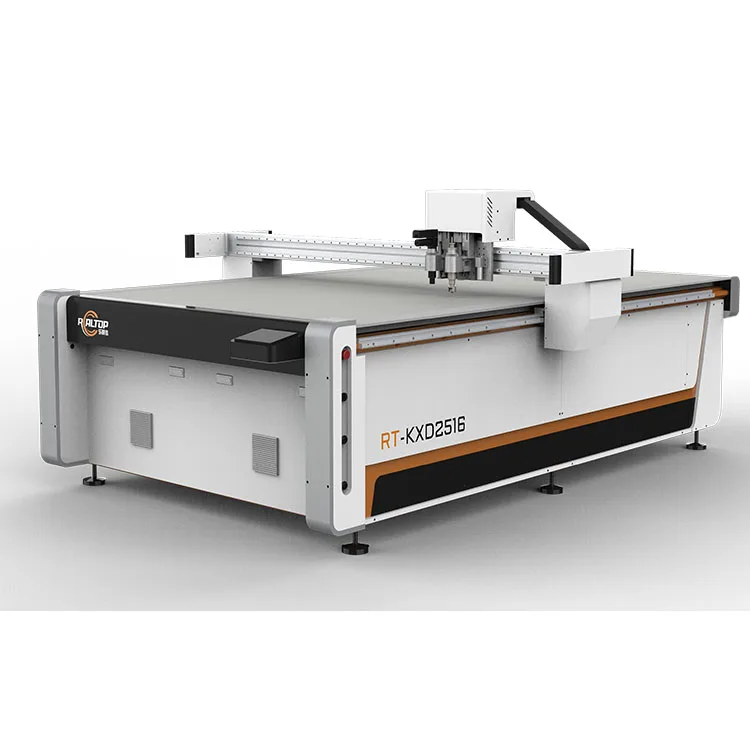
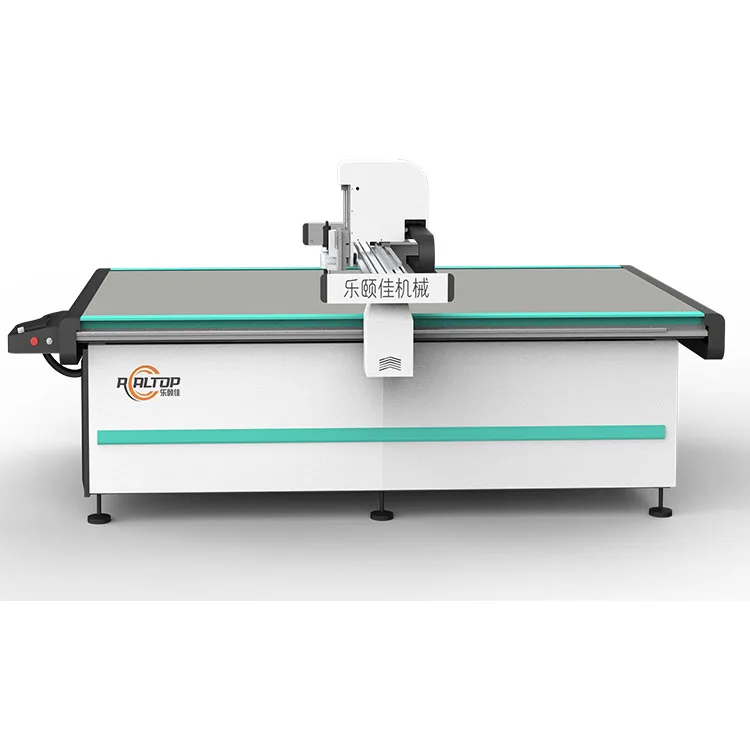
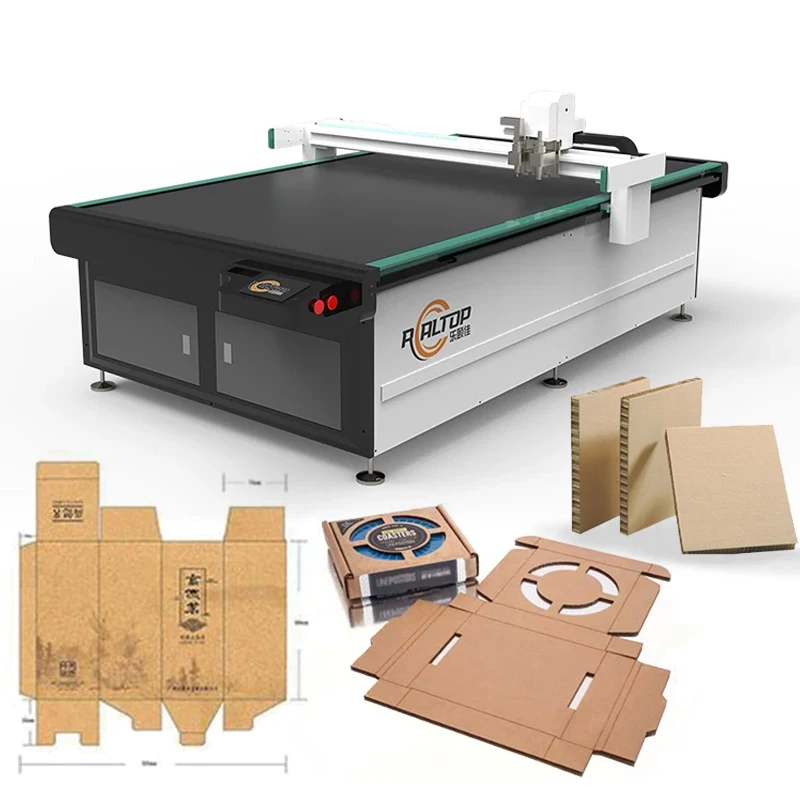
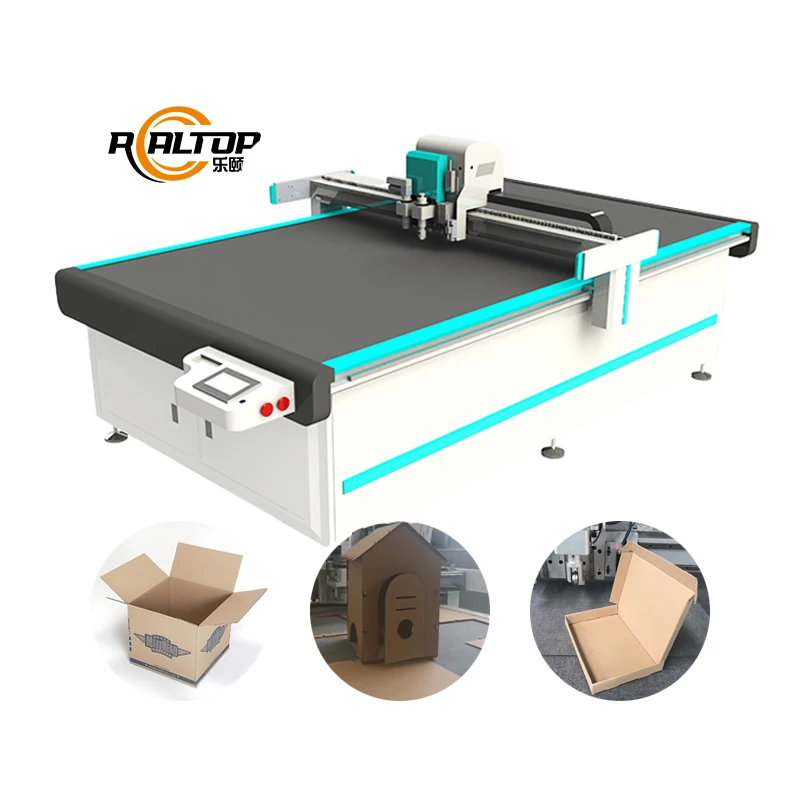
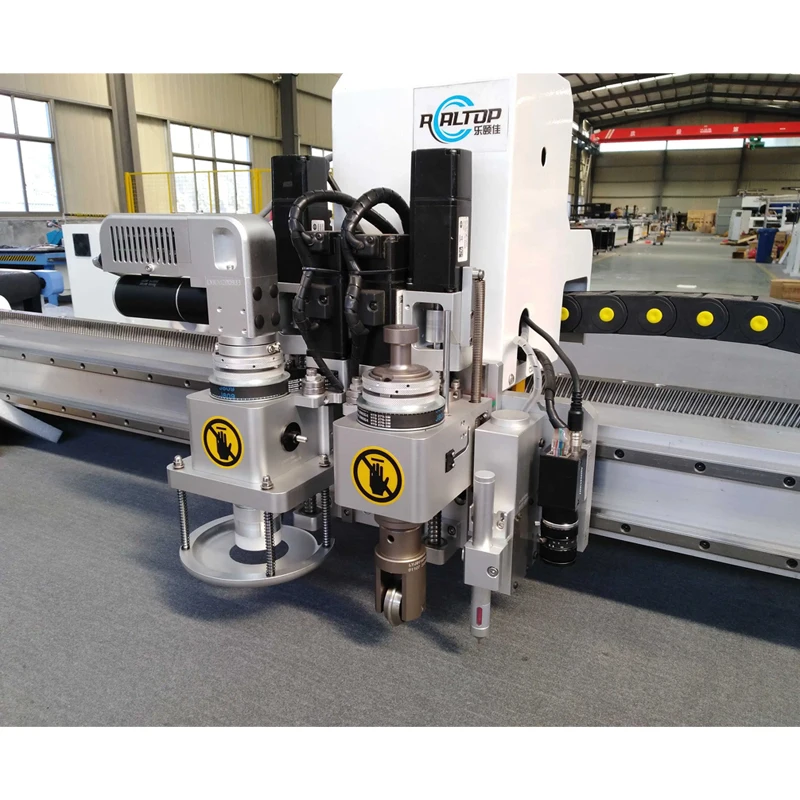

Configured per flute profile — tool head, vacuum zoning and blade amplitude are matched to the buyer’s actual corrugated board stock rather than sold as a standard package.
Technical Specifications
| Parameter | Value |
|---|---|
| Product Type | CNC Oscillating Knife Carton Cutting Machine |
| Working Area | 1600 × 2500 mm |
| Machine Dimensions | 3450 × 2300 × 1250 mm |
| Rated Power | 9 kW |
| Table Type | Flatbed vacuum working table |
| Tool Head | Multifunctional: vibration full cutting, vibration half cutting, cursor location |
| Translational Velocity | 800–1200 mm/s |
| Cutting Speed | 200–800 mm/s (according to different cutting materials) |
| Repeated Accuracy | ≤ 0.1 mm |
| Transmission | Digital servo motor, linear guide, synchronous belt, ball screw |
| Instruction System | HP-GL compatible format |
| Voltage | 380 V ±10% |
| Vacuum Pump | 7.5 kW |
| Guide Rail | Taiwan Hiwin square rail |
| Safety Device | Infrared sensors |
| Standards | CE declaration where applicable |
Application Suitability
| Application | Material or Output |
|---|---|
| Packaging carton sample making | Grey board, single-face and double-wall corrugated board |
| Corrugated box short-run production | E-flute, B-flute and BC-flute corrugated sheets |
| Gift box and retail packaging | Art board, coated paper, magnetic closure box stock |
| Sticker and label contour cutting | Self-adhesive vinyl, synthetic paper |
| Billboard and business card cutting | PVC foam board, card stock |
| Large electrical carton packaging | Heavy-duty triple-wall corrugated board |
Why Board Thickness Matters More Than Working Area
A machine chosen on table size alone often fails once the buyer’s real corrugated stock arrives on the floor. The correct tool head, blade stroke and vacuum zoning must be specified against the actual flute type and board caliper before the order is signed.
I have watched packaging shops receive a digital cutting table that handled 2 mm grey board in the factory test, then choke on 6 mm BC-flute corrugated because the oscillating amplitude was too short and the vacuum zones were too wide for small carton panels. The material lifts, the blade drags, and an entire batch of sample cartons is scrapped before the operator realizes the configuration was wrong. [NEED_CITE: typical corrugated flute caliper ranges in packaging]
Matching the Tool Head to the Flute Profile
Corrugated board is not a single material. An E-flute sheet at 1.5 mm needs a different blade angle and oscillation frequency from a BC-flute board at 7 mm. The multifunctional head on this CNC oscillating knife carton cutting machine production line switches between vibration full cutting, vibration half cutting and creasing without a manual tool change, keeping the workflow continuous across crease lines and cut contours on the same sheet.
Vacuum Zoning That Follows the Cut Path
A 7.5 kW vacuum pump is only effective if the suction reaches the area where the blade is working. The aluminum honeycomb table divides the surface into independent zones so that vacuum concentrates under the active cutting region. This matters most on small carton panels and nested sticker layouts where a single large zone would leave edges unsupported and allow corrugated flutes to lift into the blade path. [NEED_CITE: vacuum hold-down requirements for corrugated board cutting]
Reading the Spec Sheet Against Real Board Stock
The stated cutting speed of 200–800 mm/s spans a wide range because material resistance varies with flute density and liner weight. A 9 kW rated power budget covers both the servo drives and the vacuum pump running simultaneously, so the machine does not stall when a dense double-wall sheet meets the blade at high traverse. The Taiwan Hiwin square rails and ball screw transmission keep the repeated accuracy within 0.1 mm across the full 1600 × 2500 mm stroke, which is the tolerance most packaging CAD files assume for crease-to-cut registration. Blade wear on abrasive recycled liners shortens intervals between replacements, so the tool configuration must account for the buyer’s specific stock source.
The Cost of Skipping a Material Trial
When a carton cutting table ships without a prior test on the buyer’s own corrugated board, the first production run becomes the trial. Ragged edges on B-flute mean the blade stroke was too shallow. Crushed flutes along the crease line mean the creasing wheel pressure was set for a different board weight. Small nested panels lift off the table because vacuum zoning was left on full-area mode instead of being narrowed to the cutting footprint. Every one of these issues stops the line, wastes board, and delays the sample approval that the packaging buyer is waiting for. [NEED_CITE: carton sample approval workflow in packaging supply chains]
Why Source This Line From Realtop
Realtop designs and builds both knife and laser cutting platforms in-house, so the buyer gets a cutting method matched to the material rather than forced into one technology. Each tool head and table zone is specified against the flute type, board caliper and daily carton volume stated in the inquiry. CCD camera positioning is available for printed contour work on pre-printed carton stock. Software compatibility with the buyer’s existing packaging CAD format is confirmed before the order is finalized. Voltage, plug type and control language are locked in during the specification review, not discovered at unpacking. A sample cutting report on the buyer’s own board is produced before commitment.
Documentation & Verification
- Machine specification sheet listing tool head options and vacuum zone map for your board range
- Electrical schematic confirming 380 V ±10% supply and circuit breaker sizing for 9 kW total load
- Sample cutting report on your corrugated stock showing edge quality and crease depth
- Software licence and HP-GL file format compatibility note matched to your CAD workflow
- Factory test record with photos of actual carton panels cut before crating
Installation, Commissioning & Support
- Flat concrete floor required to support the 3450 × 2300 mm footprint and dynamic load during high-speed traverse
- Dedicated 380 V three-phase circuit with earth leakage protection sized for the 9 kW rated draw
- Machine ships in single-frame configuration; vacuum table and gantry are aligned on-site during commissioning
- First-run parameter tuning covers blade amplitude, vacuum zone mapping and creasing pressure for your board grades
- Operator training includes nesting software import, tool head changeover and daily blade inspection routine
- Spare blade and creasing wheel kit supplied; replacement intervals depend on liner abrasiveness of your stock
What to Include in Your Inquiry
Send the actual corrugated board grades you run, including flute type, caliper and liner weight, along with the largest and smallest carton panel dimensions in your current orders. Specify your local voltage and frequency, the control language your operators need, and the packaging CAD format you export from. If you have daily volume targets, state them alongside the board grade so the cutting speed and vacuum configuration can be matched before quotation.
Frequently Asked Questions
Q: How do I choose between the oscillating knife and the creasing wheel for my corrugated board?
A: The oscillating knife handles full and half cuts through the flute structure, while the creasing wheel compresses the board along fold lines without severing the liner. The tool selection depends on flute type and board caliper; thicker BC-flute requires deeper creasing pressure and a longer blade stroke than E-flute stock.
Q: Will small carton parts stay flat during high-speed cutting?
A: The vacuum table is divided into independent zones so suction concentrates under the active cutting area rather than spreading across the full 1600 × 2500 mm surface. This prevents lightweight nested panels from lifting into the blade path when the head traverses at speeds up to 1200 mm/s.
Q: Is the software compatible with my existing packaging CAD files?
A: The instruction system accepts HP-GL compatible format. File format compatibility with your specific CAD output is confirmed during the pre-order specification review, and a software licence note is included in the documentation package to record the agreed formats.
Q: How is daily carton output verified before I commit?
A: Cutting speed ranges from 200 to 800 mm/s depending on material resistance. A sample cutting test on your own corrugated board measures actual cycle time per sheet, including contour complexity and crease line count, giving a realistic basis for daily output planning.
Q: How is crease quality validated on my board before shipment?
A: A sample cutting report is produced on your supplied corrugated stock, documenting edge quality, crease depth and fold accuracy. You review the physical sample panels before the machine enters final assembly and crating.




商品评价
Clear filtersThere are no reviews yet.