




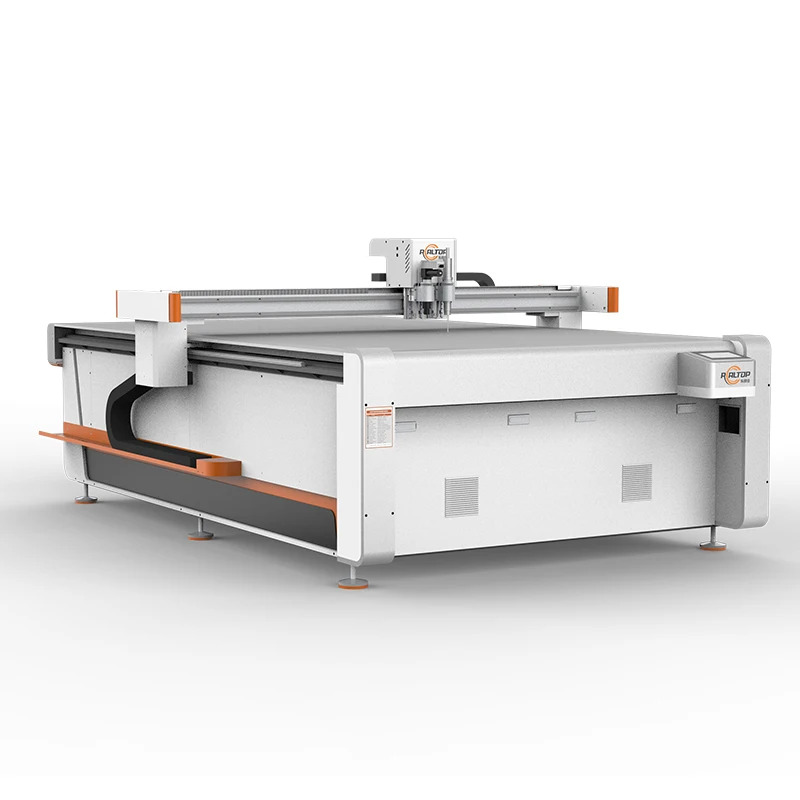
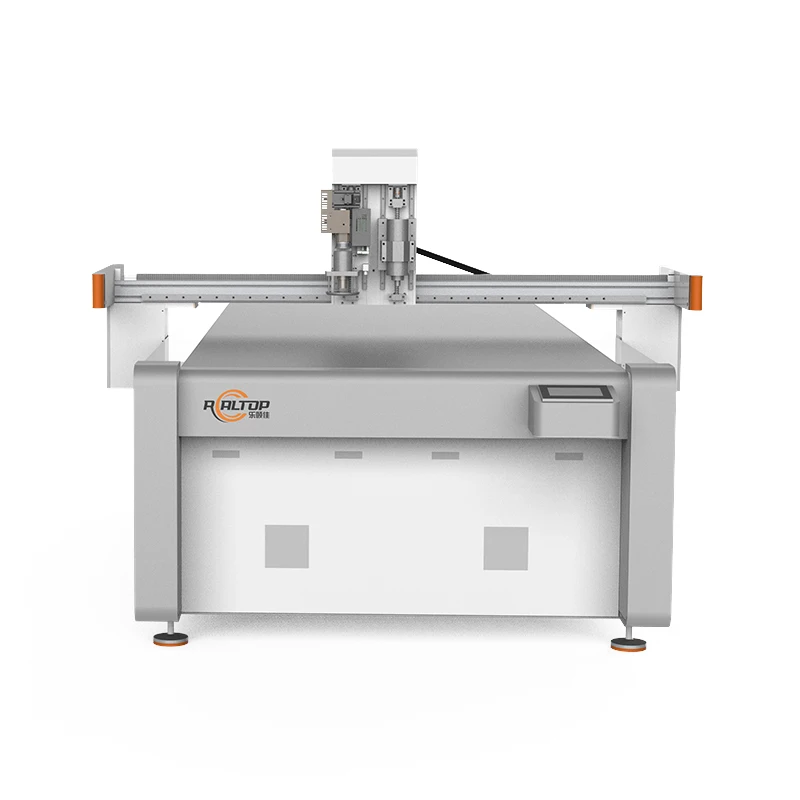
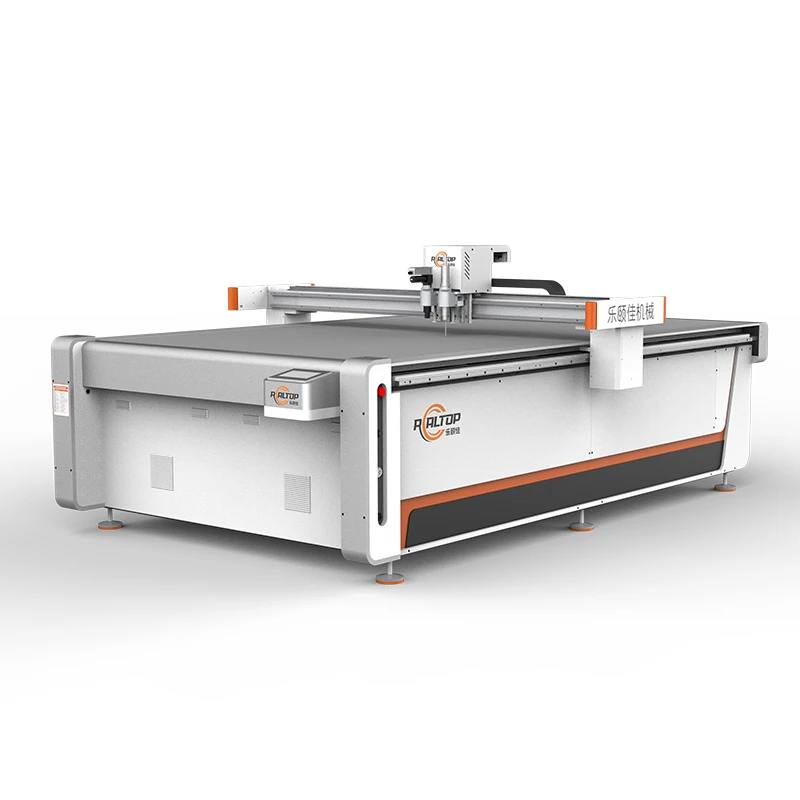
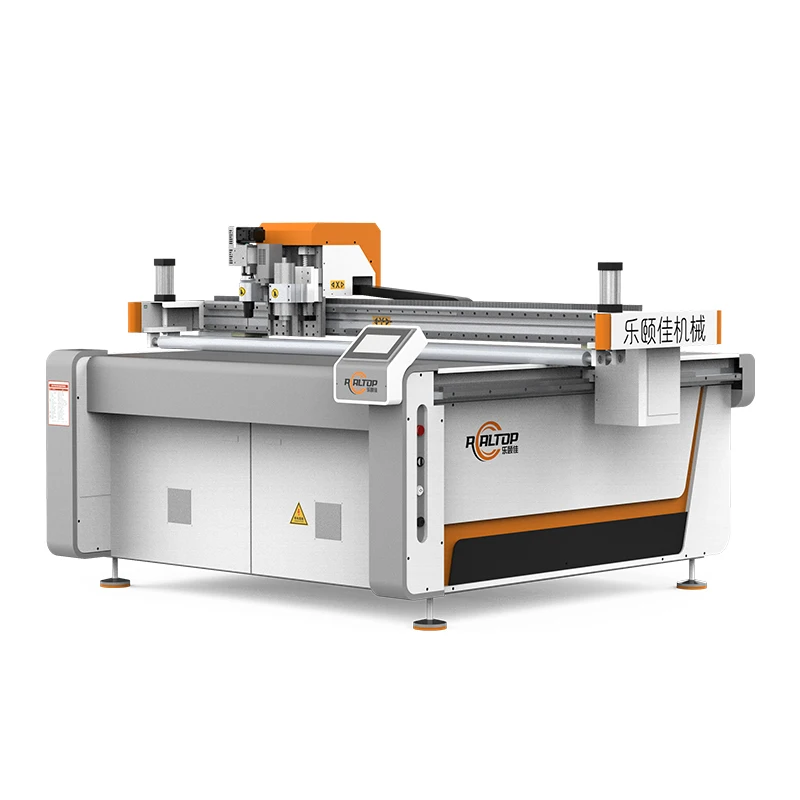
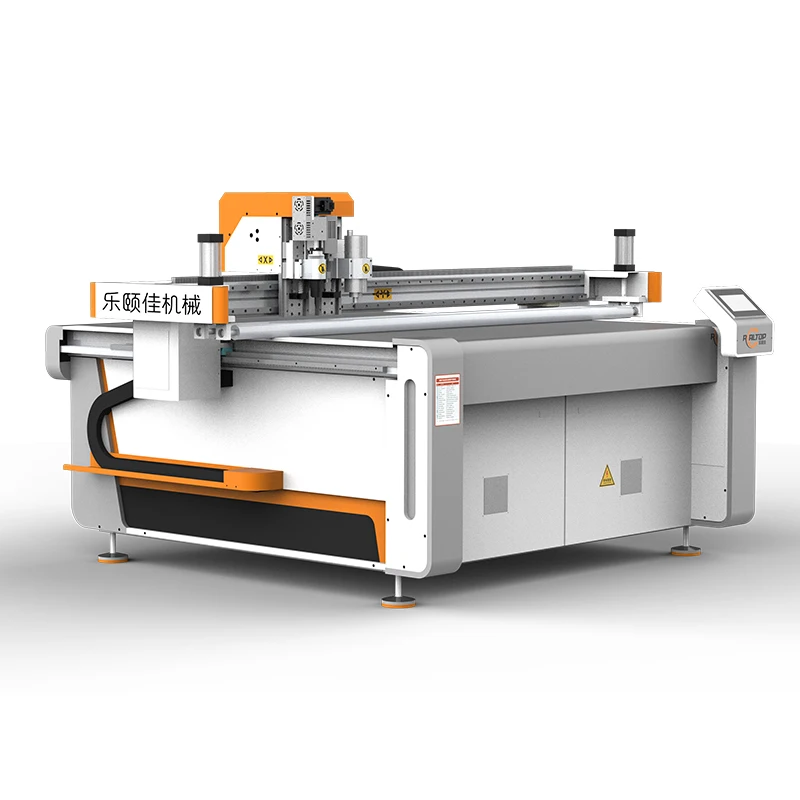
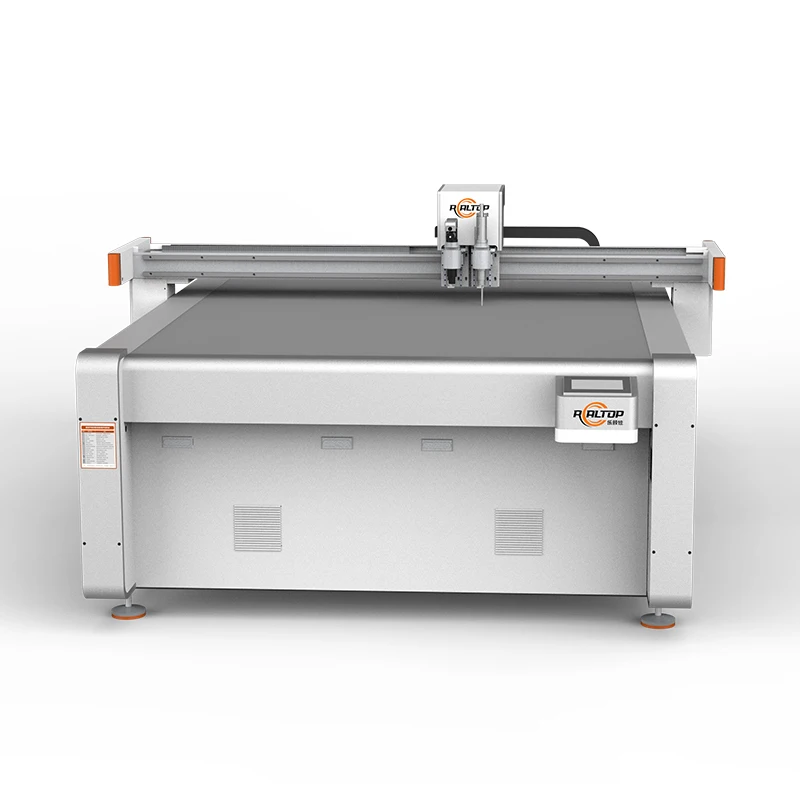

Swiss Knife Integration — oscillating head specified per material density, tested on buyer foam before order confirmation.
Technical Specifications
| Parameter | Value |
|---|---|
| Model | RT-D2516/RT-S2516 |
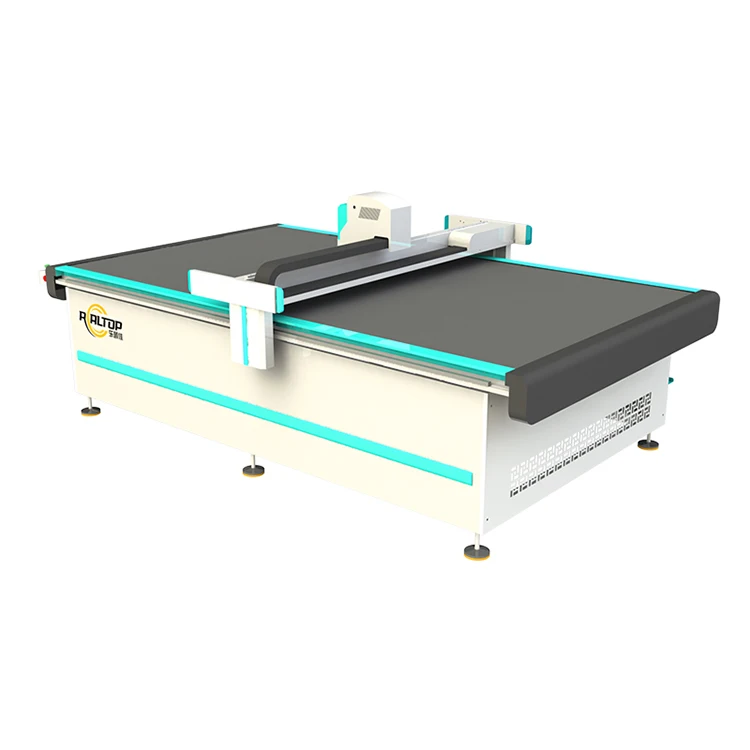
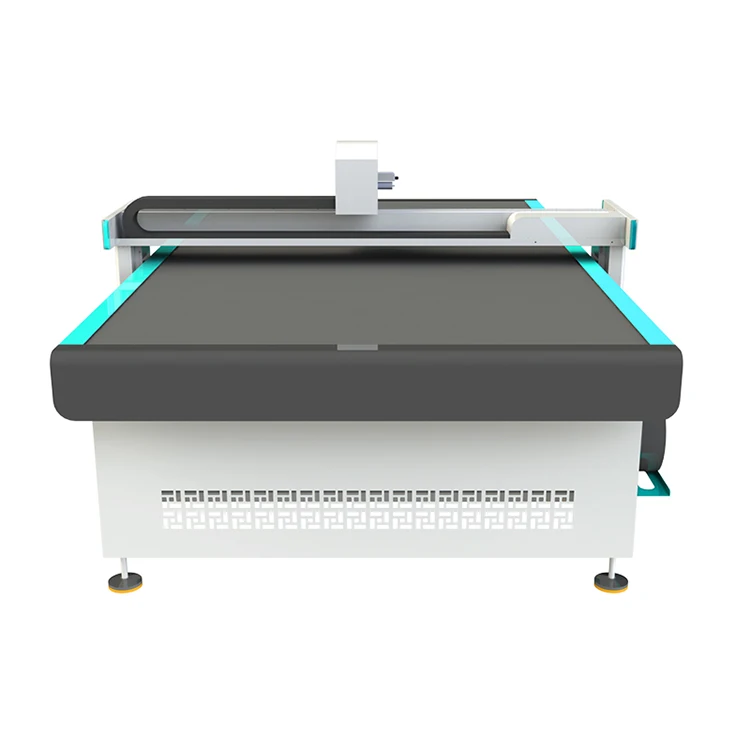
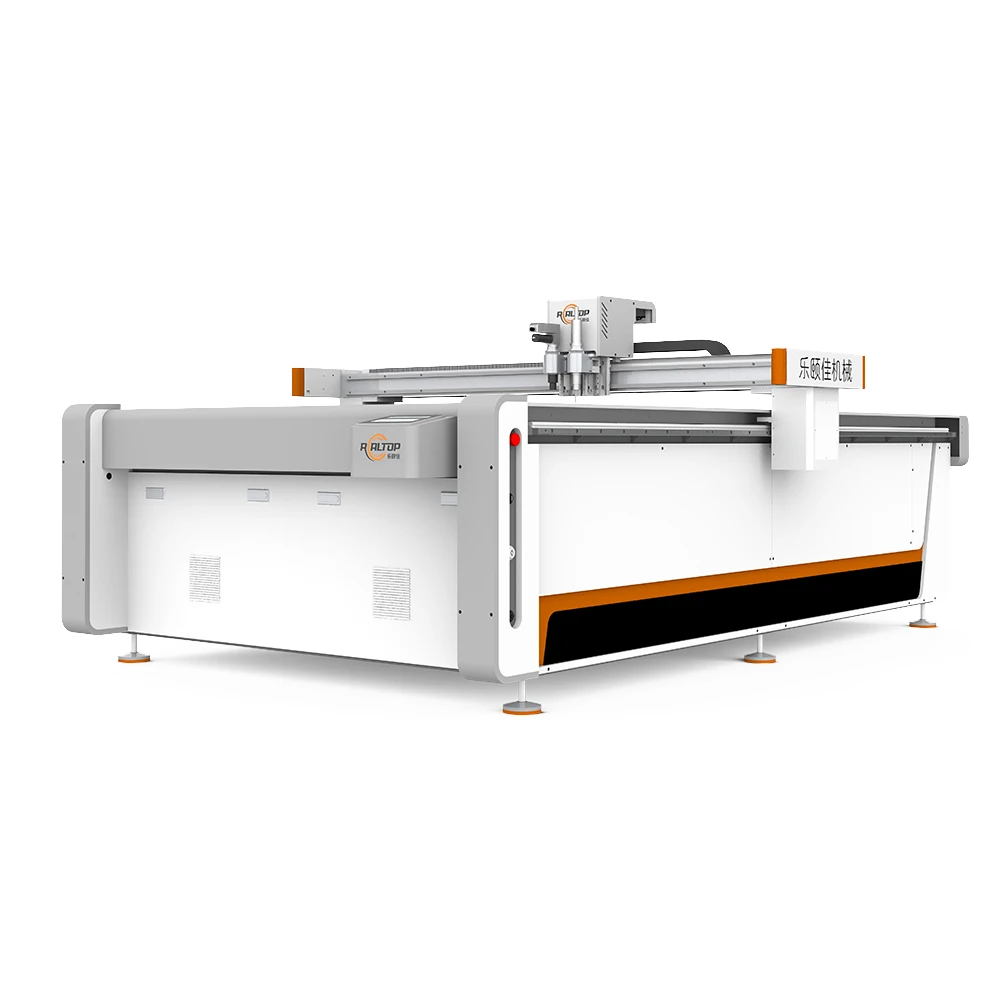
| Product Type | CNC Oscillating Knife Cutting Machine |
| Working Area | 1600 × 2500 mm |
| Machine Size | 3450 × 2300 × 1250 mm |
| Rated Power | 9 kW |
| Table Type | Flatbed vacuum working table |
| Multifunctional Head | Swiss imported knife with vibration full cutting, vibration half cutting and cursor location |
| Cutting Thickness | 20–80 mm (basis not stated in source — varies by foam type and density) |
| Cutting Materials | Leather, flexible composites, sponge composite leather, PVC, soft glass, silicon, rubber |
| Translational Velocity | 800–1200 mm/s |
| Repeated Accuracy | ≤ 0.1 mm |
| Transmission System | Digital servo motor, linear guide, synchronous belt, ball screw |
| Servo Motor | Delta servo motor |
| Linear Rail | Taiwan Hiwin rail |
| Vacuum Pump | 7.5 kW |
| Instruction System | HP-GL compatible format |
| Voltage | 380V ± 10% |
| Safety Device | Infrared sensors, anti-collision, emergency stop |
| Optional Configuration | CCD camera positioning, auto feeding system, Germany imported conveyor belt |
Application Suitability
| Application | Material or Output |
|---|---|
| Automotive interior trimming | PU foam, EVA sound-deadening pads, composite door panel inserts |
| Gasket and seal fabrication | Rubber sheets, silicone pads, closed-cell foam strips |
| Soft furnishing production | High-resilience foam for sofa cushions, mattress toppers, upholstery layers |
| Floor mat and carpet cutting | Interlocking EVA tiles, carpet underlay, anti-fatigue foam mats |
| Packaging insert fabrication | Protective EPE and XPE foam for electronics and instrument cases |
| Footwear component cutting | Sponge composite leather, insole foam, midsole blanks |
Why Foam Density Decides the Real Cutting Speed
The machine cuts at the pace the material allows, not the pace the brochure promises.
A cutting head that runs flawlessly on low-density packaging foam can stall, deflect, or produce ragged edges when it meets high-density automotive seating foam. Translational velocity of 800–1200 mm/s is the mechanical travel range; actual production throughput depends on foam density, thickness, and part geometry. I once watched a line stall because the specified equipment matched the area but not the material, leaving a production manager explaining idle operators to upper management. [NEED_CITE: typical density ranges for automotive versus packaging foam grades]
How the Oscillating Knife Meets Variable Foam Grades
The Swiss imported oscillating knife on the RT-D2516/RT-S2516 executes high-frequency vibration strokes that slice through foam without dragging or crushing the cell structure. This matters because compressed foam rebounds after the blade passes, creating dimensional inaccuracy in downstream assembly. Full cutting, half cutting, and cursor location modes let operators switch between through-cuts for blanks and kiss-cuts for perforated tear-off sections on the same sheet, reducing tool changes in mixed-production runs.
Vacuum Table Zoning and Small-Part Retention
The 7.5 kW vacuum pump paired with the flatbed table holds material against the cutting force of the oscillating head. Small gasket parts and narrow foam strips are the hardest to keep flat; once a corner lifts, the knife catches and the part is scrapped. Uniform suction across the 1600 × 2500 mm work area addresses this directly. For nested layouts with many small parts, confirming vacuum zoning configuration before shipment prevents the frustrating reality of parts shifting mid-cycle. [NEED_CITE: vacuum hold-down requirements for nested small-part cutting]
Reading the Spec Sheet for Foam Work
Cutting thickness of 20–80 mm spans most industrial foam ranges, but the usable depth depends on the specific foam chemistry and density. Repeated accuracy of ≤ 0.1 mm keeps automotive interior panels within assembly tolerance and prevents cumulative error across multi-piece upholstery sets. The Delta servo motor and Taiwan Hiwin linear rail combination provides the positional control needed to maintain that accuracy over long production runs. HP-GL format compatibility means most nesting and CAD software packages can drive the machine without custom post-processors.
What Happens When Configuration Skips the Material Test
Choosing a tool head rated for thin flexible sheets and running it on 60 mm high-density foam produces torn edges and excessive blade wear. Operators compensate by slowing the feed rate, which erases whatever throughput advantage the machine was supposed to deliver. Worse, the vacuum table set for large-format pieces may not generate enough localized suction for small gaskets, causing lift and scrapped parts. These problems surface after installation, when the production line is already committed and downtime carries real cost. [NEED_CITE: cost of unplanned downtime in automotive interior supply chains]
What the Manufacturer Puts Behind the Machine
In-house design covers both the knife cutting head and the table structure, so configuration changes for specific foam grades stay within one engineering team rather than crossing supplier boundaries. Sample cutting on buyer-supplied material before order confirmation means the tool head, blade type, and vacuum setting are validated against actual production stock. Voltage and control language are confirmed to match the destination facility before the machine leaves the factory, avoiding rewiring delays on arrival. Software file format and nesting workflow compatibility is checked during the pre-order stage, not discovered during commissioning. Documentation includes a factory test record run on the buyer’s material with measured results, not a generic pass certificate.
Documentation & Verification
- Machine specification sheet listing configured tool head and vacuum table zones
- Electrical schematic confirming 380V ± 10% wiring and Delta servo connections
- Sample cutting report on buyer-supplied foam at specified density and thickness
- Factory test record showing repeated accuracy measurement before dispatch
- Software licence and HP-GL file format compatibility note for buyer’s nesting system
- Spare parts list covering Swiss knife blades and vacuum pump consumables
Installation, Commissioning & Support
- Floor space of at least 4000 × 3000 mm required around the 3450 × 2300 × 1250 mm machine frame
- Dedicated 380V ± 10% three-phase circuit with capacity exceeding the 9 kW rated power draw
- 7.5 kW vacuum pump requires separate extraction ducting and acoustic consideration for enclosed workshops
- First-run parameter tuning on buyer’s actual foam stock to establish cutting speed and depth baselines
- Operator training covers oscillating knife blade change, vacuum zone selection, and CCD camera calibration
- Spare blade inventory and vacuum pump filter replacement schedule provided at handover
Before You Request a Quote
Send the specific foam type, density, and sheet dimensions you run in daily production, along with your typical part nesting layout. Confirm the voltage and frequency at your facility and the control language your operators need. If you use a particular CAD or nesting software package, share the file format so compatibility is verified before the machine is built. State whether you need the auto feeding and conveyor system or if manual loading fits your workflow.
Frequently Asked Questions
Q: How does cutting thickness capacity vary across different foam types?
A: The 20–80 mm range applies across materials, but usable depth depends on foam density and cell structure. High-density PU foam at 80 mm requires different blade geometry and feed rates than low-density EPE at the same thickness. A sample cutting report on your specific material confirms the achievable depth and edge quality before the order is finalized.
Q: Can the vacuum table hold small gasket parts securely during nested cutting?
A: The 7.5 kW vacuum system provides suction across the full 1600 × 2500 mm table. For nested layouts with many small parts, vacuum zoning configuration should be discussed during the specification stage so suction distribution matches your typical nesting pattern and prevents part lift during oscillating knife cuts.
Q: Will my existing nesting software files work with this cutting system?
A: The instruction system accepts HP-GL compatible format, which covers most standard nesting and CAD packages. File format and workflow compatibility are verified during the pre-order stage. If your software outputs a proprietary format, a test file exchange confirms translation accuracy before the machine ships.
Q: What voltage and control language options are available for export markets?
A: The standard configuration is 380V ± 10%, but voltage and plug type are confirmed to match your facility’s supply before production. Control interface language is specified at the same stage, ensuring operators can navigate menus and error messages in their working language from the first day of production.



商品评价
Clear filtersThere are no reviews yet.