




Tool Head Matching per Material — oscillating, drag, pneumatic and rotary knife options configured after sample cutting on your specific composite stock, not guessed from a datasheet.
Technical Specifications
| Parameter | Value |
|---|---|
| Model | 1625 |
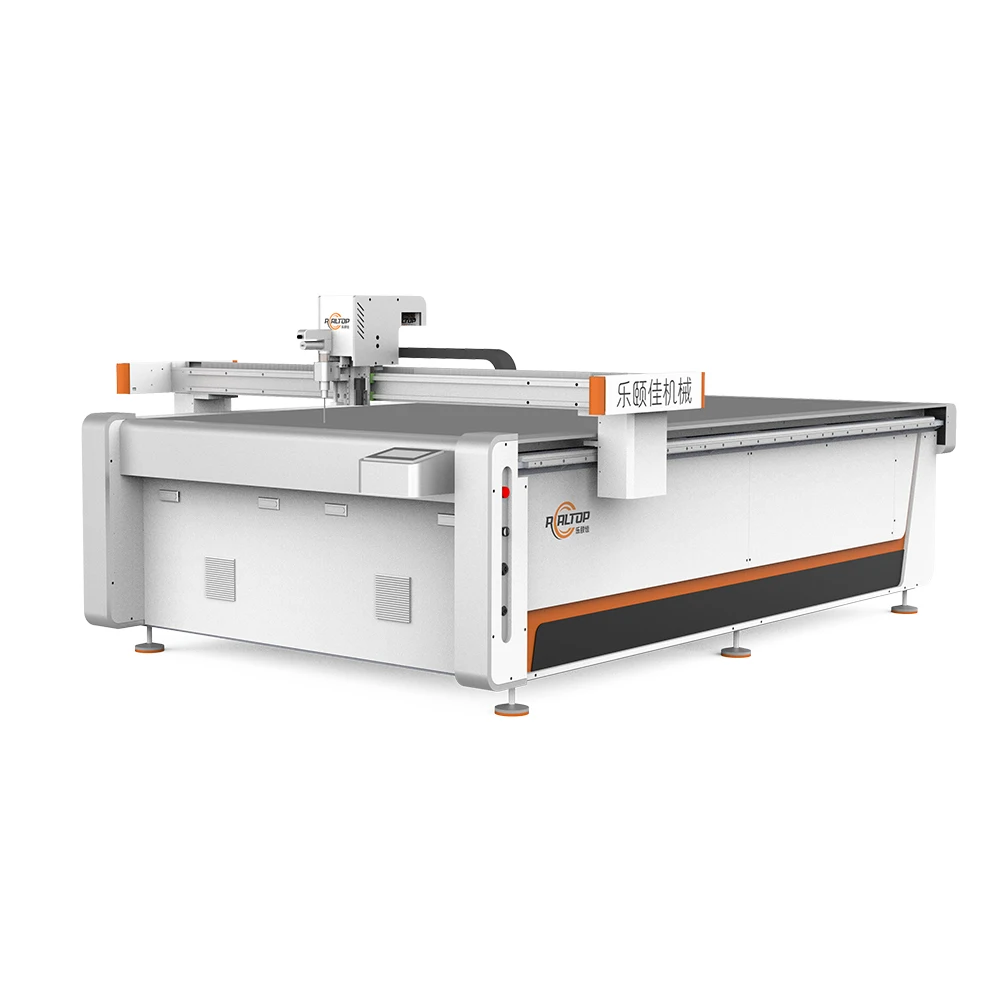
| Product Type | CNC Oscillating Knife Cutting Machine |
| Working Area | 1600 × 2500 mm |
| Tool Head Options | Oscillating knife, Driven rotary knife, Creasing wheel, Kiss cutting tool, Pneumatic knife, Milling tool, V groove knife |
| Cutting Speed | 0–2000 mm/s |
| Cutting Thickness | ≤ 30 mm (basis not stated in source — confirm with material and density) |
| Cutting Accuracy | ±0.1 mm |
| Vacuum Pump | 9 kW |
| Vacuum Table | Aluminum bellows vacuum table |
| Control System | PLC control panel |
| Servo Motors | Panasonic, Delta or Dorna options |
| Voltage Options | 110V, 220V, 380V (frequency to be confirmed per market) |
| File Format Support | PLT, DXF, AI, PDF |
| Safety Devices | Infrared sensor device and emergency stop |
| Machine Size | 3300 × 2100 × 1350 mm |
| Language Options | English, Russian, Italian, Chinese (special languages customizable) |
Application Suitability
| Application | Material or Output |
|---|---|
| Aerospace interior and structural trim | Carbon fiber prepreg, Nomex honeycomb core, thermal and acoustic insulation pads |
| Automotive and rail vehicle interiors | Headliners, floor carpets, acoustic felt, battery insulation sheets, damping pads |
| Wind energy blade manufacturing | Fiberglass cloth, vacuum infusion mesh, foam core preforms |
| Sporting goods fabrication | Bicycle frame prepreg layups, helmet liners, surfboard and kayak composite panels |
| Industrial gaskets and seals | PTFE sheets, rubber compounds, ceramic fiber blankets, G10 epoxy boards |
Why Material Thickness Alone Is the Wrong Starting Point for a Composites CNC Cutting Machine
The real question is what the material is made of, not just how thick it is.
I have watched buyers specify a flatbed cutter by working area and thickness capacity, then discover on the first production run that their carbon fiber prepreg delaminates under the standard oscillating blade, or that fiberglass cloth shifts despite full vacuum because the table zoning does not match their nest layout [NEED_CITE: delamination causes in dry and prepreg composite cutting]. A Composites CNC Cutting Machine for industrial application must be configured around the specific layup — resin content, weave direction, core structure and surface finish — before working area even enters the conversation. The thickness number on the spec sheet means very little if the tool head and blade geometry are wrong for the material chemistry.
Cold-Cutting Process Integrity for Resin-Based Laminates
Thermal cutting methods introduce heat into the cut zone, which can soften thermoplastic resins, char fiber edges or cause micro-delamination in prepreg stacks. The oscillating knife on this Composites CNC Cutting Machine for industrial application works by mechanical shearing at high frequency, keeping the cut zone at ambient temperature. That matters when you are cutting carbon fiber prepreg for aerospace fairings or battery insulation sheets for EV platforms, where any thermal alteration of the resin matrix changes the cure behavior downstream. Edge quality stays consistent through the full sheet without the operator adjusting for heat buildup mid-cut.
Tool Head Selection Across Rigid and Flexible Composite Stock
Rigid G10 epoxy boards and flexible fiberglass infusion mesh sit on opposite ends of the composite spectrum, yet both need to be processed on the same floor. The interchangeable tool head carriage accepts an oscillating knife for rigid laminates, a driven rotary knife for continuous cuts through flexible rolls, and a pneumatic knife for thicker foam cores [NEED_CITE: tool head selection guidelines for composite material types]. Switching between heads takes minutes, not a full tooling changeover, which keeps the production schedule intact when the job list mixes headliner felt one hour and carbon spar caps the next.
Reading the Spec Sheet for What It Actually Tells You
The 1600 × 2500 mm working area covers most automotive interior panels and wind blade preform sections in a single placement, reducing repositioning errors. The ±0.1 mm cutting accuracy holds tight enough for aerospace gasket stacks where assembly tolerances leave no margin for drift. The 9 kW vacuum pump paired with the aluminum bellows table delivers the holding force needed for thin fiberglass cloth that tends to lift at the trailing edge during high-speed passes. Servo drive options from Panasonic, Delta or Dorna let the buyer align the motion system with the brand already serviced by their local automation distributor, simplifying long-term parts supply.
What a Misconfigured Vacuum Zone Costs on the Production Floor
Vacuum table zoning that is too coarse for the part geometry means small composite gaskets and seal profiles lose hold-down at the edges, allowing the knife to pull the material instead of cutting it [NEED_CITE: vacuum hold-down requirements for small nested composite parts]. The result is frayed edges on fiberglass, shifted contours on prepreg laminates and scrapped nests that could have been saved with a finer zone grid. This failure rarely shows up during factory acceptance testing with standard sample materials, because the test pieces are usually larger than the buyer’s actual smallest part.
Why This Build Approach Works for Composite Production
In-house design covers both knife and laser cutting platforms, so the buyer gets a recommendation based on the material rather than a sales target for one technology. Every tool head and table configuration is specified against the buyer’s actual composite stock after sample cutting, not assumed from a general material category. Software file format compatibility — PLT, DXF, AI, PDF — is confirmed against the buyer’s existing nesting workflow before the order is placed. Voltage, plug type and control language are locked in during the specification stage, eliminating the common arrival-day surprise of a wrong plug or unreadable HMI.
Documentation & Verification
- Factory test record cut on your composite material with edge quality photographs before dispatch
- Machine specification sheet listing confirmed tool head, blade type and vacuum zone layout
- Electrical schematic with voltage and frequency matching your facility supply
- Software licence and file format compatibility note for your nesting workflow
- Spare parts list with blade specifications and replacement intervals for your material
Installation, Commissioning & Support
- Machine footprint of 3300 × 2100 mm requires a level concrete floor with clearance for material loading on two sides
- Dedicated circuit matching confirmed voltage option — 110V, 220V or 380V — with the agreed frequency and plug type
- Aluminum bellows vacuum table leveled and zone-tested on site with your smallest production part
- PLC control panel configured in the agreed language with file import verified against your nesting software
- Operator training covers blade change procedure, vacuum zone adjustment and daily belt tension check
- Spare blade inventory matched to your composite material type and recommended replacement schedule
Before You Request a Quote
Send a data sheet or physical sample of the composite material you need to cut, including resin type, fiber orientation and nominal thickness. Note your typical sheet size, daily volume and the smallest part in your nest pattern. Confirm your facility voltage, frequency and the control language your operators will need.
Frequently Asked Questions
Q: How is cutting thickness verified for my specific composite material and density?
A: Thickness capacity depends on material density and fiber content, not a single number. We run your actual composite sample through the machine and document the cut quality at your required thickness before confirming the configuration. If your material contains abrasive layers such as fiberglass or ceramic fiber, we also record blade wear rate to project replacement intervals.
Q: Which tool head matches rigid versus flexible composite materials?
A: Rigid boards such as G10 epoxy and carbon fiber sheet typically use the oscillating knife for clean mechanical shearing. Flexible materials like fiberglass cloth and infusion mesh are better suited to the driven rotary knife for continuous contour cuts. We confirm the correct tool head during sample cutting on your material.
Q: How does vacuum table zoning affect small composite part cutting?
A: If a zone is larger than the part sitting on it, vacuum leaks around the edges and holding force drops. The aluminum bellows table is zoned to match typical nest layouts. We test your smallest production part on the configured zone grid during factory acceptance to confirm the material stays flat through the full cut cycle.
Q: What file formats and nesting workflows are compatible?
A: The control software accepts PLT, DXF, AI and PDF files. Before the order is finalized, we verify that your existing nesting software exports a format the machine reads without manual rework, and confirm that contour recognition and tool path assignment function correctly with your file structure.
Q: What voltage and control language options are confirmed before shipment?
A: The machine is configurable for 110V, 220V or 380V supply. Frequency, plug type and control panel language are agreed during the specification stage and written into the order documents. We confirm all three against your facility data before production begins so no adjustment is needed on arrival.





商品评价
Clear filtersThere are no reviews yet.