




Custom tooling matched to material — Every gasket cutting machine configuration starts with a sample test on the buyer’s actual sealing stock, not a catalog guess.
Technical Specifications
| Parameter | Value |
|---|---|
| Model | RT-D2516/RT-S2516 |
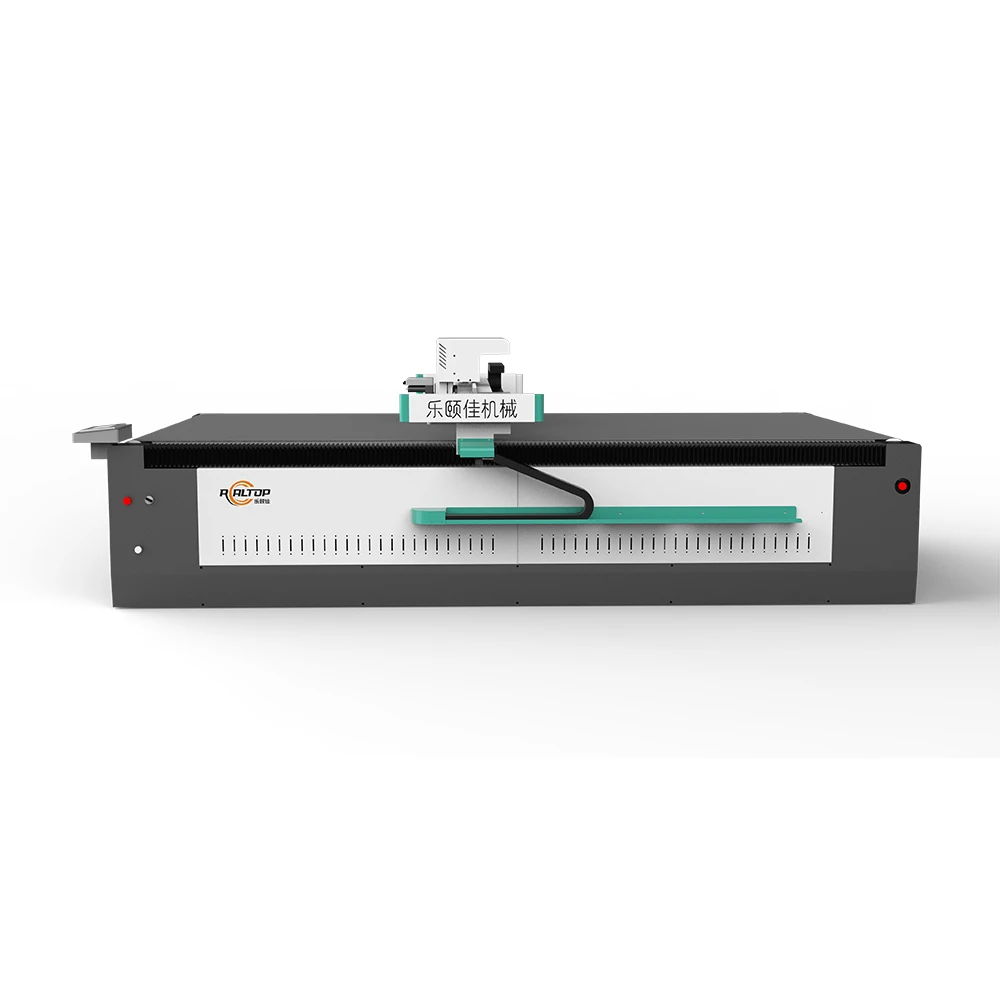
| Product Type | CNC Oscillating Knife Cutting Machine |
| Working Area | 1600 × 2500 mm |
| Machine Size | 3450 × 2300 × 1250 mm |
| Rated Power | 9 kW |
| Cutting Thickness Range | 20–80 mm depending on material density and compound |
| Repeated Positioning Accuracy | ≤0.1 mm |
| Translational Velocity | 800–1200 mm/s |
| Table Type | Flat vacuum working table |
| Vacuum Table Surface | Magnesium-aluminum alloy with PVDF powder coating, anodic and hard oxidation |
| Vacuum Pump | 7.5 kW |
| Multifunctional Head | Swiss imported knife with vibration full cut, half cut, and cursor location |
| Transmission System | Digital servo motor, linear guide, synchronous belt, ball screw |
| Servo Motor Brand | Delta |
| Linear Rail | Taiwan Hiwin |
| Conveyor Belt | Germany imported |
| Instruction System | HP-GL compatible format |
| Voltage | 380V ±10% |
| Safety Device | Infrared sensors |
| Certification | CE |
Application Suitability
| Application | Material or Output |
|---|---|
| Automotive sealing gasket production | Rubber, silicone, and composite sheet stock for engine bay and door seals |
| Industrial pipe and flange gaskets | PTFE, ETFE, and fiber-reinforced composite materials |
| HVAC duct and valve gaskets | Non-woven fiber, cork-rubber, and compressed aramid sheets |
| Plumbing and pump sealing pads | EPDM, nitrile rubber, and graphite-filled composite rolls |
| Electrical enclosure gaskets | Soft PVC, foam rubber, and closed-cell sponge profiles |
Why Working Area Alone Fails on Dense Gasket Stock
Specifying a gasket cutting machine on bed size without matching tool head and vacuum zoning to the actual compound is the most common procurement error in sealing pad production.
A buyer I worked with sourced a unit rated for 20 mm cutting depth on standard rubber. Their production floor was running glass-fiber-reinforced PTFE at 35 mm. The knife chatter destroyed blade life within days, and the edge quality forced manual trimming on every second piece. Working area was correct; the cutting system was not [NEED_CITE: tool head selection criteria for composite gasket materials].
Matching Knife Frequency to Gasket Compound Density
The RT-D2516/RT-S2516 ships with a Swiss imported oscillating knife head capable of both full cut and half cut vibration modes. Dense PTFE composites need high-frequency oscillation to shear through reinforced fibers without delaminating layers, while soft silicone gaskets require lower amplitude to avoid tearing the material edge. Selecting the wrong vibration mode produces ragged profiles that fail compression testing during assembly.
Vacuum Zoning That Holds Small Gasket Profiles Flat
The 1600 × 2500 mm magnesium-aluminum vacuum table is divided into independent zones. Small sealing pads — flange gaskets under 80 mm across — tend to lift at the trailing edge when a single large vacuum zone is active. Zoned suction concentrates hold-down force exactly where the knife is cutting. The PVDF-coated, hard-oxidized surface resists scoring from abrasive fiber compounds that would scar a standard aluminum table over repeated production runs.
Reading the Specs Beyond Nominal Values
The Delta servo system paired with Taiwan Hiwin linear rails delivers repeated positioning accuracy of ≤0.1 mm across the full working area. For multi-cavity gasket nests where bolt-hole patterns must align within tight tolerance, this repeatability keeps dimensional drift off the shop floor. The 7.5 kW vacuum pump generates the negative pressure needed to flatten rolled composite stock that arrives with memory curl from the supplier [NEED_CITE: vacuum hold-down requirements for curled gasket sheet stock]. Translational velocity reaches 800–1200 mm/s depending on path geometry and cut depth.
The Hidden Cost of a Wrong Configuration Spec
A gasket cutting machine quoted on working area and price alone often arrives with a generic drag knife, a single-zone vacuum, and no CCD mark recognition. The buyer then discovers their printed cutting templates cannot be tracked, forcing full reliance on digital nesting. When the material shifts during a long production run, scrap accumulates because the system cannot re-register to printed fiducials [NEED_CITE: CCD contour recognition reliability on printed gasket layouts]. Small parts lift without proper zoning, and blade consumption doubles because the tool head was never matched to the compound.
Why Sourcing This Equipment Through Realtop
In-house design covers both knife and laser cutting technologies, so a buyer cutting fiber-reinforced gasket sheets can choose oscillating knife for clean edge quality rather than forcing a thermal process. Tool head and table configurations are specified per material compound and daily production volume before the order is locked. CCD camera positioning is confirmed against the buyer’s actual printed layout, not assumed from a catalog feature list. Voltage and control language are verified for the destination market — whether 380V three-phase or a different standard [NEED_CITE: industrial voltage standards across export markets]. Sample cutting on the buyer’s own gasket material runs before any commitment is made.
Documentation & Verification
- Sample cutting report on your specific gasket compound and thickness before order confirmation
- Tool head and vacuum zone configuration list matched to your material type
- Electrical schematic and voltage confirmation document for your local power supply
- Software licence and HP-GL file format compatibility note for your existing nesting workflow
- Factory test record with dimensional measurement on your gasket profile before dispatch
- Operation and maintenance manual with spare parts list for consumable blades
Installation, Commissioning & Support
- Flat foundation with level tolerance to support 3450 × 2300 × 1250 mm machine footprint and vibration isolation
- Dedicated 380V ±10% three-phase circuit with sufficient capacity for 9 kW machine load plus 7.5 kW vacuum pump
- Table and gantry assembly on-site with rail alignment verified by installation technician
- First-run parameter tuning on your gasket material to establish baseline cutting speed and knife frequency
- Operator training covering HP-GL file import, nest layout, vacuum zone activation, and blade change procedure
- Scheduled blade and belt inspection intervals based on your material abrasiveness and daily runtime
Before You Request a Quote
Provide the exact gasket compound you run — rubber grade, PTFE composite, aramid fiber — along with the thickness range and maximum sheet or roll dimensions. Include your typical daily cutting volume and whether your layout workflow relies on printed mark recognition or digital-only nesting. State your local voltage and frequency so the electrical package is confirmed before production begins.
Frequently Asked Questions
Q: How is cutting thickness verified for my specific gasket material?
A: We run sample cuts on your actual compound at the thickness you specify. The test covers edge quality, dimensional accuracy, and knife wear across a full nest pattern. You receive a sample cutting report documenting results before any order is confirmed, so the tool head and knife frequency are matched to your material, not assumed.
Q: What vacuum table zoning is needed for small gasket profiles?
A: Small flange and valve gaskets under 80 mm require concentrated suction to prevent lift during the cut. The magnesium-aluminum table is divided into selectable zones activated only under the cutting head. This approach maintains hold-down on small profiles without wasting vacuum capacity across the full 1600 × 2500 mm bed.
Q: How does CCD contour recognition perform on printed gasket sheets?
A: The camera reads registration marks on your printed layout and adjusts the cutting path in real time. Performance depends on mark contrast and print quality, so we test with your actual printed sheets at production speed before confirming the configuration. Digital-only nesting is supported when printing is not part of your workflow.
Q: Which tool head handles dense PTFE versus soft rubber gaskets?
A: Dense PTFE and fiber-reinforced composites need the oscillating knife at high vibration frequency to shear through reinforcement without delamination. Soft rubber and silicone use lower amplitude or a drag knife to prevent edge tearing. The multifunctional head on the RT-D2516/RT-S2516 supports both modes and is configured after your material sample test.
Q: What software formats are supported for gasket nesting optimization?
A: The system accepts HP-GL compatible formats and integrates with common nesting software used in gasket production. We verify file format compatibility and nesting workflow against your existing CAD or nesting platform before the order, ensuring no data conversion bottleneck on your production floor.



商品评价
Clear filtersThere are no reviews yet.