




Tool Head Versatility — Seven configurable cutting heads matched to material behavior before order confirmation, preventing the forced-method compromises common in single-tool setups.
Technical Specifications
| Parameter | Value |
|---|---|
| Model | 1625 |
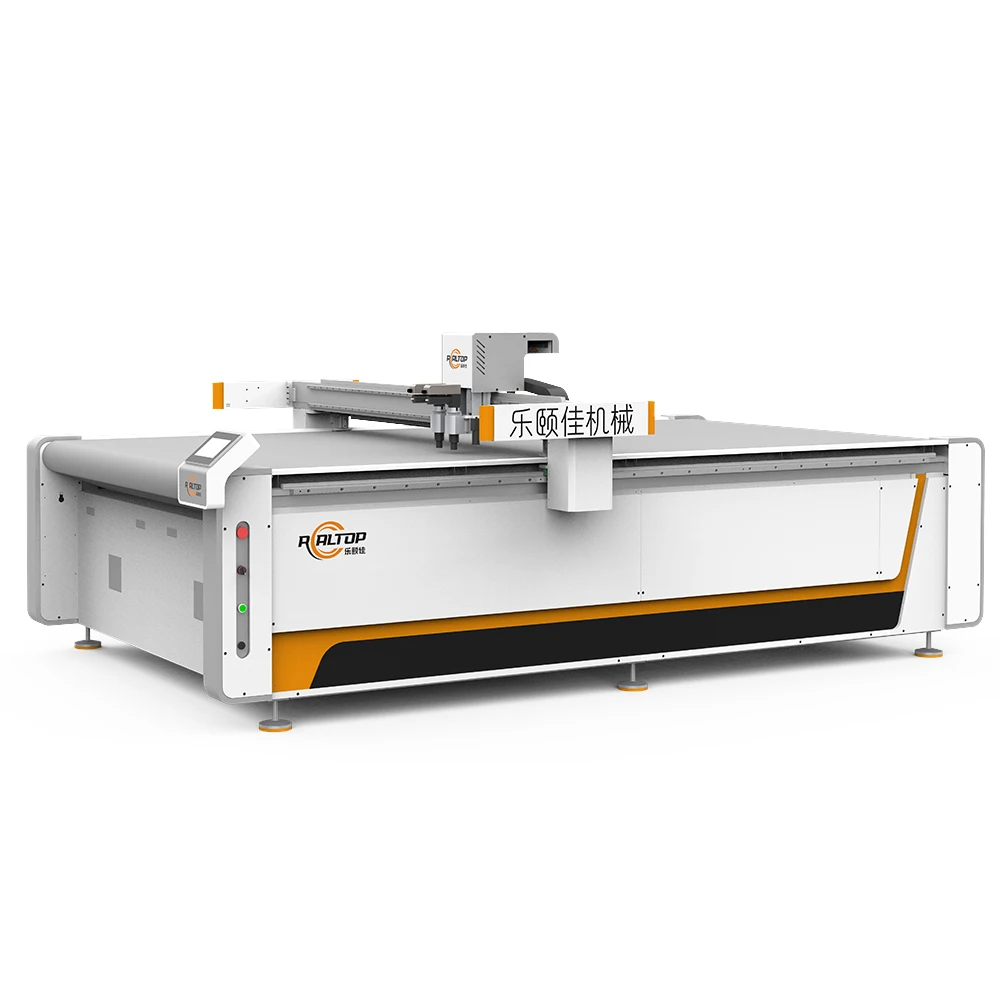
| Product Type | CNC Oscillating Knife Cutting Machine |
| Working Area | 1600×2500 mm |
| Tool Head Options | Oscillating knife, Driven rotary knife, Creasing wheel, Kiss cutting tool, Pneumatic knife, Milling tool, V-groove knife |
| Cutting Speed | 0–2000 mm/s |
| Cutting Thickness | ≤ 30 mm (basis not stated in source — confirm material type and density) |
| Cutting Accuracy | ±0.1 mm |
| Vacuum Table | Aluminum bellows vacuum table |
| Vacuum Pump | 9 kW |
| Control System | PLC control panel with intuitive interface |
| Servo Motor Options | Panasonic, Delta, Dorna |
| Supported File Formats | PLT, DXF, AI, PDF |
| Voltage Options | 110V, 220V, 380V |
| Software Language | English, Russian, Italian, Chinese (custom languages available) |
| Safety Devices | Infrared sensor device and emergency stop device |
| Machine Dimensions | 3300×2100×1350 mm |
| Certification | CE |
Application Suitability
| Application | Material or Output |
|---|---|
| Aerospace fabrication | Carbon fiber prepreg, aramid honeycomb, fiberglass cloth, ceramic fiber blankets, thermal and acoustic insulation foam |
| Automotive and rail interiors | Carbon fiber covers, FRP panels, acoustic felt, damping pads, carpets, sealing strips |
| Wind power and new energy | Fiberglass cloth, carbon fiber cloth, vacuum infusion mesh, foam core materials, insulating materials |
| Sporting goods manufacturing | Carbon fiber sheets and fabric, fiberglass, Kevlar, high-performance foam, composite fabrics |
| Advertising and signage | PVC sheets, acrylic boards, vinyl, foam board |
| Packaging sample making | Cardboard, corrugated carton, folding box stock |
| Gasket and sealing production | PTFE, rubber compounds, foam gasket stock |
Why Material Thickness Claims Fail on the Shop Floor
A stated cutting depth means nothing without the material grade and density attached to it.
Buyers often receive a quotation listing 30 mm cutting capacity and assume that figure applies uniformly across every stock they run. In practice, high-density rubber composite and closed-cell foam behave completely differently under the same oscillating knife stroke. A tool head that slices cleanly through 25 mm of soft EVA may crush or delaminate a 15 mm carbon fiber prepreg panel. [NEED_CITE: material density effects on oscillating knife cutting depth] The only reliable verification is a sample cut on your actual material, with the tool head, vacuum hold-down, and feed rate all set to production conditions before any purchase commitment is made.
Cold-Cutting Integrity Across Composite Layups
Thermal processes like laser or plasma introduce heat-affected zones that alter resin cure states in prepreg materials and melt synthetic fiber edges. The CNC oscillating knife cutting machine for industry application avoids this entirely by using mechanical shear force at controlled frequencies. Carbon fiber prepreg and aramid honeycomb retain their original matrix properties after cutting, which matters when downstream processes like autoclave curing or vacuum infusion depend on consistent material behavior. The aluminum bellows vacuum table holds flexible composite sheets flat without localized stress points that could shift fibers during the cut.
Nesting Yield and Multi-Material Workflow
Production environments rarely run a single material all day. A gasket shop might cut PTFE in the morning and rubber compound in the afternoon, while an automotive interior supplier switches between acoustic felt and damping pads across shifts. The 1625 platform accommodates this by supporting seven tool head types that can be swapped or specified at order, so the machine configuration follows the production schedule rather than forcing material choices to fit a fixed tool. Software compatibility with PLT, DXF, AI, and PDF files means nesting layouts prepared in third-party CAD systems import directly, preserving yield calculations already validated by the production team. [NEED_CITE: nesting software compatibility in digital cutting workflows]
How Core Parameters Shape Daily Output
The ±0.1 mm cutting accuracy becomes critical in gasket and sealing work, where a flange gasket that deviates beyond tolerance causes leaks under pressure. For signage producers cutting contoured vinyl letters, this same tolerance keeps registration tight when multi-color layers must align. The 9 kW vacuum pump paired with an aluminum bellows table generates sufficient hold-down force for large-format sheets, but zoning matters equally: small parts cut from a full sheet can lift if the vacuum zone is larger than the part footprint, so zone configuration should match the typical part size distribution in your nesting layouts. Servo motor selection — Panasonic, Delta, or Dorna — influences acceleration behavior and positional repeatability at the upper end of the 2000 mm/s speed range, particularly on tight corner contours where inertia management separates clean cuts from jagged edges.
The Hidden Cost of Specifying by Working Area Alone
Choosing a machine based solely on bed size is the most common procurement mistake in flatbed cutting equipment. A 1600×2500 mm table fits the sheet size, but if the vacuum zoning is designed for large panels and you mostly cut small gaskets or signage letters, parts will shift during the final passes. [NEED_CITE: vacuum table zoning requirements for small-part digital cutting] Wrong tool head selection produces ragged edges on fabric or crushed foam cores, forcing secondary trimming that erodes the throughput the machine was purchased to deliver. Voltage and plug mismatches discovered after arrival mean weeks of downtime while transformers or adapters are sourced locally, and control panels in an unsupported language turn routine parameter adjustments into guesswork.
Why Production Teams Source This Configuration Here
In-house design covers both knife and laser cutting technologies, so the cutting method is matched to your material rather than forcing every job through one process. Tool head and table configuration is specified per material type and production volume before the order is finalized, not substituted with generic defaults during assembly. CCD camera positioning is available for printed contour work where registration marks must be tracked at production speed. Software compatibility is confirmed against your existing file formats and nesting workflow before the machine enters production. Voltage, control language, and plug type are locked in during the specification stage, not left as assumptions. Sample cutting on your own material runs before shipment, so edge quality and cutting depth are verified under factory test conditions rather than promised on paper.
Documentation & Verification
- Machine specification sheet covering all seven tool head options and their material compatibility ranges
- Electrical schematic confirming voltage, phase, and plug type for your facility before dispatch
- Tool head and table configuration list matched to your stated material and production volume
- Sample cutting report produced on your supplied material with edge quality photographs
- Factory test record documenting accuracy verification and vacuum hold-down performance
- Software license and file format compatibility note confirming PLT, DXF, AI, and PDF import capability
Installation, Commissioning & Support
- Foundation must support 3300×2100×1350 mm footprint with level tolerance for vacuum table sealing integrity
- Dedicated circuit required matching confirmed voltage option — 110V, 220V, or 380V with correct phase
- Machine ships fully assembled; positioning and utility connection are the primary on-site tasks
- First-run parameter tuning covers tool head selection, vacuum zone mapping, and cutting speed calibration
- Operator training addresses PLC interface navigation, file import workflow, and tool change procedures
- Spare parts list identifies oscillating knife blades, rotary knife consumables, and vacuum table seals
What to Include in Your Inquiry
Provide the specific materials you cut, including type, density, and maximum thickness, along with typical sheet dimensions and daily volume targets. Share your local voltage and frequency standards, preferred control panel language, and any existing nesting software or file formats your workflow depends on. If your production involves printed contour cutting or multi-layer composite layups, note those requirements so the correct positioning and tool head configuration can be included in the sample cutting test.
Frequently Asked Questions
Q: How is cutting thickness verified for my specific composite or gasket material?
A: We run a sample cut on your actual supplied material using the recommended tool head and vacuum settings. The sample cutting report documents edge quality, dimensional accuracy, and maximum achievable thickness under production conditions. This test happens before order commitment, so you see real results rather than generic capacity claims.
Q: Which tool head is recommended for my material — and how does that affect edge quality?
A: Tool head selection depends on material composition and thickness. Oscillating knives suit most composites and foams, driven rotary knives handle fabrics, and V-groove knives address packaging creasing. We specify the correct head during the sample cutting stage, documenting edge quality so you can compare options before finalizing the configuration.
Q: How does vacuum table zoning handle small parts without material lift?
A: The aluminum bellows vacuum table is configured with zones matched to your typical part sizes. Small gaskets or signage letters need localized vacuum zones to prevent lift during final cutting passes. We review your nesting patterns during the specification stage and set zoning accordingly before factory testing.
Q: Can the control panel and software language be confirmed before shipment?
A: Yes. The PLC control panel language and software interface are set during order confirmation. Available options include English, Russian, Italian, Chinese, and custom languages. We document the confirmed language in the specification sheet so there are no surprises when the machine arrives at your facility.
Q: What is the workflow for sample cutting and factory test before I commit?
A: You send representative material samples to our facility. We configure the tool head, vacuum table, and cutting parameters, then run production-speed cuts. You receive a sample cutting report with photographs and dimensional data. If results meet your requirements, the same configuration is locked in for your machine build.




商品评价
Clear filtersThere are no reviews yet.