


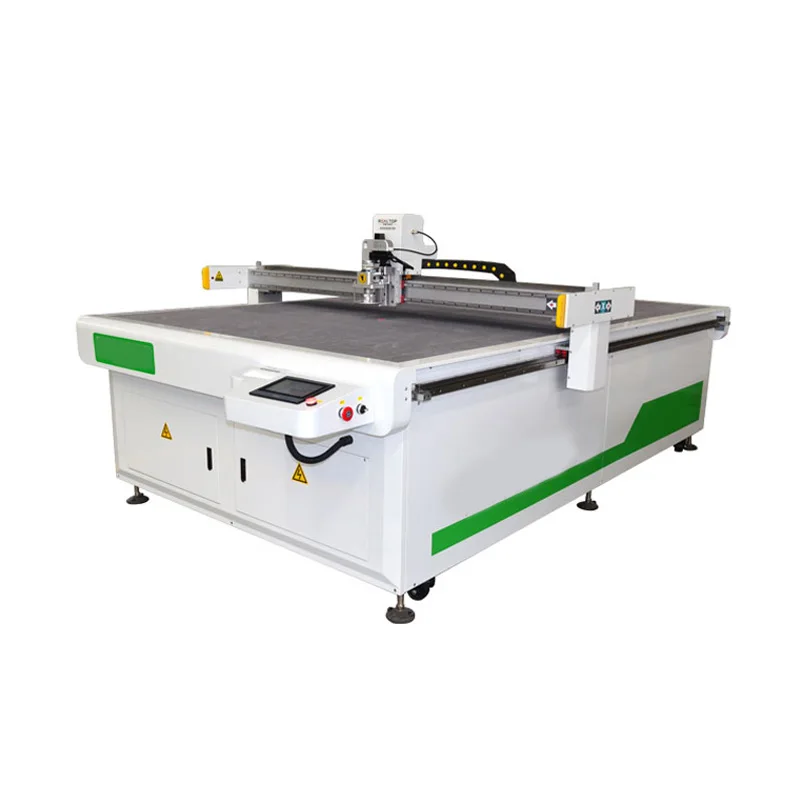

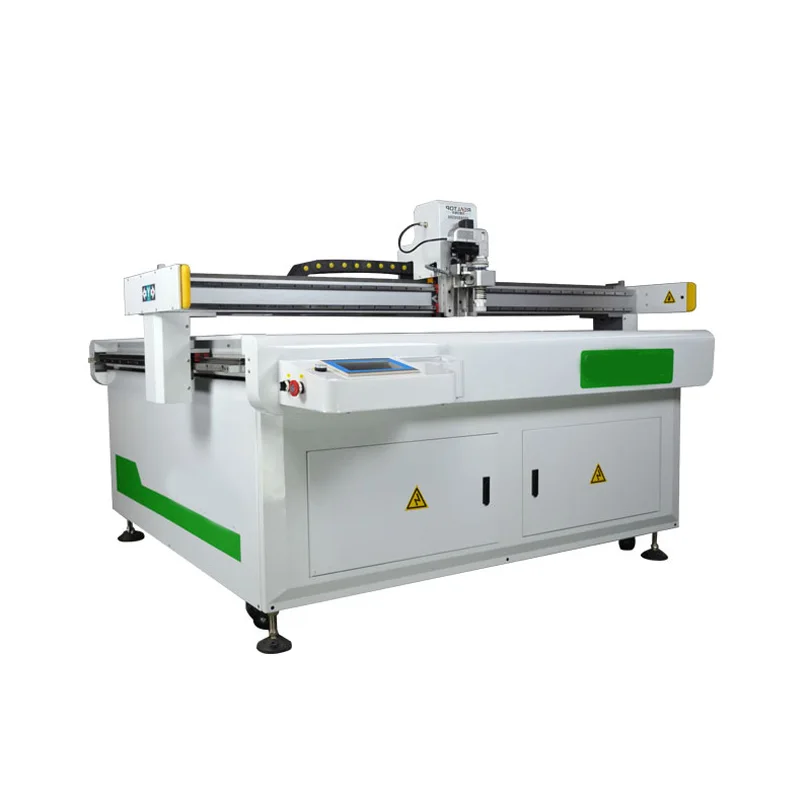

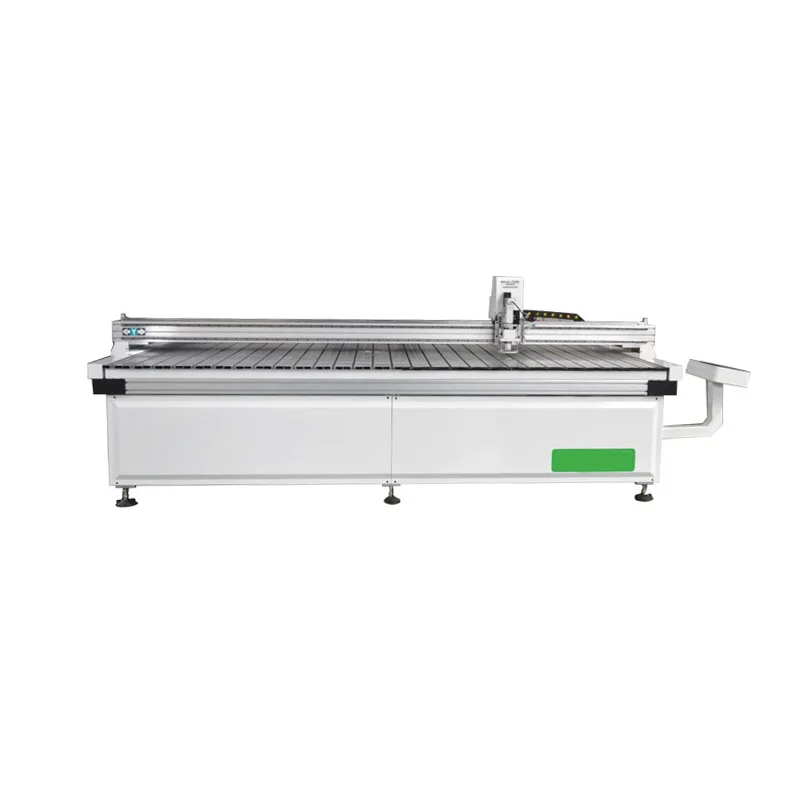


Precision Configuration Mapping — every tool head and vacuum zone is specified against the buyer’s actual board grade, flute profile and thickness before the order is finalized.
Technical Specifications
| Parameter | Value |
|---|---|
| Model | RT-D2516/RT-S2516 |
| Product Type | CNC Flatbed Digital Cutting Machine |
| Working Area | 1600×2500 mm |
| Overall Dimensions (L×W×H) | 3450×2300×1250 mm |
| Rated Power | 9 kW |
| Voltage | 380V ±10% (frequency to be confirmed before shipment) |
| Working Table Type | Flat working table with vacuum hold-down |
| Tool Head | Swiss imported knife with vibration full cutting, vibration half cutting and cursor location function |
| Translational Velocity | 800–1200 mm/s |
| Cutting Speed | 200–800 mm/s (varies according to material type and thickness) |
| Repeated Accuracy | ≤0.1 mm |
| Transmission System | Digital servo motor, linear guide, synchronous belt, ball screw (imported) |
| Servo Motor | Japanese Yaskawa |
| Linear Guide | Taiwan Hiwin rail |
| Conveyor Belt | Germany imported |
| Vacuum Pump | 7.5 kW |
| Auto Feeding | Equipped |
| Safety Device | Infrared sensors |
| Instruction System | HP-GL compatible format |
| Control Language | To be confirmed before shipment |
| CCD Camera | To be confirmed if equipped |
| Software & File Formats | HP-GL compatible (additional formats to be confirmed) |
Application Suitability
| Application | Material or Output |
|---|---|
| Packaging sample making | Corrugated board, folding carton stock, cardstock, micro-flute |
| Short-run carton production | Single-face and double-wall corrugated, grey board |
| Display and POP prototyping | Foam board, honeycomb paper, rigid and flexible substrates |
| Leather and footwear patterns | Genuine leather, synthetic leather, composite sheet stock |
| Garment and textile cutting | Woven and knit fabric layers, technical textiles |
| Flexible material processing | Sponge, composite leather, PVC, soft glass, silicone, rubber |
| Advertising and signage | Acrylic board, foam PVC, self-adhesive vinyl |
What Board Thickness Actually Means for Your Packaging CNC Cutting Machine Production Line
A working area tells you where the sheet fits — the tool head, vacuum zoning and cutting speed tell you whether it cuts cleanly.
When a packaging shop orders a flatbed cutter based only on table size, the first production run often exposes the gap. Three-ply grey board behaves nothing like E-flute corrugated, and a knife configured for one will crush or rag the other. I saw this firsthand when a customer’s carton creases came out torn because the vibration knife was set for a lighter stock than what they were actually running [NEED_CITE: material thickness and tool head configuration matching in packaging sample making]. The daily output drops, the sample quality fails client review, and the machine sits idle while the right tooling ships.
This CNC packaging sample cutting machine production line addresses that gap by tying configuration directly to the board grades and flute types in your actual job queue. The 1600×2500 mm working area accommodates full packaging sheets, and the Swiss imported oscillating knife handles both full-cut and half-cut operations. But those specs only matter when matched to your specific material profile — which is why sample cutting on your own board stock happens before any configuration is locked in.
How the Cutting Workflow Serves Packaging Sample Turnaround
Packaging sample making lives and dies by turnaround speed. A designer sends a CAD file in the morning and expects a folded, creased carton blank by afternoon for client approval. The RT-D2516/RT-S2516 supports that tempo with translational velocities reaching 800–1200 mm/s and an auto-feeding system built on a Germany-imported conveyor belt. Sheets load continuously, which means the operator spends time managing the job queue rather than wrestling with material alignment on the table.
The flat working table with vacuum hold-down keeps corrugated and cardstock pinned through every cut and crease pass. When a sheet lifts even slightly during a half-cut crease line, the result is a fold that tears instead of bending cleanly — a sample that fails the client’s structural review and forces a re-run [NEED_CITE: vacuum hold-down requirements for corrugated board cutting]. The 7.5 kW vacuum pump and infrared safety sensors form the baseline environment that lets the cutting head do its job without material drift or operator risk.
Production Yield and Material Waste in Short-Run Packaging
Short-run carton production occupies a difficult position in packaging: too few units to justify a die tool, but enough volume that material waste accumulates quickly if cuts are imprecise. The repeated accuracy of ≤0.1 mm on this machine keeps nested carton blanks within tolerance, so each sheet yields the maximum number of usable pieces. For shops running custom box orders where every sheet of double-wall corrugated costs real money, that precision translates directly into fewer rejected blanks and less stock sent to recycling.
The HP-GL compatible instruction system accepts files from common packaging CAD platforms, which means the nesting layout designed in software reaches the cutting table without reformatting errors. When file translation corrupts a crease line or shifts a cut path by even a fraction of a millimeter, the entire sheet can be wasted. Confirming software and file format compatibility before the order — not after installation — is a step that protects material yield from day one.
Why Servo Drive and Linear Motion Matter for Crease Quality
The Japanese Yaskawa digital servo motor paired with Taiwan Hiwin linear rails is not simply a parts list — it defines how the knife behaves at the moment of direction change. Crease lines on carton blanks require the knife to start, stop and reverse within fractions of a millimeter. A servo that lags or a rail with play produces creases that wander off the intended fold line, resulting in boxes that do not close square. The imported ball screw and synchronous belt complete the motion chain, ensuring that the cutting speed of 200–800 mm/s remains consistent regardless of path complexity.
For packaging shops cutting intricate carton formats with tight radii and multiple internal crease lines, this drive configuration maintains the repeated accuracy of ≤0.1 mm across the entire 1600×2500 mm work envelope. The 9 kW rated power delivers sufficient energy for sustained cutting passes through thicker board grades without torque drop at low speeds — a common cause of incomplete cuts in corrugated material.
The Real Cost of Skipping Material-Based Configuration
Choosing the wrong tool head for your board grade does not show up in the quotation — it shows up on the first production day. A vibration knife configured for thin cardstock will not penetrate three-ply grey board cleanly, leaving crushed fibers along the cut edge and torn crease lines that weaken the carton structure. The reverse is equally costly: an aggressive oscillating setting on lightweight folding carton stock tears the surface and produces feathered edges that fail client visual inspection.
Vacuum table zoning presents a similar trap. Small carton blanks cut from a full sheet can lift at the edges if the vacuum zones are sized for larger formats [NEED_CITE: vacuum table zoning for small packaging blanks]. When that happens mid-cut, the entire sheet is scrapped. These failures are not machine defects — they are configuration errors that sample cutting on the buyer’s own material would have prevented.
What Distinguishes This Machine in a Packaging Production Environment
The in-house design team covers both knife cutting and creasing tooling, so the configuration is matched to packaging board grades rather than forcing one tool head across incompatible materials. Tool head and creasing wheel options are specified per material and production volume before the order is confirmed.
Sample cutting on the buyer’s own board grade, flute profile and thickness is completed before commitment, producing a cutting report that shows actual edge quality and crease integrity. Software compatibility with the buyer’s existing packaging CAD workflow is verified at the order stage, not after installation. Voltage and control language customization for the target market is confirmed before shipment, preventing the delays and rewiring costs that arise from mismatched electrical specifications [NEED_CITE: voltage and frequency standards by export market].
Documentation & Verification
- Machine specification sheet with confirmed voltage and frequency for your local supply
- Tool head and creasing wheel configuration list matched to your board grades
- Sample cutting report on your actual packaging material before order commitment
- Software licence and file format compatibility note for your CAD platform
- Electrical schematic with circuit layout for your installation team
- Operation and maintenance manual in your confirmed control language
Installation, Commissioning & Support
- Floor space allocation based on 3450×2300×1250 mm overall dimensions plus material handling clearance
- Dedicated 380V circuit rated for 9 kW machine power plus 7.5 kW vacuum pump
- Auto-feeding conveyor alignment and vacuum zone calibration during on-site commissioning
- Infrared safety sensor testing and emergency stop verification before first production run
- Operator training on tool head changeover between cutting and creasing operations
- Spare oscillating knife blades and consumable parts list provided at handover
Before You Request a Quotation
Send the specific board grades, flute profiles and thicknesses you run most often, along with a typical carton blank layout showing the largest sheet size in your workflow. Confirm your local voltage and frequency, the language you need for the control interface, and which packaging CAD software generates your cutting files. If you are integrating this machine into an existing production line with upstream printing or downstream folding, share the sheet dimensions and feed direction so the auto-feeding configuration aligns with your current material flow.
Frequently Asked Questions
Q: What board grades, flute types and thicknesses can this machine cut and crease?
A: The RT-D2516/RT-S2516 handles corrugated board across common flute profiles, cardstock, folding carton stock and grey board. Actual cutting depth depends on the oscillating knife configuration and material density. We run a sample cut on your exact board grade and thickness before finalizing the tool head and creasing wheel setup, so you see real edge and crease quality on your own material before committing.
Q: How does the auto-feeding system integrate with upstream printing and downstream folding?
A: The Germany-imported conveyor belt feeds sheets continuously from the infeed side. Integration depends on your existing equipment’s sheet dimensions, feed height and transfer direction. Share your upstream printer output specs and downstream folder infeed requirements during the inquiry stage so the conveyor height and feed speed can be configured to match your line without manual sheet transfer bottlenecks.
Q: What software file formats does the instruction system accept from packaging CAD platforms?
A: The instruction system is HP-GL compatible, which covers output from many packaging CAD platforms. If your design software exports in DXF, AI or other vector formats, confirm compatibility during the order stage. We verify file import and nesting workflow against your actual software before shipment, preventing format translation errors that waste material on the first production run.
Q: How is vacuum table zoning configured for small carton blanks to prevent material lift?
A: The 7.5 kW vacuum pump supplies the flat working table, and zoning configuration depends on the smallest blank size in your typical nesting layout. Small carton blanks cut from large sheets can lift at unsealed zones if the table is configured only for full-format hold-down. During the sample cutting stage, we test your actual nesting pattern to confirm that vacuum distribution prevents lift across all blank sizes in the layout.
Q: What is the daily sample throughput for typical folding carton and corrugated box formats?
A: Throughput depends on the complexity of the cut path, the number of crease lines per blank, the board thickness and the nesting density on each sheet. Translational velocity reaches 800–1200 mm/s with cutting speeds between 200–800 mm/s depending on material. Share your typical carton blank geometry and daily sample volume so we can project realistic output based on your actual job mix rather than generic cycle estimates.


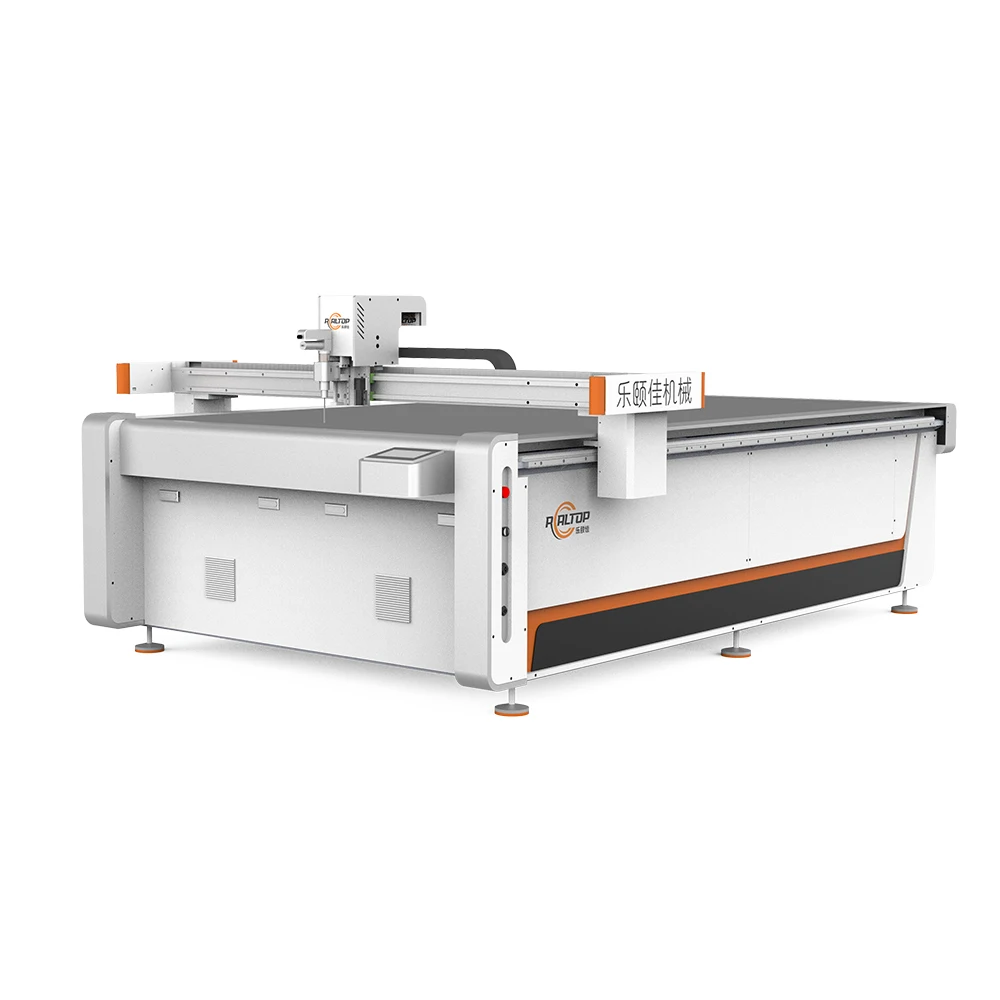


商品评价
Clear filtersThere are no reviews yet.