




Production-Ready Configuration — Every tool head, vacuum zone, and software parameter is verified against your actual fabric roll before the machine leaves the factory, eliminating on-site rework.
Technical Specifications
| Parameter | Value |
|---|---|
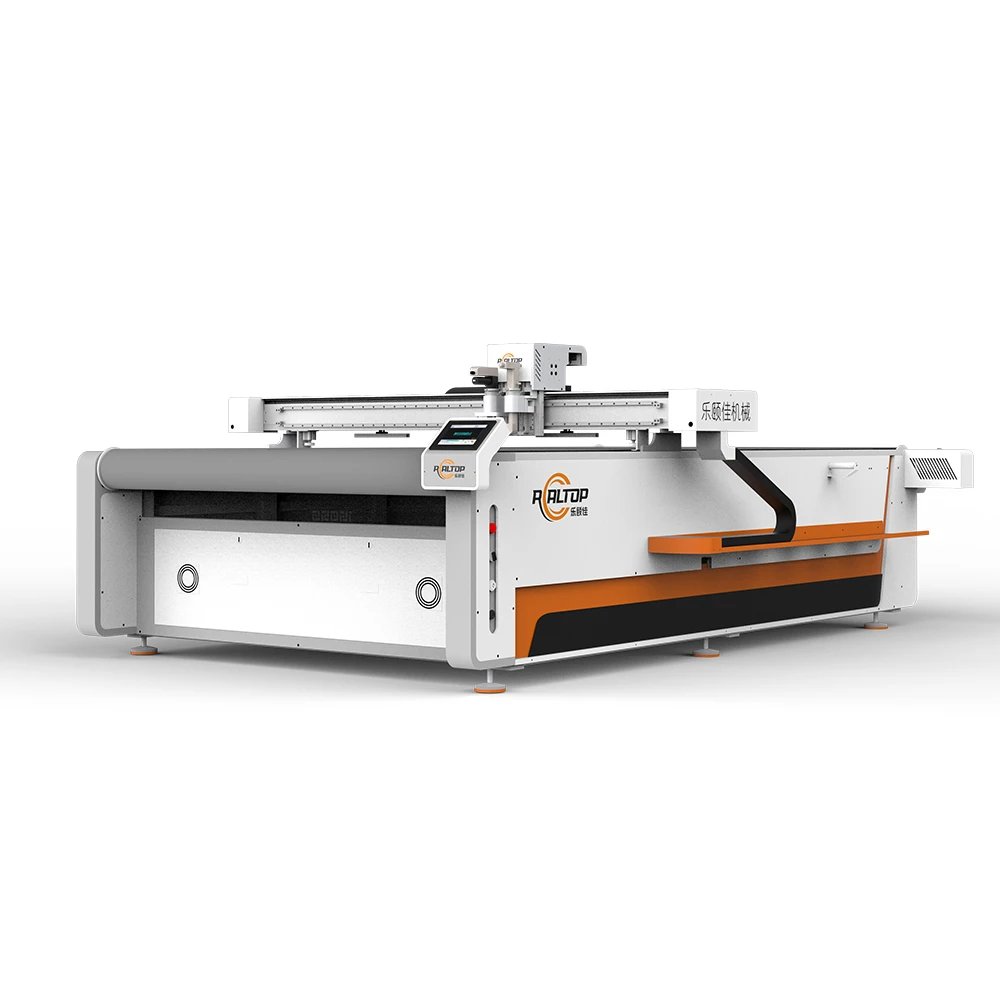
| Product Type | CNC Oscillating Knife Cutting Machine |
| Working Area | 1600×2500 mm |
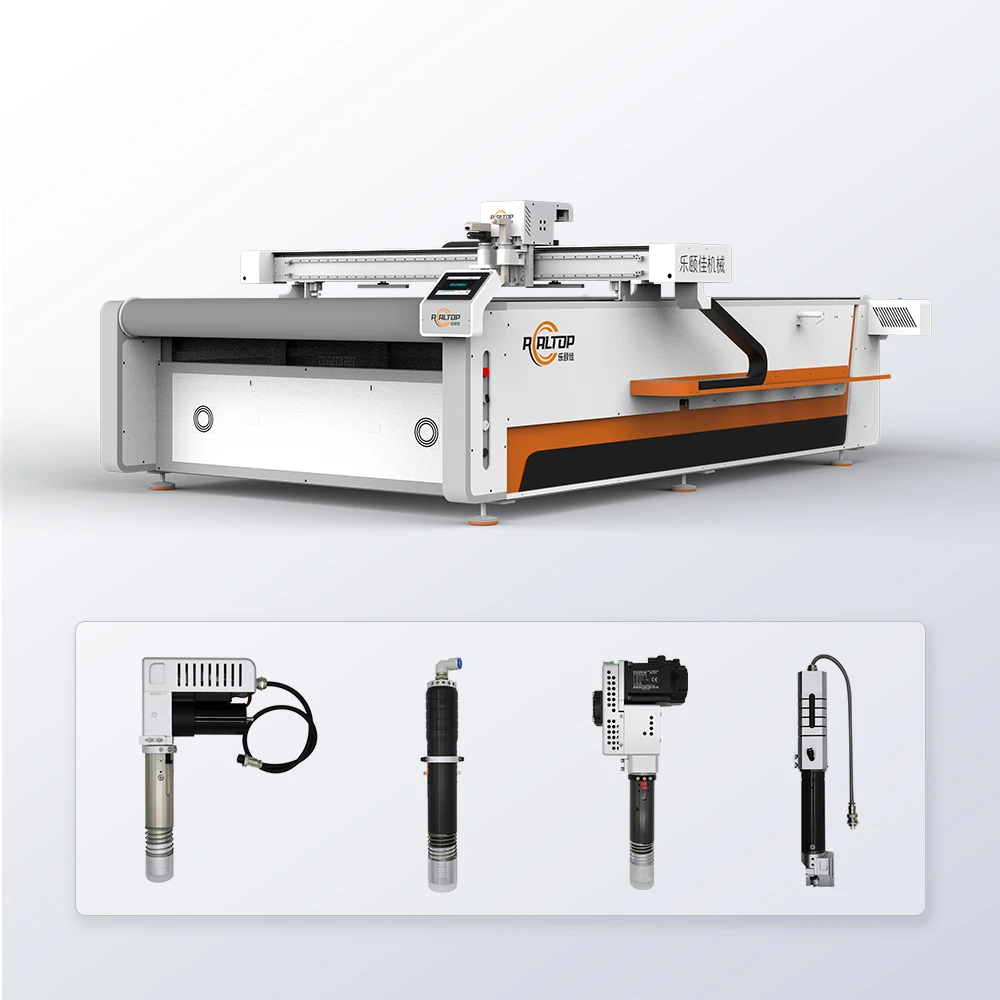
| Available Tool Heads | Oscillating knife, Driven rotary knife, Creasing wheel, Kiss cutting tool, Pneumatic knife, Milling tool, V groove knife |
| Cutting Speed | 0–2000 mm/s |
| Cutting Thickness Capacity | ≤ 30 mm (basis to be confirmed based on fabric type and layer density) |
| Positioning Accuracy | ±0.1 mm |
| Vacuum Pump Power | 9 kW |
| Control Interface | PLC control panel with intuitive interface |
| Servo Motor Options | Panasonic, Delta, Dorna |
| Vacuum Table Construction | Aluminum bellows vacuum table |
| Voltage Options | 110V, 220V, 380V |
| Compatible File Formats | PLT, DXF, AI, PDF |
| Safety Devices | Infrared sensor device and emergency stop device |
| Language Support | English, Russian, Italian, Chinese, custom languages available |
| Machine Dimensions | 3300×2100×1350 mm |
| Applicable Materials | Fabric, Cardboard, Carton, Mats, PVC, EVA, Leather, Acrylic, Foam, PTFE, Rubber |
| Standards Compliance | CE |
Application Suitability
| Application | Material or Output |
|---|---|
| Apparel pattern cutting | Suit fabrics, knitwear, lace, delicate textiles requiring fray-free edges |
| Automotive interior production | Seat fabrics, carpets, PVC floor mats needing burr-free contours |
| Home textile manufacturing | Sofa upholstery fabrics, heavy curtains, area rugs in multi-layer stacks |
| Composite material processing | Carbon fiber prepreg, aramid fabrics, specialty technical textiles |
| Promotional and banner production | Vinyl, PVC sheets, and printed fabrics requiring contour recognition |
Why "2000 mm/s" Means Nothing Without the Right Tool Head
A Cloth CNC Cutting Machine for production line integration delivers throughput only when the oscillation frequency and blade geometry match your specific fabric weave and weight.
Buyers often fixate on maximum travel speed and working area, then discover the machine cannot hold a clean edge on their actual material. A high oscillation frequency that slices through denim cleanly will shred delicate lace or melt synthetic blends. Conversely, a blade profile optimized for light knuckles produces ragged, crushed edges when it encounters heavy canvas or multi-layer upholstery stacks. The result is secondary trimming, rejected panels, and production downtime that no speed specification predicted [NEED_CITE: oscillation frequency and blade selection for textile cutting].
Tool Head Selection Across Textile Weights
The available tooling range addresses the full spectrum of fabric cutting challenges encountered on the shop floor. An oscillating knife handles standard apparel textiles and light upholstery, where vertical vibration produces a clean shear cut without fraying the weave. For heavier technical materials or tightly woven composites, a driven rotary knife maintains continuous cutting pressure through the stack, preventing delamination between layers. A pneumatic knife variant provides adjustable downward force, which is critical when processing compressible foams or padded laminates where static blade pressure would distort the material before cutting. Selecting the correct Cloth CNC Cutting Machine for production line workflow begins with mapping each tool head to your most common fabric categories.
Vacuum Zoning and Material Hold-Down
A 9 kW vacuum pump generates the suction necessary to immobilize fabric across the 1600×2500 mm aluminum bellows table surface, but uniform hold-down depends on how the table is zoned. Large, uninterrupted panels like automotive carpet blanks require full-table vacuum engagement to prevent edge lift during high-speed contour cuts. Small apparel pieces—collar stays, pocket flaps, or intricate lace motifs—demand localized zones that concentrate suction directly beneath the part footprint. Without adequate zoning, the vacuum dissipates across unoccupied table area, allowing small parts to shift and producing dimensional inaccuracies that exceed the ±0.1 mm positioning tolerance [NEED_CITE: vacuum table zoning effects on small part accuracy].
Decoding the Specification Sheet for Real Production Impact
The cutting thickness specification of ≤ 30 mm carries significant variance depending on fabric density and layer count. A loosely woven cotton might compress to thirty layers within that limit, while a dense, resin-impregnated aramid may only permit a single or double ply. The servo motor selection—Panasonic, Delta, or Dorna—determines acceleration characteristics and long-term positioning repeatability under continuous duty cycles. File format compatibility with PLT, DXF, AI, and PDF profiles ensures the Cloth CNC Cutting Machine for production line deployment integrates with existing pattern design software without requiring intermediate conversion steps that introduce dimensional errors. Voltage configurability across 110V, 220V, and 380V systems prevents the costly discovery, after shipment, that the local power supply cannot support the machine’s draw.
The Cost of Underspecified Configurations
Ordering a machine based solely on working area and maximum speed creates hidden costs that surface weeks after installation. Insufficient vacuum zoning for your typical part geometry causes small pieces to lift and shift, generating scrap and requiring manual re-cuts that erode daily throughput. A single tool head specified for your lightest material will struggle with heavier production runs, forcing operators to reduce speed manually and negating the advertised cutting rate. Software that cannot import your existing nesting files forces patterns to be redrawn or converted, introducing errors and consuming engineering hours that delay production starts [NEED_CITE: cost of misconfigured CNC cutting equipment].
Why Production Managers Source From This Build
In-house design and production across both knife cutting and table fabrication means the tool head recommendation is based on material behavior, not on which single machine is available. The vacuum table zoning is configured per buyer specification rather than shipped as a generic full-table default, ensuring hold-down matches actual part sizes. Software compatibility with your DXF, PLT, AI, or PDF workflow is confirmed during the pre-order phase, not discovered as an incompatibility after arrival. Voltage, plug type, and control language are validated against your facility requirements before the machine enters final assembly. Sample cutting on your own fabric rolls—sent to the factory before commitment—provides physical evidence of edge quality and dimensional accuracy under your specific conditions.
Documentation & Verification
- Electrical schematic confirming voltage, phase, and plug type for your destination market
- Tool head and table zone configuration list matched to your submitted fabric samples
- Factory test record documenting cut quality on your material before crating
- Software license and file format compatibility note for your nesting workflow
- CE declaration documentation for customs clearance and regulatory compliance
- Spare parts list with wear-item part numbers for local procurement planning
Installation, Commissioning & Support
- Floor space planning around the 3300×2100 mm footprint with clearance for material loading
- Dedicated circuit provision matching confirmed 110V, 220V, or 380V requirements
- Leveling and assembly of the aluminum bellows vacuum table sections on-site
- First-run parameter tuning of oscillation frequency and vacuum zones on your fabric
- Operator training on PLC control panel functions in your selected language
- Consumable blade inventory and replacement schedule based on your production volume
Preparing Your Inquiry for Accurate Quotation
Provide the specific fabric types, weights, and layer counts your operation processes daily to receive a tool head and vacuum zone recommendation that matches reality. Include your local voltage, phase, and frequency specifications along with preferred control language to prevent post-shipment configuration mismatches. Share sample nesting files or pattern layouts so software compatibility and throughput estimates can be evaluated before order placement.
Frequently Asked Questions
Q: How does cutting thickness capacity vary across different fabric types and layer configurations?
A: The ≤ 30 mm specification depends entirely on material density and compressibility. A lightweight knit might allow dozens of layers within that limit, while a dense technical textile may only permit one or two plies. Sample cutting on your actual fabric rolls, sent before order commitment, establishes the realistic layer count and tool head configuration for your production environment.
Q: What file formats and nesting software integrate with your existing design workflow?
A: The system accepts PLT, DXF, AI, and PDF profiles directly, eliminating intermediate conversion that introduces dimensional errors. Software compatibility is verified during the pre-order phase using your actual nesting files to confirm that import, toolpath generation, and material optimization functions operate correctly with your existing pattern libraries.
Q: How does vacuum table zoning affect small part cutting in apparel and textile applications?
A: Localized vacuum zones concentrate suction directly beneath small part footprints like collar stays or pocket flaps, preventing the material lift that occurs when a single full-table zone dissipates suction across unoccupied areas. Zone configuration is specified during the order process based on your typical part geometry to maintain the ±0.1 mm positioning accuracy.
Q: What is the sample cutting and material testing process before order commitment?
A: You send actual production fabric rolls to the factory, where they are cut using the recommended tool head, oscillation frequency, and vacuum zone configuration. A sample cutting report documents edge quality, dimensional accuracy, and achievable layer count, providing physical evidence that the Cloth CNC Cutting Machine for production line deployment meets your quality standards before the machine is built.
Q: Which tool head configuration is optimal for my specific fabric type and production volume?
A: Oscillating knives suit standard apparel textiles, driven rotary knives handle heavy or composite materials, and pneumatic knives adjust downward force for compressible foams. The recommendation is based on your submitted fabric samples and daily volume requirements, not on a generic default configuration applied across all buyer orders.





商品评价
Clear filtersThere are no reviews yet.