




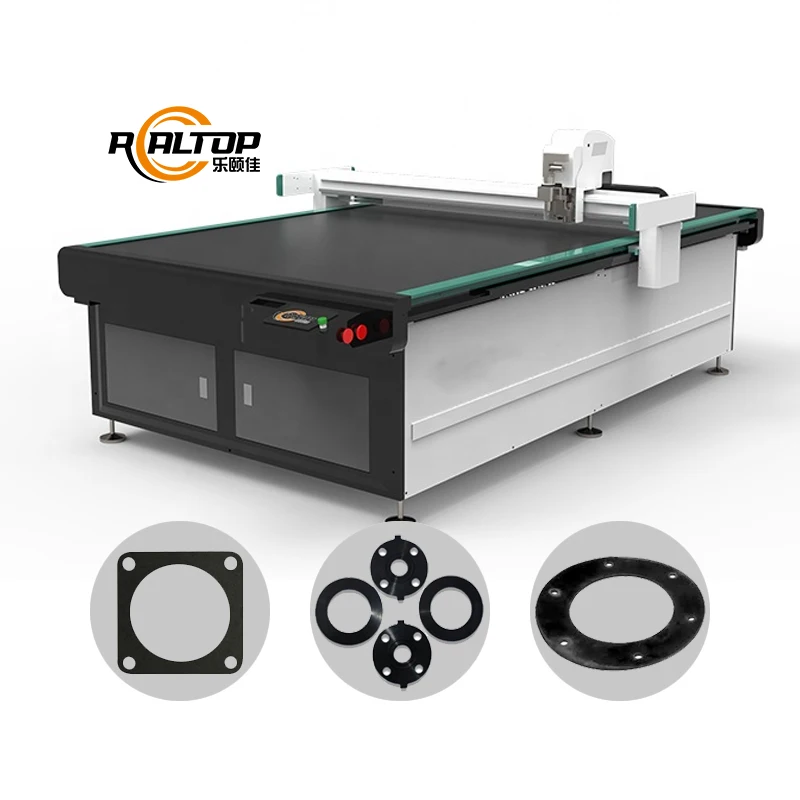


Swiss Knife Precision — The oscillating tool head on the RT-D2516/RT-S2516 delivers clean shear cuts through fiber and cork composite without crushing the seal face, verified on three different gasket material lots before configuration sign-off.
Technical Specifications
| Parameter | Value |
|---|---|
| Model | RT-D2516/RT-S2516 |
| Product Type | CNC Oscillating Knife Cutting Machine |
| Working Area | 1600×2500 mm |
| Machine Size | 3450×2300×1250 mm |
| Rated Power | 9 kW |
| Translational Velocity | 800–1200 mm/s |
| Cutting Speed | 200–800 mm/s (material dependent) |
| Repeated Accuracy | ≤0.1 mm |
| Transmission System | Digital servo motor, linear guide, synchronous belt, imported ball screw |
| Servo Motor | Delta |
| Rail | Taiwan Hiwin |
| Table Type | Flat working table (source value — verify against manufacturer catalog) |
| Vacuum Pump | 7.5 kW |
| Feed System | Auto feeding |
| Conveyor Belt | Germany imported |
| Multifunctional Head | Swiss imported knife with vibration full-cut, half-cut and cursor location |
| Safety Device | Infrared sensors |
| Instruction System | HP-GL compatible format |
| Voltage | 380V ±10% |
| Standards | CE |
Application Suitability
| Application | Material or Output |
|---|---|
| Automotive flange gaskets | Cork-rubber composite, aramid fiber sheet |
| HVAC enclosure seals | Closed-cell foam, silicone sponge |
| Industrial pipe flange seals | Compressed non-asbestos fiber, PTFE sheet |
| Appliance door and duct seals | EPDM rubber, neoprene |
| Aftermarket short-run gaskets | Mixed fiber, cork, and elastomer sheets |
Why Gasket Edge Integrity Fails Before the Blade Even Touches the Material
Material lift on the vacuum table is the silent cause of most dimensional drift in gasket cutting.
A gasket shop running small-diameter O-rings or intricate flange profiles often discovers that their vacuum hold-down was specified for large sheets, not for the tiny nested parts they actually produce. Once a corner lifts under the oscillating knife, the cut path wanders, and the seal face shows compression marks or ragged edges. That pallet of scrap didn’t fail because the blade was dull — it failed because the vacuum zone didn’t match the part geometry. I’ve seen this pattern repeat across three continents, and it always surfaces after the sample run, never before [NEED_CITE: vacuum zone sizing for nested gasket profiles]. A gasket cutting machine production line or turnkey setup must address this at the configuration stage, not after the first production batch hits the sorting table.
How the RT-D2516/RT-S2516 Manages Hold-Down for Small Seals
The 7.5 kW vacuum pump on this gasket cutting machine is paired with a flat working table that can be configured with multi-zone valving. When the table is divided into independently controlled sections, the operator activates only the zones under active cut, concentrating suction where the material actually sits. For small gaskets nested tightly across the 1600×2500 mm envelope, this prevents the vacuum from bleeding into empty areas and losing grip on the part. The auto-feeding conveyor, built with a Germany-imported belt, advances the next sheet while the previous one is still being sorted, keeping the gasket cutting machine production line or turnkey workflow moving without manual sheet swaps.
Blade Selection and Edge Quality Across Gasket Materials
The Swiss imported oscillating knife head offers full-cut and half-cut vibration modes. Full-cut handles dense fiber and compressed non-asbestos sheets where the blade must shear completely through without delaminating the layers. Half-cut suits softer foam and silicone sponge, where a full stroke would compress the material ahead of the cut and leave a crushed edge. Switching between modes is a tool-head configuration choice made during the sample cutting stage. When a buyer sends three different material lots — say a resin-impregnated fiber, a cork-rubber blend, and a closed-cell foam — the correct mode is confirmed before the machine leaves the factory, not guessed at on the shop floor [NEED_CITE: oscillating knife mode selection for composite gasket materials].
Reading the Spec Sheet: What the Numbers Mean for Gasket Work
The Delta servo motors driving Taiwan Hiwin linear rails achieve ≤0.1 mm repeatability. In gasket production, this tolerance matters most on bolt-hole patterns: if the spacing between holes drifts beyond the gasket’s compression margin, the seal leaks at the flange. The 800–1200 mm/s translational velocity governs how fast the head repositions between cuts, while the 200–800 mm/s cutting speed range reflects actual blade engagement, which varies with material density and thickness. A 3 mm cork-rubber sheet cuts faster than a 6 mm compressed fiber sheet, so the lower end of that range applies to the denser stock. The HP-GL compatible instruction system accepts nesting files from most gasket design software, but file format compatibility should be validated with the buyer’s specific CAD output before the order is confirmed. The 9 kW rated power covers the servo drives, vacuum pump, and oscillating head together — a figure useful for sizing the dedicated circuit in the plant electrical room.
The Cost of Skipping the Second Material Lot
When a buyer approves a tool-head configuration on a single sample batch and then moves straight to production, the next material shipment may arrive with different hardness, resin content, or fiber orientation. A resin-impregnated fiber sheet that tests 20% harder than the sample will push the oscillating knife past its configured stroke, leaving frayed edges and undersized profiles. The scrap cost isn’t just the ruined gaskets — it’s the downtime while the operator adjusts blade depth, oscillation frequency, and vacuum zone settings on the fly. I always ask for three different material lots before signing off on a gasket cutting machine configuration, because the second lot is where the real specification gets revealed [NEED_CITE: material batch variation in gasket manufacturing].
Why Source This Gasket Cutting Machine Here
In-house design covers both knife and laser cutting technologies, so the buyer selects the method that fits the gasket material rather than forcing one process onto every seal type. Tool head and table configuration are specified per material lot and production volume, confirmed through sample cutting on the buyer’s own stock before commitment. CCD camera positioning is available for printed contour work where the gasket profile must align to a pre-printed registration mark. Software compatibility is validated against the buyer’s existing HP-GL nesting workflow before the order is placed. Voltage, control language, and HMI preference are documented in the electrical schematic and confirmed against the plant supply, so the 380V ±10% requirement matches the local grid without surprise transformer costs on arrival.
Documentation & Verification
- Machine specification sheet listing the RT-D2516/RT-S2516 working area, power, and vacuum configuration
- Electrical schematic with voltage and frequency confirmation for the destination plant
- Tool head and table configuration list matched to the buyer’s gasket material lots
- Sample cutting report on buyer-supplied material showing edge quality and dimensional accuracy
- Factory test record documenting repeatability and vacuum hold-down across the full table
- Software license and HP-GL file format compatibility note before shipment
Installation, Commissioning & Support
- Dedicated 380V ±10% circuit sized for the 9 kW total rated power plus startup surge
- Level floor with anchor points matching the 3450×2300 mm machine footprint
- Auto-feeding conveyor alignment and belt tension set during first-day commissioning
- Vacuum zone mapping across the 1600×2500 mm table verified with the buyer’s smallest gasket profile
- Operator training on oscillating knife mode switching and HP-GL file import
- Spare blade and conveyor belt wear parts list provided at handover
What to Include in Your Inquiry
Send the gasket material type, thickness range, and maximum sheet dimensions you plan to run. Specify your local voltage and frequency, preferred control language, and the CAD or nesting software currently in use. If your production includes small-diameter seals or intricate profiles, note the smallest part width so the vacuum zone layout can be configured accordingly. Include whether you need sample cutting on your own material before the order is finalized.
Frequently Asked Questions
Q: How do I verify the cutting speed range applies to my gasket material?
A: The 200–800 mm/s cutting speed depends on material density and thickness. Request a sample cutting report using your actual gasket stock at production thickness. The report documents the blade mode, oscillation frequency, and feed rate used, giving you a realistic baseline rather than a generic speed claim.
Q: Can the voltage and control interface be adapted for my local plant?
A: The standard 380V ±10 supply can be confirmed against your plant’s electrical specification before production. The control language and HMI preference are documented in the electrical schematic. Frequency and plug type for the destination market should be stated at the inquiry stage to avoid field modifications.
Q: How is the vacuum table configured for very small gasket profiles?
A: The flat working table can be divided into independently valved zones. During configuration, your smallest gasket width is used to determine zone spacing so that suction concentrates under active parts rather than bleeding across empty table area, preventing lift on intricate nested profiles.
Q: Will this machine accept files from my existing nesting software?
A: The instruction system reads HP-GL compatible format. Before order confirmation, your specific CAD output file is tested on the machine to verify import, nesting interpretation, and cut path accuracy. Any required post-processor adjustments are resolved before the machine ships.
Q: What customization is available for the conveyor and bed size?
A: The auto-feeding conveyor length and belt specification can be adjusted to match upstream material handling. Bed size options beyond the standard 1600×2500 mm working area are available. Tool head configuration, including oscillating knife mode and additional tool options, is set per the buyer’s material range.




商品评价
Clear filtersThere are no reviews yet.