




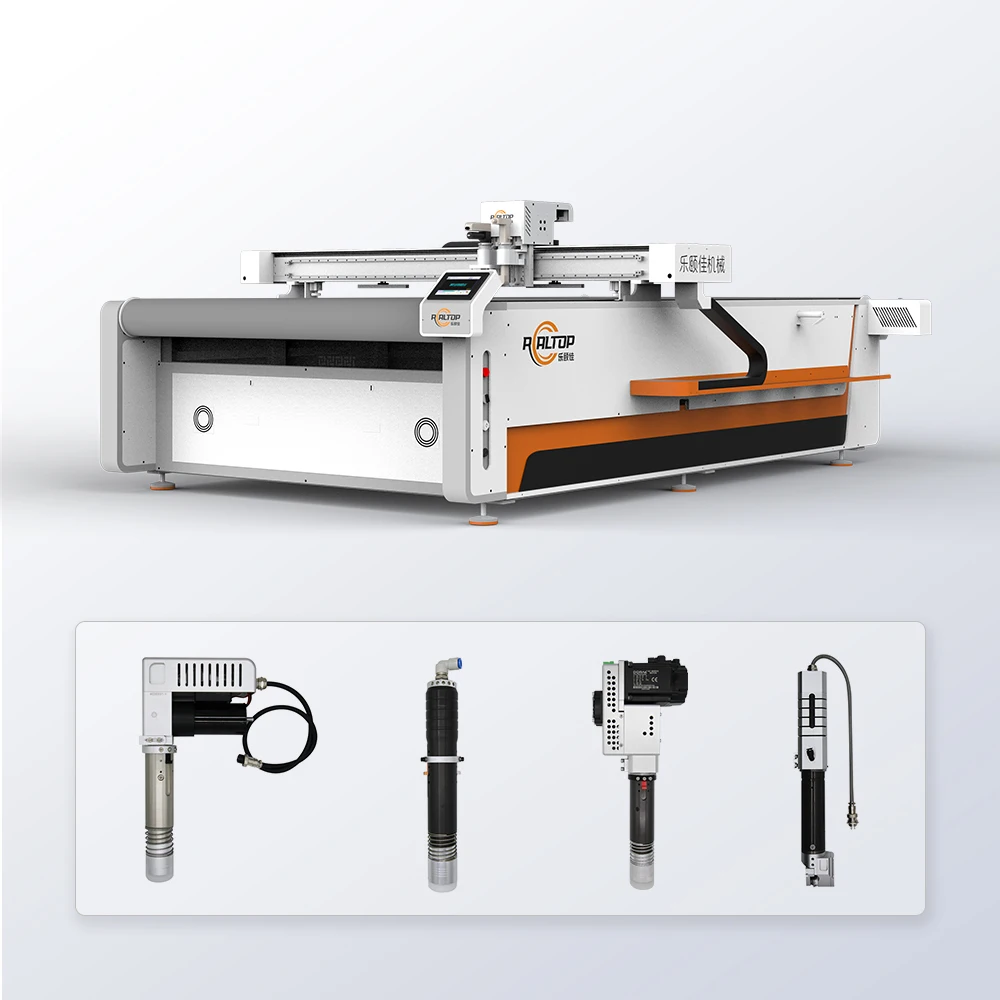
Cutting Method Matched to Material — we specify the oscillating knife, driven rotary or creasing tool based on your fabric type, coating and layup rather than selling one head for every job.
Technical Specifications
| Parameter | Value |
|---|---|
| Product Type | CNC Oscillating Knife Cutting Machine |
| Working Area | 1600×2500 mm |
| Tool Head Options | Oscillating knife, Driven rotary knife, Creasing wheel, Kiss cutting tool, Pneumatic knife, Milling tool, V groove knife |
| Applicable Materials | Fabric, Cardboard, Carton, Mats, PVC, EVA, Leather, Acrylic, Foam, PTFE, Rubber |
| Cutting Speed Range | 0–1500 mm/s |
| Maximum Cutting Thickness | ≤ 40 mm (basis to be confirmed with material and density) |
| Cutting Accuracy | ±0.1 mm |
| Vacuum Pump | 9 kW |
| Voltage Options | 110V, 220V, 380V |
| Supported File Formats | PLT, DXF, AI, PDF |
| Safety Devices | Infrared sensor, Emergency stop |
| Machine Dimensions | 3300×2100×1350 mm |
| Control System | PLC control panel |
| Servo Motor Brands | Panasonic, Delta, Dorna (options available) |
| Software Languages | English, Russian, Italian, Chinese; custom languages available |
| Vacuum Table | Aluminum bellows vacuum table with high flatness and seal |
| Compliance | CE |
Application Suitability
| Application | Material or Output |
|---|---|
| Garment and footwear cutting | Multi-layer woven fabric, fleece, velvet, non-woven textiles |
| Packaging and carton sample making | Corrugated cardboard (E-flute, B-flute, BC-flute), greyboard, cardstock, art paper |
| Automotive interior and gasket production | Leather, synthetic leather, EVA/EPE/PU foam, rubber mats |
| Signage and advertising board | PVC sheets, PET, thin plastic, foam board |
| Composite and foam fabrication | Adhesive-backed composites, PTFE, layered foam panels |
| Leather goods manufacturing | Genuine and synthetic leather, coated textiles |
Why "Standard Fabric" Trials Miss the Real Production Job
A clean cut on cotton tells you nothing about how the machine handles coated or abrasive layers.
I once configured a cloth cutting line for a buyer who sent a standard polyester swatch for testing. The trial went perfectly. Two weeks into production we discovered the actual material was a PU-coated composite used for automotive headliners — the blade dulled within days and the edges came out frayed. Output dropped sharply and the line fell behind schedule [NEED_CITE: material variability impact on blade wear and edge quality in composite textiles]. That gap between the sample and the real roll is where most CNC oscillating knife cutting machine for garment and packaging production purchases fail. The failure is rarely the machine itself — it is the assumption that one tool head, one vacuum setting and one feed rate cover every fabric that will eventually cross the table.
Tool Head Selection Defines the Edge, Not the Speed Dial
Every fabric reacts differently to blade geometry and oscillation frequency. A plain woven cotton accepts a standard oscillating knife cleanly, but a dense velvet or a non-woven insulation batt tears under the same setup. Driven rotary knives handle continuous long cuts on single-ply technical textiles where the oscillating head would chatter, while the creasing wheel is essential when the same corrugated board must fold without cracking. The configuration decision happens before the machine is built — swapping heads after delivery means downtime and recalibration.
Vacuum Zoning Decides Whether Small Parts Stay Flat
A 1600×2500 mm table holding a full lay of multi-layer fabric needs uniform suction across its surface. When the layout nests small pattern pieces — collar tabs, gussets, gasket rings — a poorly zoned vacuum bed lets edges lift at high traverse speeds, producing miscuts and scrapped panels [NEED_CITE: vacuum hold-down requirements for small nested parts on flatbed cutting tables]. The aluminum bellows table on this unit is divided into zones that can be activated or isolated to match the active cutting area, so a small batch of leather shoe uppers holds as firmly as a full spread of garment panels.
Reading the Spec Sheet Against Your Actual Material Flow
The 0–1500 mm/s cutting speed range is achievable on thin, homogeneous textiles. Once you introduce a three-layer composite with an adhesive interlayer or a 20 mm EVA foam sheet, the effective speed must come down to maintain the ±0.1 mm accuracy and prevent delamination. The 9 kW vacuum pump is sized for continuous duty across the full table area, but its real performance depends on zone selection and seal condition — a worn bellows gasket on one quadrant undermines hold-down across the adjacent zones [NEED_CITE: vacuum pump capacity and zone sealing effect on flatbed cutting accuracy]. The PLC panel supports multiple display languages, which matters when the operator in your overseas workshop does not read the default interface. File formats PLT, DXF, AI and PDF are accepted, but confirming that your nesting software exports cleanly into one of these before ordering avoids a costly software mismatch at commissioning.
The Cost of Guessing the Configuration Before the Material Arrives
Choosing a single oscillating knife head for a product mix that includes both apparel fabric and corrugated samples means one of those jobs will produce poor edges. The blade wears faster on abrasive cardboard, shortening change intervals and increasing consumable spend. On foam and rubber, insufficient vacuum zoning lets the material shift mid-cut, and the scrap rate climbs without an obvious cause [NEED_CITE: scrap rate causes from vacuum zoning mismatch in flatbed digital cutting]. Buyers who skip the material-specific sample test almost always discover the mismatch after the machine is bolted to their floor, when returns and reconfiguration cost far more than a week of upfront trials.
Why This Manufacturer Fits Production Buyers
In-house design covers both knife and laser cutting technologies, so you are not forced into one method when the material demands the other. Each tool head and vacuum table configuration is specified against your material type, thickness and daily volume rather than sold from a fixed catalogue page. CCD camera positioning is available for printed contour work where registration marks must be tracked at production speed. Software compatibility — file format export, nesting workflow, language — is confirmed before the order is released to production. Voltage, plug type and control panel language are locked in before shipment, matching the electrical standards of the destination market. Every unit ships with a sample cutting report run on the buyer’s own material, not a generic factory swatch.
Documentation & Verification
- Machine specification sheet listing configured tool heads and vacuum zone layout
- Electrical schematic with confirmed voltage and plug type for destination market
- Tool head and table configuration list matched to your material and thickness
- Sample cutting report produced on your actual fabric or board before shipment
- Software licence with file format compatibility note for your nesting workflow
- Operation and maintenance manual in the confirmed operator language
Installation, Commissioning & Support
- Floor space planning based on the 3300×2100×1350 mm machine footprint plus material staging area
- Dedicated electrical circuit sized for the selected voltage option and 9 kW vacuum pump draw
- Assembly and leveling of the aluminum bellows vacuum table on-site to maintain flatness specification
- First-run parameter tuning of oscillation frequency and feed rate against your delivered material samples
- Operator training on the PLC panel in the confirmed display language with nesting software workflow
- Spare blade and bellows gasket kit included to cover the initial production period
Before You Send the Inquiry
Share the exact material type, coating or laminate structure, sheet dimensions and the number of layers you plan to cut in a single pass. Tell us your target daily output and the shift pattern of the line this machine will join. Confirm the local voltage and frequency standard so the electrical build matches your workshop supply before the unit leaves the factory.
Frequently Asked Questions
Q: How do I verify cutting speed and thickness against my specific fabric or foam?
A: Send a sample of your actual production material — including any coating or laminate — for a cutting test. The resulting report documents achievable speed, edge quality and maximum single-pass thickness on your specific layup, not a generic reference fabric. This eliminates the gap between catalogue speed and your real output.
Q: Which tool head should I choose for my material mix?
A: Oscillating knives suit most woven and knitted fabrics. Driven rotary knives handle continuous single-ply technical textiles. Creasing wheels are necessary for corrugated and cardstock folding lines. If your production spans multiple material families, the machine accepts multiple heads configured to your product list before delivery.
Q: How does vacuum table zoning prevent small-part lift?
A: The aluminum bellows table is divided into independently controlled zones. When cutting small nested pieces, only the active zone runs at full suction, concentrating hold-down force where the head is working. This keeps lightweight fabric edges and thin gasket blanks flat even at higher traverse speeds.
Q: What file formats and nesting workflows are supported?
A: The system accepts PLT, DXF, AI and PDF files. Before order confirmation, we verify that your existing nesting software exports cleanly into one of these formats so there is no workflow interruption or additional software purchase required at commissioning.
Q: How are voltage, language and plug type customized for my market?
A: Voltage is configurable across 110V, 220V and 380V options. The PLC panel display language is set to your choice from English, Russian, Italian, Chinese or a custom language. Plug type is confirmed during the specification stage to match local electrical standards before the machine is wired at the factory.





商品评价
Clear filtersThere are no reviews yet.