


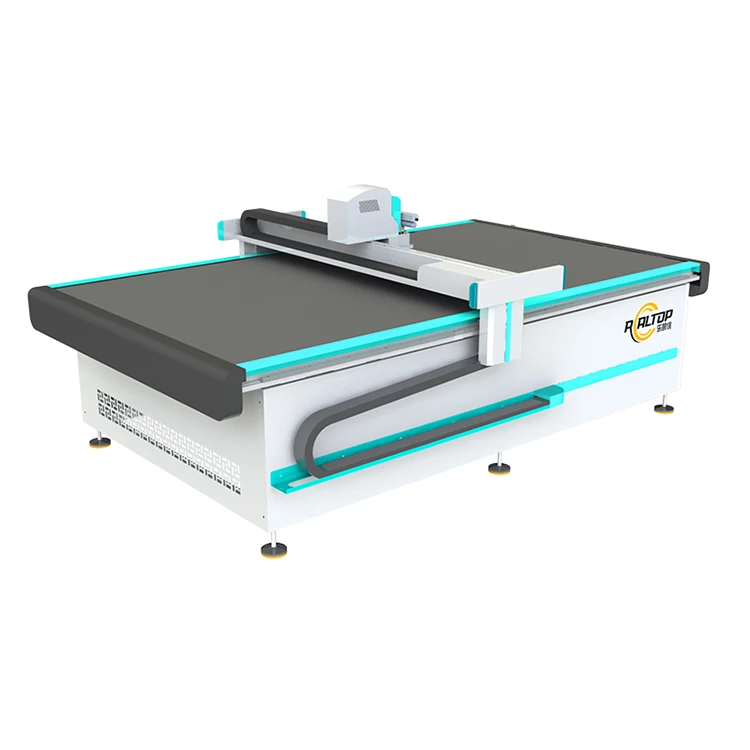

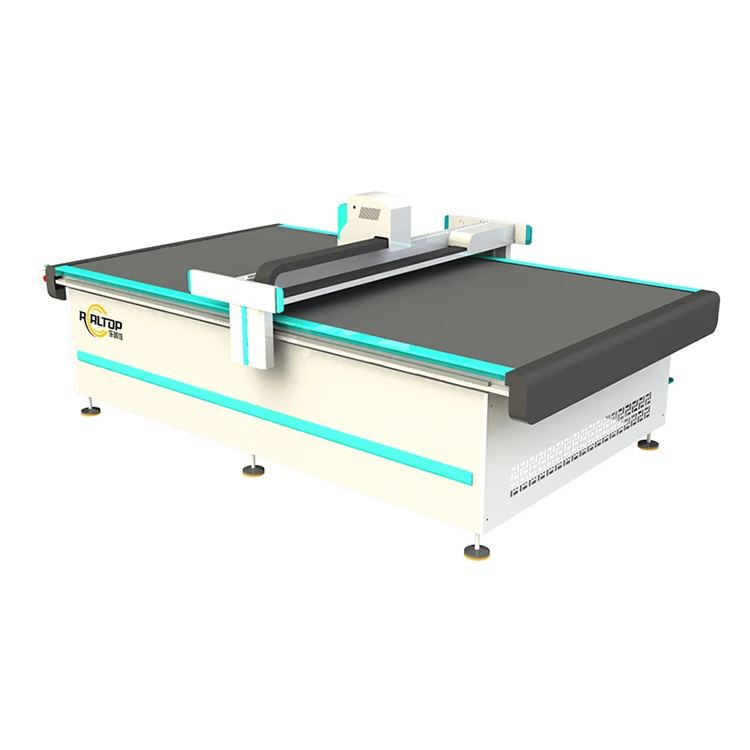
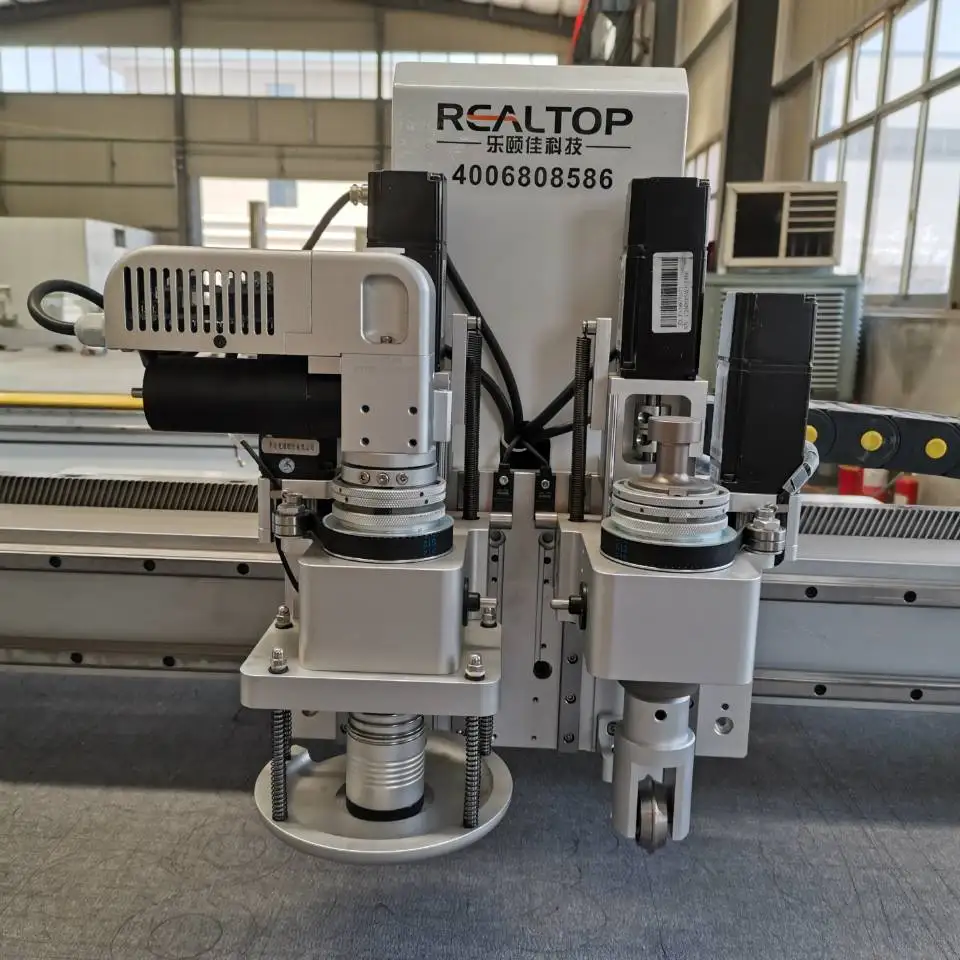
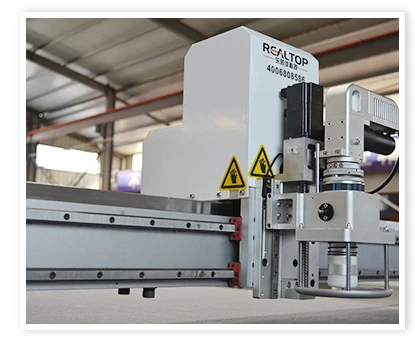
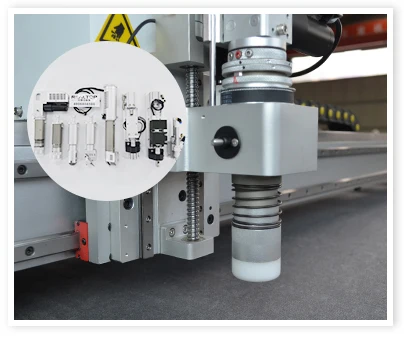

Cutting depth matched to composite layup — we verify oscillating knife penetration and vacuum zoning against your specific material stack before quoting the machine configuration.
Technical Specifications
| Parameter | Value |
|---|---|
| Model | RT-D2516 / RT-S2516 |
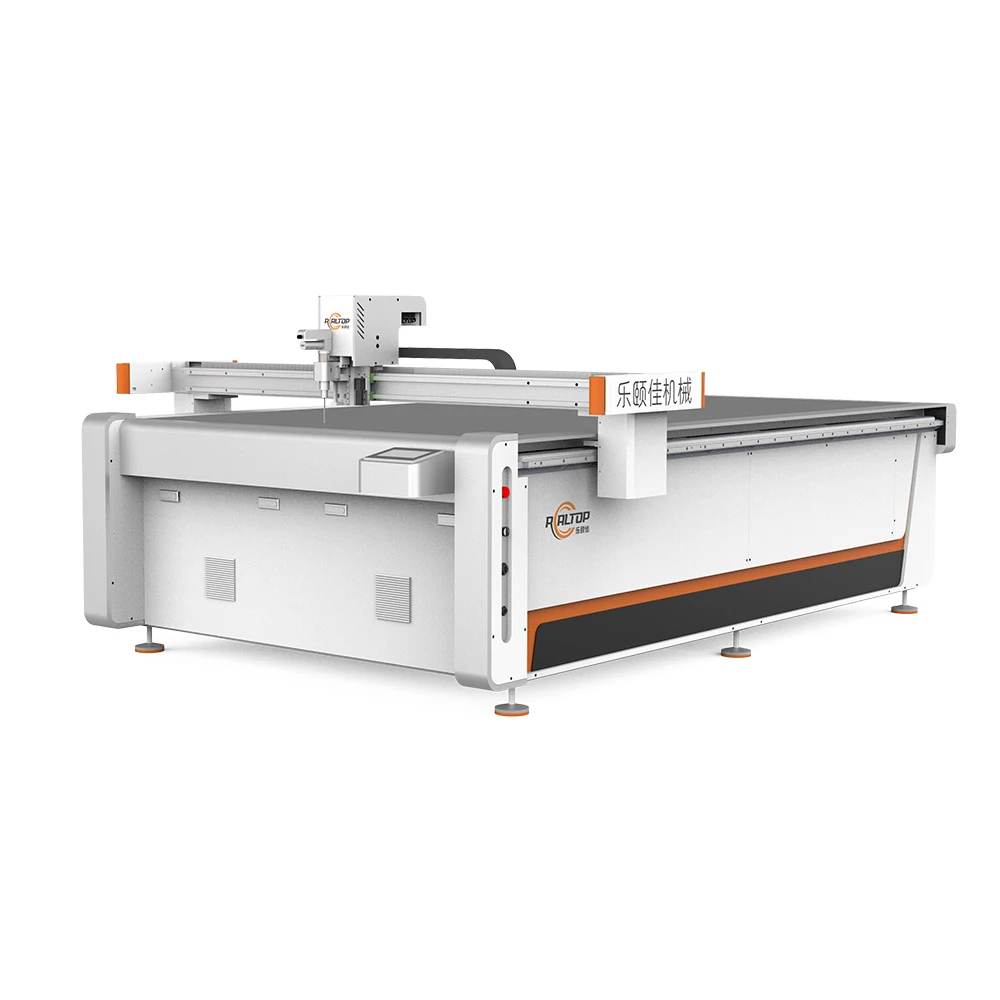
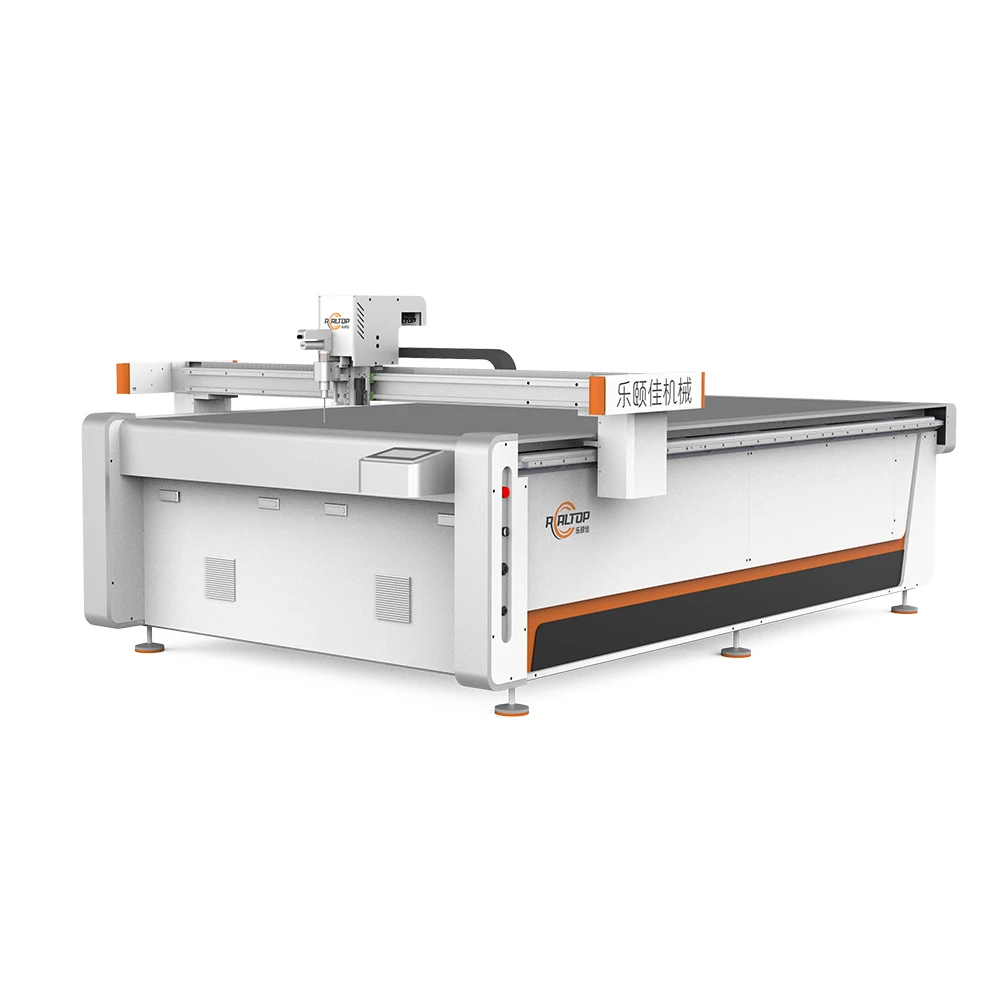
| Product Type | CNC Oscillating Knife Cutting Machine |
| Working Area | 1600 × 2500 mm |
| Machine Size | 3450 × 2300 × 1250 mm |
| Rated Power | 9 kW |
| Voltage | 380V ±10% |
| Tool Head Options | Oscillating knife, pneumatic knife, high-power vibrating knife, circular knife, V-cutting knife, drag knife, creasing wheel, dotted line knife, punching, brush |
| Multifunctional Head | Swiss imported knife with vibration full cutting, vibration half cutting and cursor location |
| Cutting Thickness Range | 20–80 mm (basis to be confirmed by material type, density and layer count) |
| Translational Velocity | 800–1200 mm/s |
| Repeated Accuracy | ≤0.1 mm |
| Transmission System | Digital servo motor (Delta or Panasonic, IP67), linear guide, synchronous belt, ball screw |
| Linear Rail | Taiwan Hiwin |
| Work Table | Flat magnesium-aluminum alloy vacuum adsorption with PVDF powder spraying, anodic and hard oxidation |
| Vacuum Pump | 7.5 kW, integrated aviation aluminum shell with built-in silencer sponge |
| Conveyor Belt | Germany imported (optional) |
| CCD / Vision Options | Small CCD camera mark point positioning, panoramic camera recognition, projection positioning |
| Safety Devices | Infrared induction blocking, anti-collision beam sensors, emergency stop |
| Frame | Welded steel, high-temperature tempering, CNC machined |
| Language Options | English, Russian, Italian, Chinese (special languages customizable) |
Application Suitability
| Application | Material or Output |
|---|---|
| Automotive interior trimming | Instrument panel skins, door panel fabric, headliner substrates and acoustic insulation composites |
| Gasket and sealing fabrication | PTFE, ETFE, rubber sheet and layered composite gasket stock |
| Sports and outdoor protective gear | EVA, XPE foam-core sandwich panels and multi-layer protective composites |
| Carpet and floor mat production | Non-woven fabric, carpet backing, rubber underlay and layered floor composites |
| Packaging and industrial inserts | Corrugated cardboard, foam board, PU and EPE protective packaging laminates |
Why the Working Area Is Only Half the Specification
A CNC oscillating knife cutting machine for composites production line specified solely on table dimensions frequently underperforms once real layups enter the feed zone. The cutting depth the knife actually achieves depends on the tool head, oscillation frequency, and vacuum hold-down acting together against your specific composite density. [NEED_CITE: composite material density variation across layup types]
I saw this firsthand when an automotive interior client ordered based on the 1600 × 2500 mm bed size alone. The instrument panel skin composite they ran daily was denser than the sample used during testing, and the knife could not maintain consistent penetration through all layers. Production slowed because operators had to reduce feed speed to keep edge quality acceptable. That gap between catalog specification and workshop reality is what pushed me to always confirm the full layup — fiber type, resin content, core material, total thickness — before recommending a tool head and vacuum zoning plan. [NEED_CITE: relationship between composite density and oscillating knife cutting parameters]
Matching Tool Head to Composite Layup Structure
Composite fabricators work with everything from single-layer rubber gasket stock to multi-layer sandwich panels combining fabric faces, foam cores and adhesive interlayers. A single oscillating knife setting will not handle that range cleanly. The RT-D2516 and RT-S2516 are available with oscillating knife, drag knife, pneumatic knife, high-power vibrating knife, circular knife, V-cutting knife, creasing wheel and punching heads, so the tooling can follow the material rather than the other way around. Choosing the wrong head is one of the most common reasons composite edges come off the table ragged or delaminated.
Vacuum Zoning and the Small-Part Problem
When a large sheet of composite material is mostly cut away, the remaining small pieces lose suction and lift during the final passes. The magnesium-aluminum alloy table on this machine uses zoned vacuum adsorption with PVDF coating to maintain grip across the full working area. Each zone can be addressed independently, which matters when nesting gaskets or automotive trim pieces where the finished part may be only a fraction of the original sheet. Without proper zoning, parts shift, the knife catches the edge, and the piece is scrapped. [NEED_CITE: vacuum zoning strategies for CNC flatbed cutting tables]
Reading the Specs That Actually Matter on the Floor
The 9 kW rated power and 7.5 kW vacuum pump together define the machine’s sustained working envelope. A lower vacuum pump rating may hold a full sheet but fail on the zoned suction needed for nested small parts. The Taiwan Hiwin linear rails and digital servo motors (Delta or Panasonic, IP67 rated) maintain the ≤0.1 mm repeated accuracy that composite cutting demands — even a small drift in a multi-pass cut creates visible stepping on the edge of layered materials. The welded steel frame undergoes high-temperature tempering and CNC machining to resist deflection under continuous cutting loads, which is critical when the machine runs full shifts processing dense composite stacks. Translational velocity of 800–1200 mm/s is achievable on lighter materials, but the actual cutting speed depends on thickness, layer count and knife type.
The Hidden Cost of Skipping Material-Specific Configuration
Choosing a tool head without testing your specific composite layup leads to frayed fiber edges on fabric-reinforced panels, crushed foam cores in sandwich structures, or incomplete cuts that leave tabs requiring manual finishing. A vacuum table without zoning causes small gasket blanks to lift and rotate, turning a nested sheet into scrap. CCD camera positioning promised for printed contour work but not verified at production speed will miss registration marks, producing off-cut panels that cannot be used in assembly. These failures rarely show up in the specification sheet — they appear on the production floor, where rework hours and material waste quietly consume the margin. [NEED_CITE: common failure modes in CNC knife cutting of composite materials]
Why Procurement Conversations Start with the Material Here
In-house knife cutting technology development means the tool head is selected based on your composite type, not a generic default. Sample cutting runs on your actual material — with a documented report on edge quality, layer separation and cutting speed — are completed before any order is placed. Voltage, plug configuration and control panel language are confirmed and recorded in the electrical schematic before the machine enters production. The CCD camera contour recognition option, whether mark point, panoramic or projection type, is tested against your printed composite panel to verify tracking performance. Software compatibility, including HP-GL format and nesting workflow integration, is validated with your existing file types so the machine fits into your production system on day one.
Documentation & Verification
- Sample cutting report on your composite layup documenting edge quality and layer adhesion
- Tool head and vacuum table configuration list matched to your material stack and daily volume
- Electrical schematic with voltage, frequency and plug type confirmed for your facility
- Software licence and file format compatibility note covering HP-GL and nesting workflows
- Factory test record with repeated accuracy verification on your specified material
Installation, Commissioning & Support
- Dedicated 380V ±10% circuit required; confirm local frequency before production begins
- Machine footprint 3450 × 2300 mm requires level concrete floor with adequate clearance for sheet loading
- Fully assembled welded frame arrives ready for utility connection, reducing on-site assembly time
- First-run parameter setting includes vacuum zoning calibration for your composite panel sizes
- Operator training covers tool head changeover and CCD camera mark point positioning setup
- Spare parts list includes knife blades, drag knife tips and creasing wheels matched to your configuration
What We Need to Match the Machine to Your Line
Before quoting a CNC oscillating knife cutting machine for composites production line configuration, share the composite layup structure including each layer material and total thickness, the typical sheet size and daily cutting volume, and your local voltage and frequency standard. If you use nesting software, provide a sample output file so we can confirm format compatibility. For printed contour cutting, send a sample panel so the CCD recognition system can be validated at target speed.
Frequently Asked Questions
Q: How is cutting thickness verified for my specific composite layup and density?
A: We run sample cuts on your actual material before order confirmation. The sample cutting report documents knife penetration depth, edge quality across each layer, and whether any delamination occurs. Cutting thickness of 20–80 mm is a general range; the achievable depth for your layup depends on density, resin content and core structure, and the report provides the verified figures for your specific stack.
Q: What tool head is recommended for multi-layer composites versus single-layer foam or gasket?
A: Multi-layer composites typically require the oscillating knife or high-power vibrating knife to cut cleanly through fiber and core layers without delamination. Single-layer foam or gasket material often works better with a drag knife or circular knife depending on density. The recommendation is finalized after sample cutting on your material, with the configuration documented before shipment.
Q: Can the vacuum table zoning be configured for small composite parts that tend to lift?
A: Yes. The magnesium-aluminum alloy vacuum table supports zoned suction, allowing specific areas to maintain full hold-down while other zones are inactive. This prevents small gaskets or trim pieces from lifting after surrounding material is cut away. Zone layout is configured based on your nesting patterns during the specification stage.
Q: How does CCD contour recognition perform on printed composite panels at production speed?
A: The system offers mark point, panoramic and projection positioning options. Performance depends on mark contrast, print quality and panel surface texture. We test the CCD camera against your printed composite sample at target translational velocity to confirm reliable tracking before the vision option is included in your configuration.
Q: What is the workflow integration with my existing nesting software and file format?
A: The instruction system supports HP-GL compatible format. We verify your nesting software output against the machine controller during the specification stage, documenting file format compatibility in writing before production. If format conversion is needed, the workflow is tested end-to-end so cutting data transfers without manual rework on the shop floor.



商品评价
Clear filtersThere are no reviews yet.