




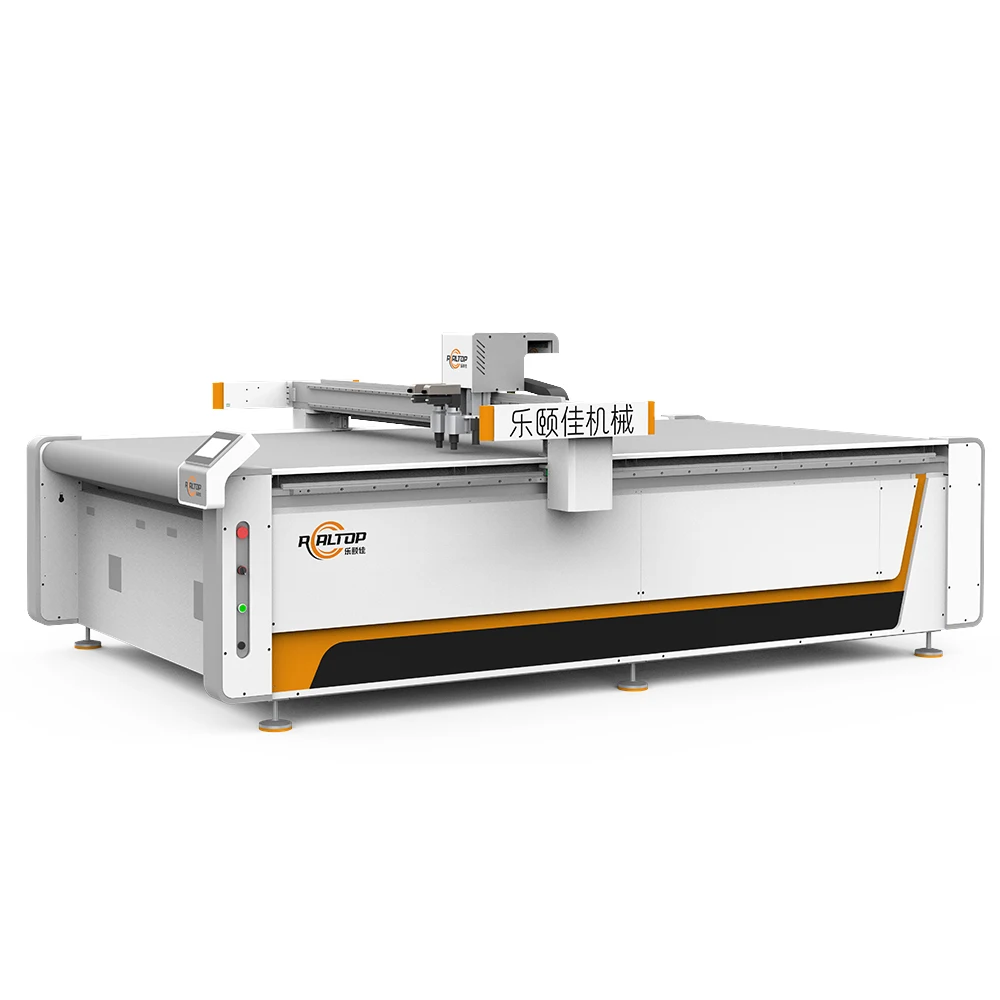
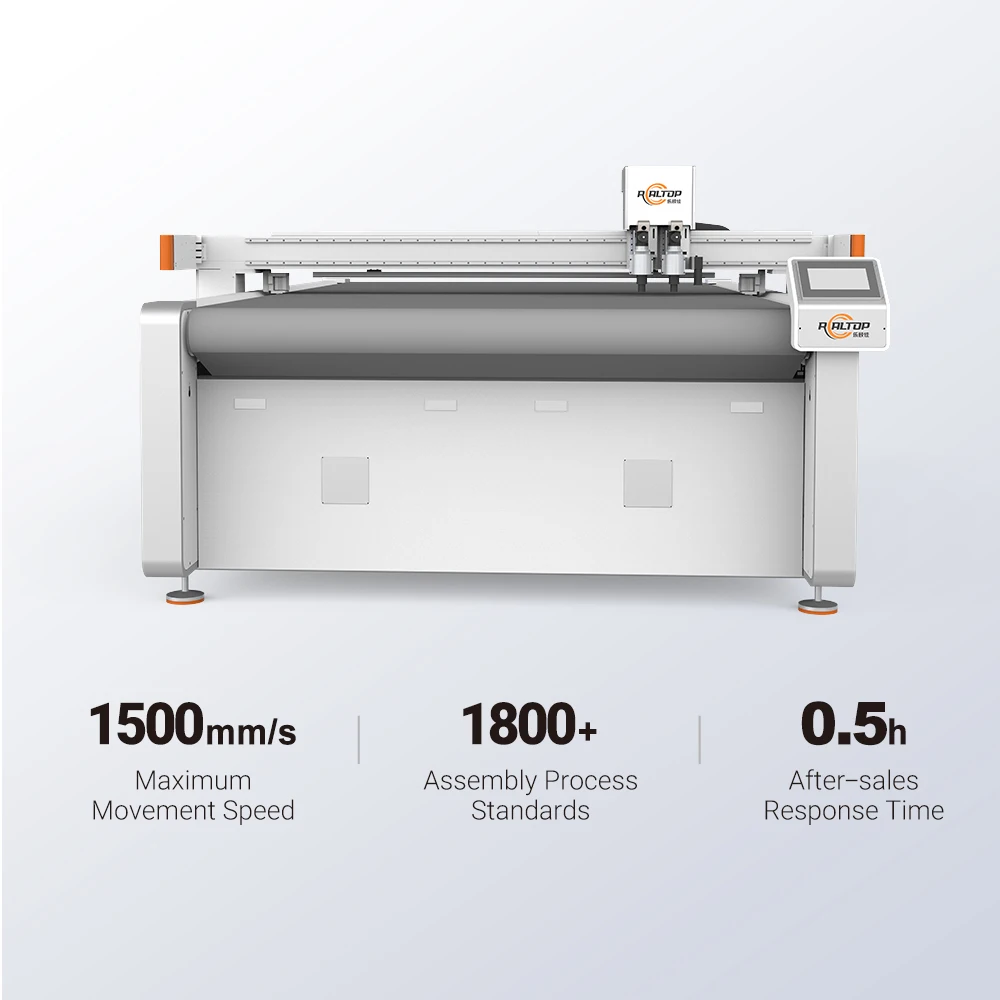


Material-Verified Configuration — Every 1625 oscillating knife cutting table ships only after your actual corrugated stock and foam inserts pass a documented sample cutting test, eliminating the guesswork between quoted thickness and real cutting depth.
Technical Specifications
| Parameter | Value |
|---|---|
| Product Type | CNC Oscillating Knife Cutting Machine |
| Model | 1625 |
| Working Area | 1600 × 2500 mm |
| Cutting Thickness Capacity | ≤ 40 mm |
| Cutting Accuracy | ±0.1 mm |
| Cutting Speed Range | 0–1500 mm/s |
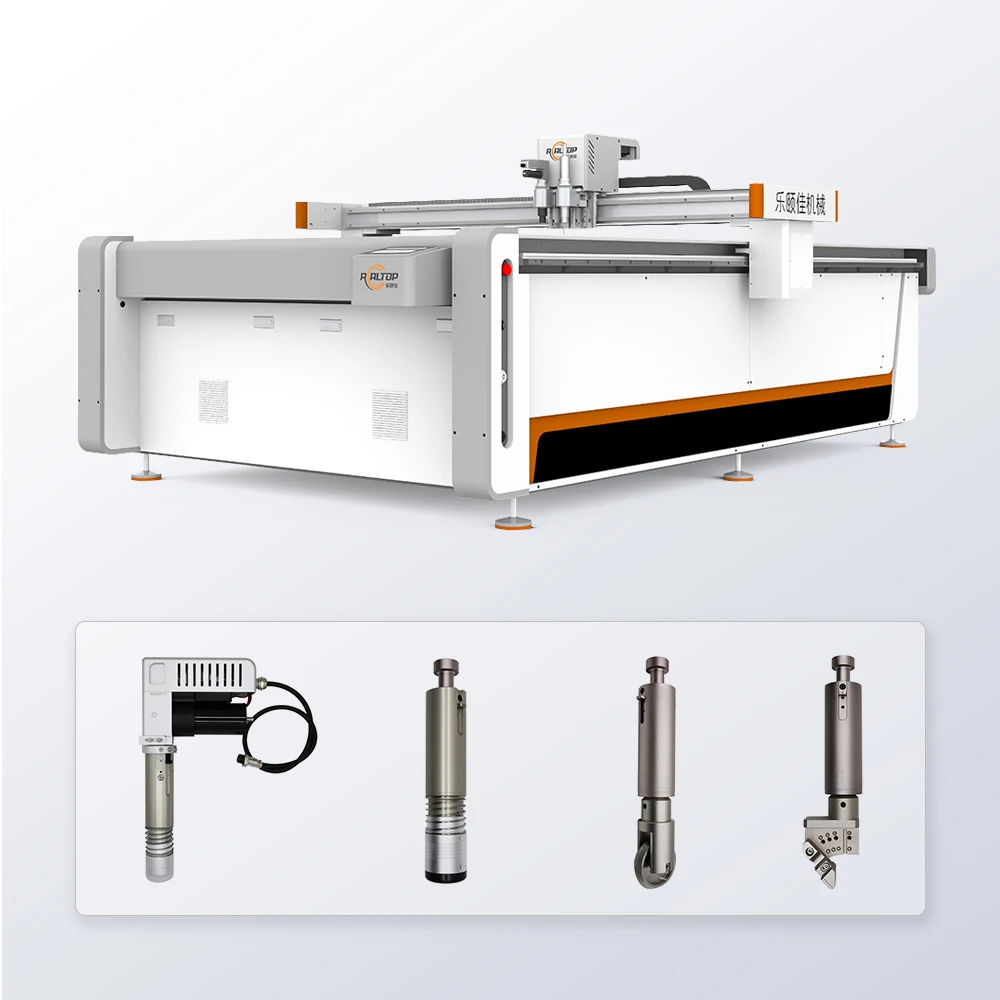
| Tool Head Options | Oscillating knife, Driven rotary knife, Creasing wheel, Kiss cutting tool, Pneumatic knife, Milling tool, V groove knife |
| Vision System | CCD camera for printed contour recognition |
| Vacuum Table | Aluminum bellows vacuum table |
| Vacuum Pump | 9 kW |
| Control System | PLC control panel with optional display languages |
| Compatible File Formats | PLT, DXF, AI, PDF |
| Packaging Software | Dedicated packaging box structure design software |
| Voltage Options | 110V / 220V / 380V (configurable) |
| Language Options | English, Russian, Italian, Chinese; special languages customizable |
| Safety Devices | Infrared sensor device, emergency stop device |
| Machine Size | 3300 × 2100 × 1350 mm |
| Servo Drive Options | Panasonic, Delta, Dorna (source value — verify against manufacturer catalog) |
Application Suitability
| Application | Material or Output |
|---|---|
| Corrugated box prototyping and short-run production | E-flute, B-flute, BC-flute corrugated board |
| Carton sample making and structural design | Greyboard, cardstock, art paper, specialty paper |
| Foam insert and protective packaging fabrication | EVA foam, EPE foam, PU foam, Coroplast |
| Flexible packaging and gasket cutting | Rubber mats, velvet/fleece fabric, non-woven fabric |
| Thin plastic and composite packaging | PVC sheets, PET sheets, synthetic leather, adhesive-backed materials |
Why "Working Area 1600×2500" Is Not Enough to Specify a CNC Oscillating Knife Cutting Machine Production Line Packaging Setup
*The real question is whether theed without crushing the flute structure underneath.**
I have watched packaging buyers sign off on a machine because the table size matched their sheet dimensions, only to discover that a standard oscillating knife could not push through five-ply BC-flute at production speed. The knife stalled mid-cut, leaving ragged edges and crushed corrugation near the crease lines [NEED_CITE: flute compression behavior under high-speed knife penetration]. That failure has nothing to do with working area and everything to do with matching tool head type, oscillation frequency, and vacuum hold-down to the specific substrate. The 1625 addresses this by offering seven selectable tool heads — from oscillating knife to V groove knife — each assigned to the material in the job queue rather than forcing a single blade to handle every board that enters the shop.
Matching Tool Heads to Corrugated Flute Types and Board Density
The oscillating knife handles standard single-wall corrugated efficiently, but double-wall and triple-wall boards demand either a pneumatic knife for extra downward force or a driven rotary knife for continuous scoring and through-cut in a single pass. Creasing wheels sit alongside the cutting tools, so the machine scores fold lines immediately after each contour cut — no secondary creasing station required. When a job calls for kiss-cutting adhesive-backed labels onto corrugated stock, the kiss cutting tool references the material surface and cuts only the top liner without scoring the flute below. This tool head flexibility means a CNC oscillating knife cutting machine production line packaging configuration is never a fixed setup; it changes with every job file loaded into the PLC panel.
CCD Camera Contour Recognition on Printed Corrugated Stock
Printed box prototypes and short-run retail packaging need the knife to follow pre-printed trim marks rather than a pure digital outline. The CCD camera reads registration marks on the corrugated surface and adjusts the cutting path in real time, compensating for sheet stretch, print offset, and feeding skew. At production speed, the camera must track marks across the full 1600 × 2500 mm working area without losing lock on low-contrast prints [NEED_CITE: optical registration accuracy on corrugated and kraft substrates]. If the board has a dark kraft liner with black trim marks, the system adjusts exposure to maintain mark detection, a setting that operators confirm during the first sheet of each batch.
How Vacuum Zoning and Pump Capacity Hold Down Nested Packaging Parts
A 9 kW vacuum pump feeding an aluminum bellows table generates full-surface adsorption, but corrugated sheets are inherently porous — air leaks through the flute channels. The aluminum bellows design compensates by maintaining suction across the entire bed even when a large sheet has already been partially cut into dozens of small carton blanks. Without adequate zoning, small packaging parts lift off the table mid-cut, producing dimension drift that pushes blanks outside the ±0.1 mm accuracy tolerance. This is especially critical when nesting multiple box sizes on a single sheet to maximize material yield; the vacuum must hold both the large outer frame and the smallest tuck-end flap simultaneously.
Reading the Specifications That Actually Affect Your Packaging Line
The ≤ 40 mm cutting thickness rating covers single-wall through double-wall corrugated, greyboard up to heavy chipboard, and dense EVA foam inserts in one setup. Cutting speed ranges from 0 to 1500 mm/s, but operators typically run corrugated board at a lower threshold to preserve flute integrity — the PLC panel stores material-specific speed profiles so each board type recalls its own parameters automatically. The dedicated packaging box structure design software imports PLT, DXF, AI, and PDF files directly, meaning structural designers can send box templates from their existing CAD environment without re-drawing in the machine’s native editor. Voltage configurability across 110V, 220V, and 380V means the electrical package is matched to the destination country before the machine leaves the factory floor.
The Hidden Cost of Skipping Material Verification Before Shipment
A buyer who specifies the 1625 by working area alone, without sending actual corrugated samples for a cutting test, risks receiving a tool head configuration that struggles with their specific flute type and ply count. The wrong vacuum zoning layout causes small nested parts to shift, producing scrap rather than saleable blanks [NEED_CITE: material waste rates from inadequate vacuum hold-down in digital cutting]. A control panel set to a language the operators cannot read delays commissioning by days or weeks while translation and retraining take place. These are not machine defects — they are specification gaps that a pre-shipment sample cutting test would have revealed and resolved before the crate was sealed.
Why Packaging Buyers Source This Machine Through REALTOP
In-house design covers both knife and laser cutting technologies, so a packaging buyer can evaluate whether an oscillating knife or a CO2 laser better suits their substrate mix — rather than being told one method fits all. Tool head and table configurations are specified per material and production volume, not offered as a one-size package. CCD camera positioning is confirmed against the buyer’s own printed stock before the order is finalized. Software compatibility is verified with the buyer’s existing PLT, DXF, or AI file workflow. Voltage, language, and specification customization are completed before shipment, not patched on arrival. Sample cutting on the buyer’s actual corrugated or foam material runs before any commitment is made.
Documentation & Verification
- Machine specification sheet listing all seven tool head options and their assigned substrates
- Electrical schematic confirming selected voltage (110V / 220V / 380V) and plug type
- Sample cutting report on your corrugated flute type and foam insert material before dispatch
- Tool head and vacuum table configuration list matched to your specific board grades
- Software licence and file format compatibility note covering PLT, DXF, AI, PDF workflows
- Factory test record documenting cutting accuracy and CCD tracking on your printed stock
Installation, Commissioning & Support
- Foundation must support the 3300 × 2100 × 1350 mm footprint with level tolerance for the aluminum bellows table
- Dedicated electrical circuit matching confirmed voltage (110V / 220V / 380V) and the 9 kW vacuum pump draw
- Machine arrives partially assembled; vacuum table and gantry require on-site alignment and calibration
- PLC control panel language set to your operator preference during initial power-up and parameter loading
- Operator training covers tool head changeover, CCD mark registration, and packaging software file import
- Spare oscillating knife blades, creasing wheels, and vacuum table seals included in the initial parts kit
What to Prepare Before Requesting a Quotation
Send actual samples of your most demanding corrugated board — including flute type, ply count, and whether the liner is printed with registration marks. Specify your target sheet size, daily blank volume, and whether your current design workflow uses PLT, DXF, AI, or PDF exports. Confirm your facility’s available voltage, frequency, and the control panel language your operators need. If your packaging line already runs nesting software, share a sample file so file format compatibility is verified before any configuration is locked in.
Frequently Asked Questions
Q: How do I confirm the 1625 can cut my specific corrugated flute type and ply count?
A: Send physical samples of your actual board — including flute profile (E, B, or BC) and ply count — for a documented sample cutting test. The report records cutting speed, knife type used, edge quality, and achievable thickness, giving you verified data rather than a generic specification claim before you commit to the order.
Q: Will the CCD camera track printed registration marks at production speed on kraft corrugated?
A: The CCD camera adjusts exposure for low-contrast marks on dark kraft liners and tracks them across the full 1600 × 2500 mm bed. Performance is validated during the sample cutting test using your own printed stock, confirming mark detection accuracy before the machine configuration is finalized for your production environment.
Q: Does the vacuum table hold small nested packaging parts without lifting during cutting?
A: The aluminum bellows vacuum table paired with the 9 kW pump maintains full-surface suction even on porous corrugated sheets. Vacuum zoning is configured based on your typical nesting layout, and hold-down effectiveness is verified during the pre-shipment sample cutting test on your actual board grades.
Q: Is the packaging design software compatible with my existing CAD and nesting files?
A: The dedicated packaging box structure design software imports PLT, DXF, AI, and PDF formats natively. Before order confirmation, a file format compatibility note is prepared using your sample files, confirming that your current nesting workflow transfers without manual re-drawing or data loss.
Q: How are voltage, plug type, and control language confirmed before the machine ships?
A: During the quotation stage, you specify your facility voltage (110V / 220V / 380V), local plug standard, and preferred PLC panel language. An electrical schematic is issued for your approval, and the control system is loaded with your chosen language before the factory test and final packing.





商品评价
Clear filtersThere are no reviews yet.