




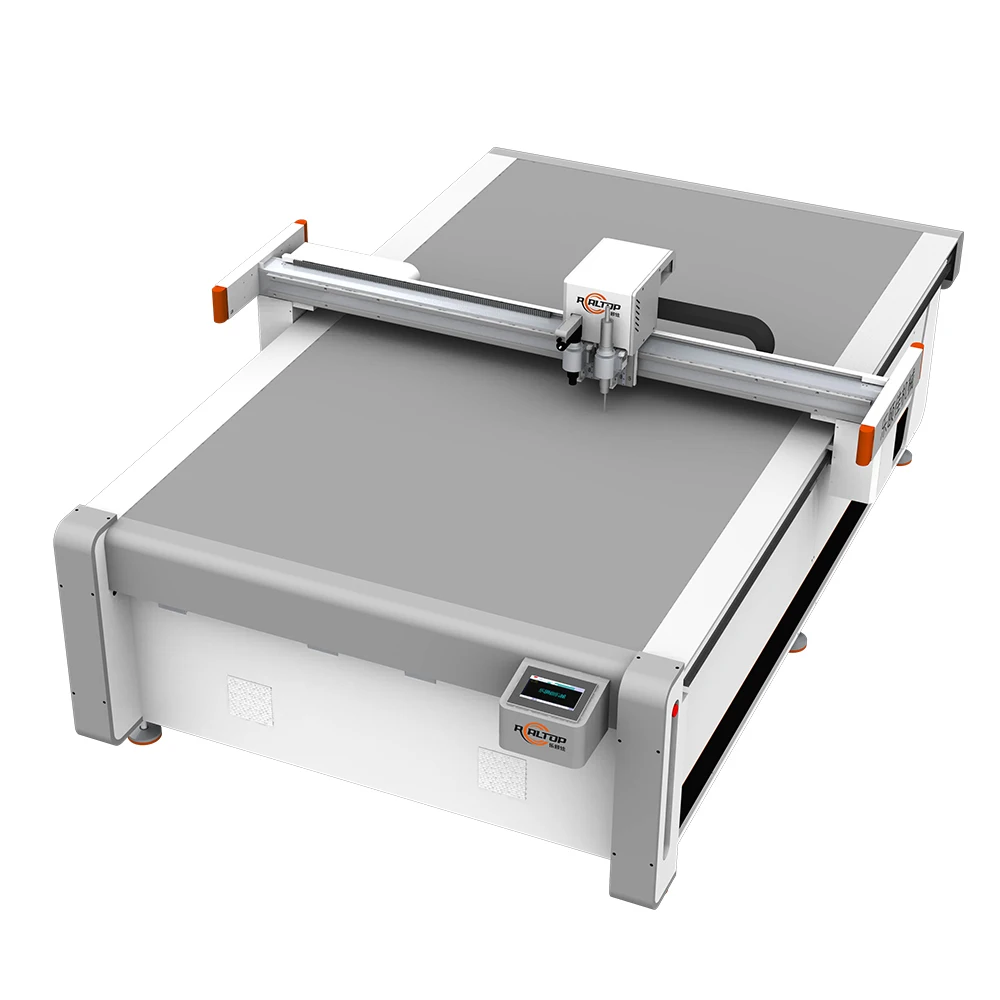
In-house tooling configuration — this Car Interiors CNC Cutting Machine production line pairs V-cut and oscillating heads on a zoned vacuum table so automotive suppliers match the blade to the composite stack instead of forcing one setup across every interior component.
Technical Specifications
| Parameter | Value |
|---|---|
| Product Type | CNC Oscillating Knife Cutting Machine with V-Cut Tool Head |
| Model | RT-D2516 / RT-S2516 |
| Working Area | 1600 × 2500 mm |
| Overall Dimensions | 3450 × 2300 × 1250 mm |
| Rated Power | 9 kW |
| Voltage | 380V ±10% (50Hz/60Hz confirmation required per destination market) |
| Translational Velocity | 800 – 1200 mm/s |
| Cutting Thickness Range | 20 – 80 mm (varies by material density — confirm on buyer substrate) |
| Repeatability | ≤0.1 mm |
| Table Surface | Magnesium-aluminum alloy, PVDF fluorocarbon powder sprayed, anodic and hard oxidation treated |
| Vacuum Pump | 7.5 kW, aviation aluminum shell with built-in silencer sponge |
| Tool Head Options | Swiss imported knife (vibration full cut, half cut, cursor location); available with pneumatic knife, high-power vibrating knife, circular knife, V-cutting knife, drag knife, creasing wheel, dotted line knife, punching, brush |
| Visual Positioning | Small CCD camera mark point positioning, panoramic camera recognition, projection positioning |
| Transmission | Imported digital servo motor (Delta or Panasonic optional), Taiwan Hiwin linear guide, synchronous belt, ball screw |
| Conveyor | Germany imported conveyor belt (optional auto feeding) |
| Safety Devices | Infrared induction blocking, anti-collision sensors on beam sides, emergency stop with in-situ resume |
| Servo Motor Protection | IP67 waterproof rating, automatic gain adjustment, vibration suppression |
| Frame | Thick-walled seamless steel, high-temperature tempered, CNC machined |
| Control / Instruction Format | HP-GL compatible |
| Software Language | English, Russian, Italian, Chinese (other languages customizable) |
| Assembly State | Fully assembled, factory tested before shipment |
| ODM / OEM | Available |
| Warranty | 1 year (parts free; buyer covers shipping; on-site engineer available with buyer covering travel and accommodation) |
Application Suitability
| Application | Material or Output |
|---|---|
| Seat covers and headrest panels | Multi-layer fabric with foam composite, leather, synthetic upholstery |
| Floor mats and trunk liners | EVA, XPE, carpet, rubber sheet — V-cut bevel combined with full cut |
| Door panel covers and dash wraps | PVC, PU, TPO film over scrim backing, printed contour tracking |
| Sealing gaskets and acoustic pads | Closed-cell foam, EPDM rubber, non-woven acoustic batting |
| Headliner blanks | Thermoformable composite sheet, fiberglass-reinforced substrate |
| Sun visor and armrest inserts | Soft-touch laminate, sponge composite, PU foam board |
What "Working Area" Leaves Out About Interior Trim Cutting
A 1600 × 2500 mm table sounds sufficient until small gaskets and clip-hole cutouts lift mid-pass because the vacuum zoning was never matched to the nesting layout. The real question for any Car Interiors CNC Cutting Machine production line is whether the vacuum holds the thinnest offcut in your specific nesting pattern.
I have watched interior suppliers uncrate a flatbed cutter, run a full seat-cover sheet fine, then attempt a trunk-liner gasket run where every small piece drifted the moment the knife passed. The vacuum pump had enough total CFM, but the zone boundaries left a six-inch strip at the edge of the sheet with almost no pull-down. Two shifts of material scrapped before anyone checked the zoning map against the nesting file [NEED_CITE: vacuum zoning layout verification before production]. That mismatch is exactly what forces a production manager to pull the machine offline and re-plumb the zones mid-installation.
Floor Mat Beveling and Full Cut in One Pass
Automotive floor mats demand a clean V-cut bevel around the perimeter and a through-cut for the clip holes and binding channels. The V-cutting knife head paired with the Swiss oscillating blade on the RT-D2516 handles both in a single lay-up. The Car Interiors CNC Cutting Machine production line holds EVA at typical mat density through the bevel stroke without the foam compressing and springing back into a ragged edge. When the same tool head transitions to a full-depth oscillating cut for the binding slots, the 7.5 kW vacuum pump keeps the mat flat across the 2500 mm travel length, preventing the belt-style mats from curling at the trailing edge.
Printed Contour Tracking for Door Panels and Dash Skins
Many interior skins arrive pre-printed with grain patterns or decorative stitching lines, and the cutting path must register to that print rather than to the sheet edge. The panoramic CCD camera on this system reads mark points across the full table width, allowing the Car Interiors CNC Cutting Machine production line to adjust the cut file on the fly when the fabric has stretched or skewed during lamination. Projection positioning overlays the nest onto the lay-up so the operator can visually confirm registration before the knife drops [NEED_CITE: CCD contour tracking accuracy under production-speed conditions]. For door-panel skins with offset printed logos, this avoids the scrap pile that accumulates when a system relies on mechanical edge guides alone.
Vacuum Zoning and the Small-Part Problem
Interior trim nests are rarely uniform rectangles — a single sheet might contain large seat panels alongside dozens of small gaskets, cable-routing cutouts, and fastener access windows. The magnesium-aluminum table on the RT-D2516 is segmented into independent vacuum zones with PVDF fluorocarbon coating that maintains flatness under thermal cycling. When a zone is activated only beneath the active cut area, small parts stay pinned instead of lifting into the knife path. The 800 – 1200 mm/s translational velocity is meaningful here because the knife exits the small part before the vacuum can bleed off, but only if the zone boundary sits inside the part footprint rather than across it.
How the Drive and Servo Spec Translates on the Shop Floor
The Delta or Panasonic digital servo motors carry an IP67 rating, which matters in interior plants where leather dust and foam particulate settle on every surface. The Taiwan Hiwin linear guide and ball-screw drive maintain the ≤0.1 mm repeatability across the 2500 mm stroke, and the automatic gain adjustment compensates for load changes as the knife moves from a dense EVA section into an open foam region within the same cut path. Thick-walled seamless steel frame stock is high-temperature tempered and CNC-machined, so the gantry does not deflect when the V-cut knife pushes laterally through a 40 mm stack. The HP-GL instruction format keeps the file pipeline compatible with most existing nesting and CAD platforms already running in automotive tier-supplier workshops.
What Happens When the Wrong Head Meets a Laminated Stack
A seat supplier in central Mexico once specified an oscillating knife rated for single-layer leather, then ran a three-layer seat sandwich — face fabric, foam interlayer, and scrim backing. The blade oscillated cleanly through the top ply, compressed the foam mid-layer, and left the scrim backing partially connected. The entire first production lot delaminated during the sewing operation downstream, stopping the trim assembly line for two shifts. The root cause was not the machine — it was the tool head selection made without a sample of the actual composite stack. That is why the sample cutting report on the buyer’s own material, including thickness, density, and ply count, must be reviewed before the order is locked [NEED_CITE: material delamination during multi-layer oscillating knife cutting].
Why Production Managers Source This Configuration
The tool head and table setup is specified per material and production volume rather than sold as a single fixed configuration. CCD camera positioning is verified against the buyer’s actual printed substrate before shipment, not assumed from a generic test pattern. Software compatibility and file format handoff from the buyer’s nesting workflow are confirmed during the order stage, eliminating the week-long troubleshooting cycle after commissioning. Voltage, plug type, and control interface language are documented in writing before the machine enters production. Sample cutting runs on the buyer’s own material — at the actual ply count and density — generate a report that precedes any commitment, so the cutting edge quality and achievable depth are known quantities rather than catalog claims.
Documentation & Verification
- Machine specification sheet listing every tool head and zone configuration as shipped
- Electrical schematic with confirmed voltage and frequency for the destination plant
- Tool head and vacuum table configuration list matched to buyer material stack
- Sample cutting report on buyer-supplied automotive interior material before order
- Factory test record documenting repeatability and zone vacuum readings at dispatch
- Software licence and HP-GL file format compatibility note for buyer nesting workflow
Installation, Commissioning & Support
- 3450 × 2300 mm footprint requires a level concrete pad with clearance for conveyor feed and operator access on three sides
- 9 kW rated load plus 7.5 kW vacuum pump demands a dedicated 380V circuit with confirmed 50 Hz or 60 Hz supply
- Machine ships fully assembled and factory tested — no structural reassembly at the buyer facility
- First-run commissioning includes vacuum zone mapping against the buyer’s nesting file and tool head calibration on production material
- Operator training covers V-cut bevel depth setting, CCD mark point registration, and emergency stop in-situ resume procedure
- Spare parts list specifies Swiss knife blades, vacuum seals, and Hiwin rail blocks with recommended reorder intervals
Preparing Your Material Data for Quotation
Send a representative sample of your heaviest composite stack and your thinnest single-ply film, along with the nesting file you intend to run most often. Confirm the local voltage and frequency, the control language your operators need, and whether your upstream CAD system outputs HP-GL directly or requires a post-processor. If your current workflow uses a specific nesting software, share the file format so compatibility is verified before the machine enters the build queue.
Frequently Asked Questions
Q: How is actual cutting throughput determined for different interior materials?
A: The 800 – 1200 mm/s translational velocity is the head travel speed on an empty stroke. Actual throughput depends on cut path complexity, material density, number of tool changes per nest, and whether CCD registration pauses are triggered. A time study on the buyer’s own nesting file and material stack provides a realistic pieces-per-hour figure before the order is placed.
Q: Which tool head combination covers most automotive interior stacks?
A: A typical configuration pairs the Swiss oscillating knife for full-depth cuts with the V-cutting knife for bevel edges on EVA floor mats, and adds a creasing wheel for fold lines on door-panel skins. The drag knife handles thin gaskets. The combination is finalized after sample cutting on the buyer’s actual composite layup.
Q: Can the panoramic CCD track printed marks at full production speed?
A: The panoramic camera reads mark points across the table width, but recognition speed depends on print contrast, mark size, and ambient lighting in the plant. A camera test on the buyer’s printed substrate at target line speed confirms reliable tracking before the system is configured for production.
Q: How does vacuum zoning prevent small gasket lift during cutting?
A: The table is divided into independent zones activated only beneath the active cut area. Small parts like clip-hole gaskets stay pinned when the zone boundary sits inside the part footprint. The zone layout is mapped against the buyer’s nesting file during commissioning to confirm hold-down on the smallest pieces.
Q: How does the machine integrate with existing nesting and conveyor workflows?
A: The HP-GL compatible control accepts files from most standard nesting platforms. The optional Germany-sourced conveyor belt feeds material continuously for high-volume mat and fabric runs. File format and conveyor feed rate are confirmed during the order stage so the Car Interiors CNC Cutting Machine production line syncs with upstream and downstream equipment already on the floor.



商品评价
Clear filtersThere are no reviews yet.