




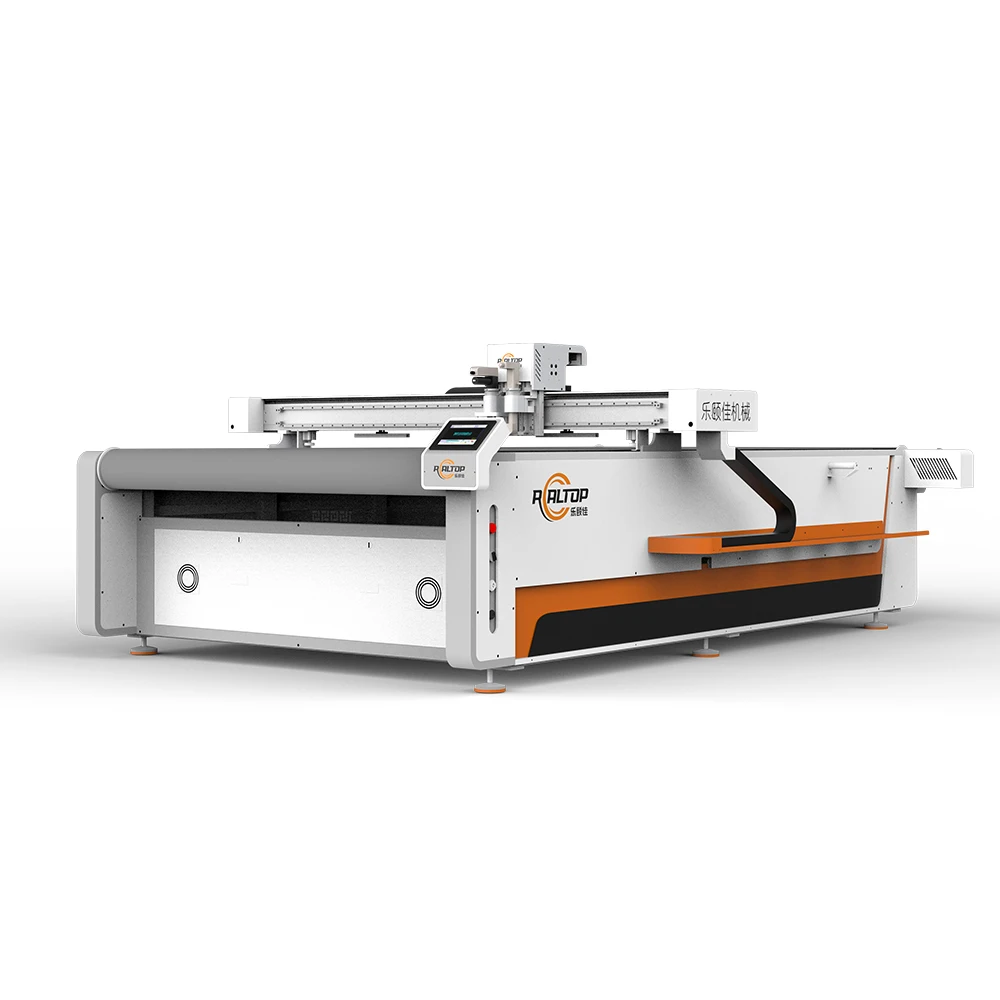
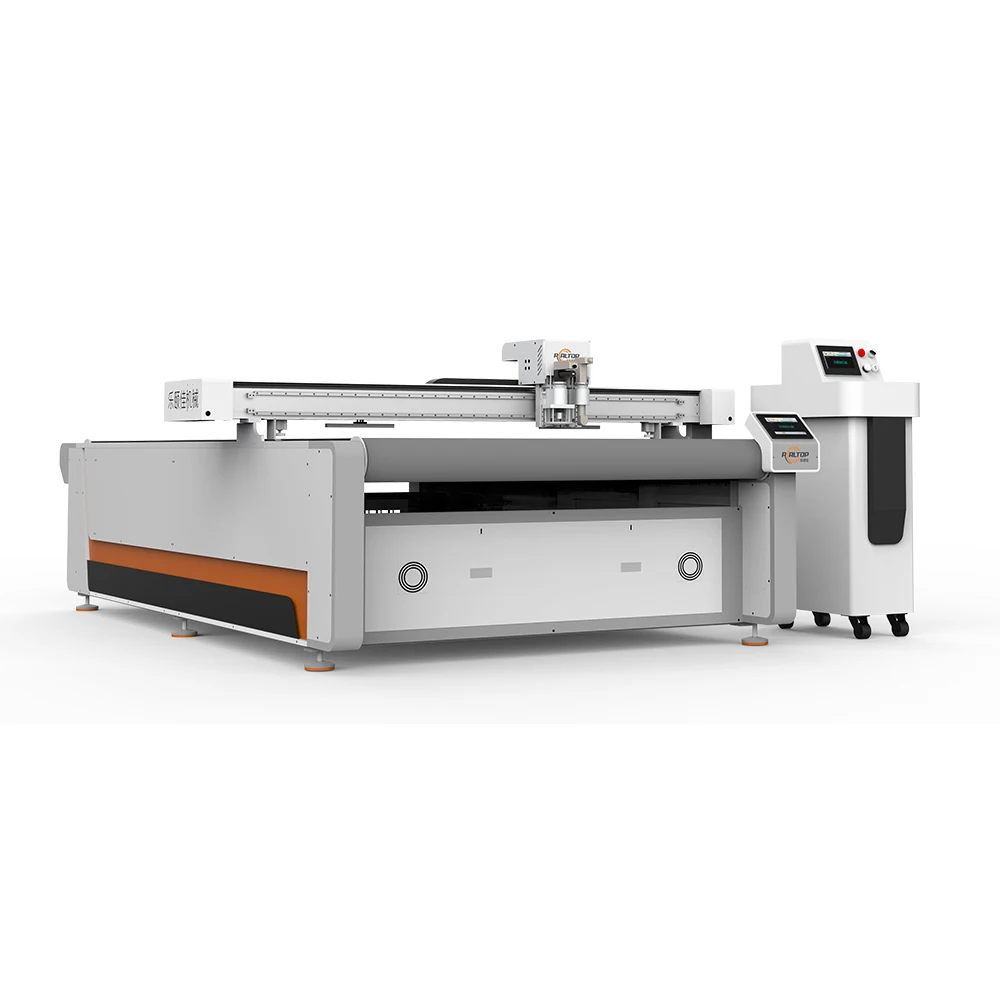
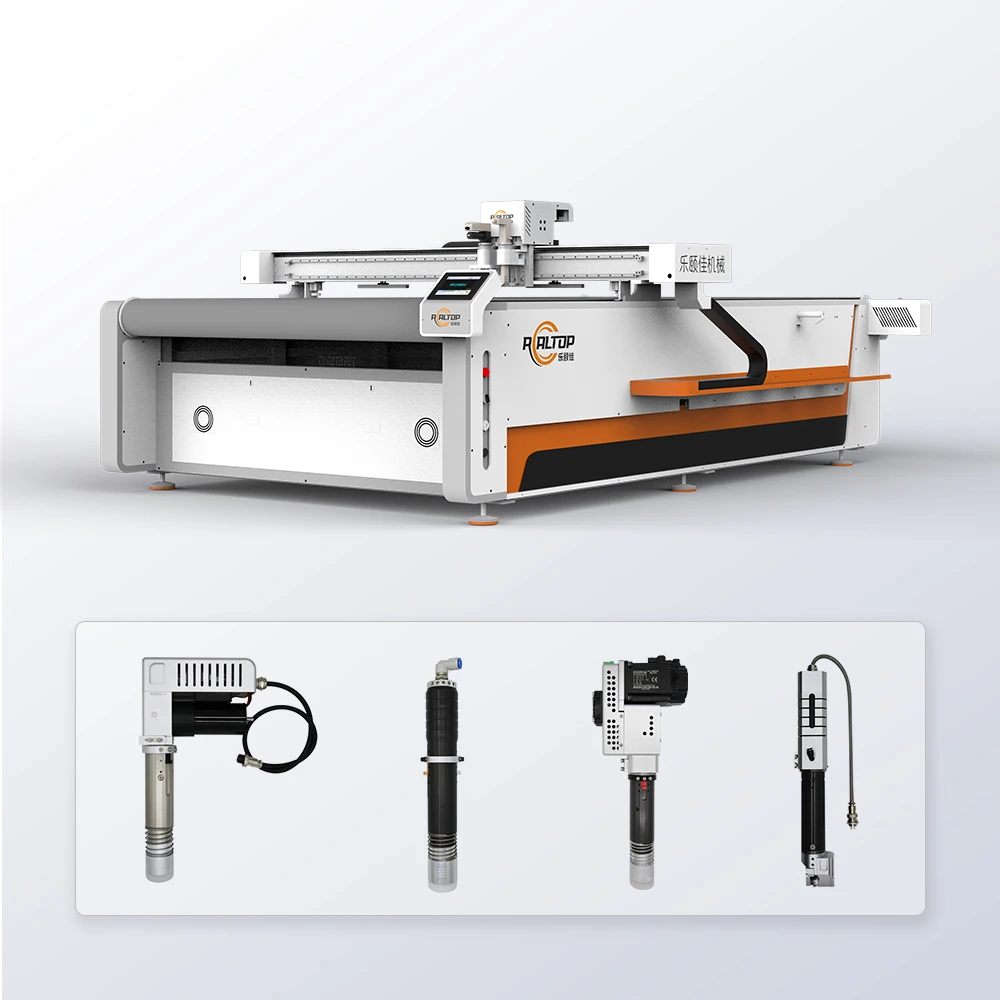
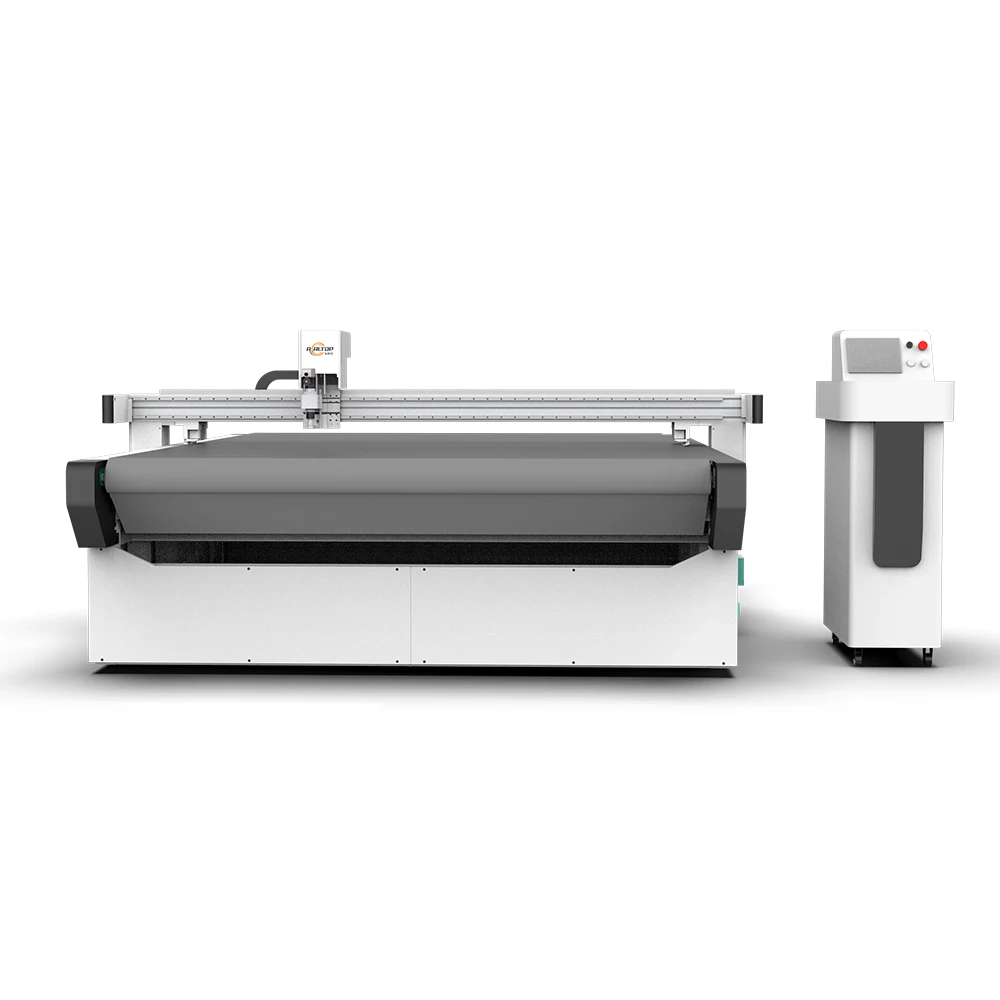


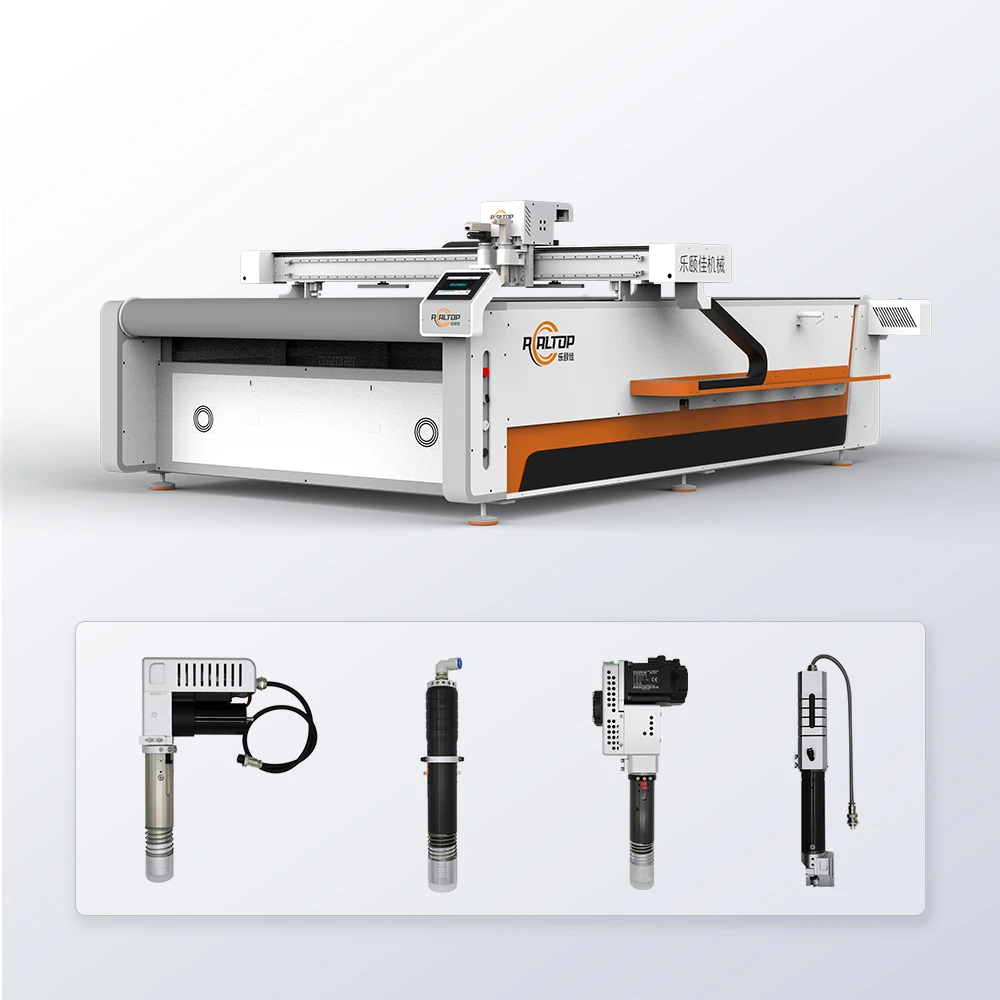
Interchangeable cutting heads matched to material behaviour — this oscillating knife table is configured for polypropylene nonwoven after a sample cutting report confirms layer count, abrasion and edge seal requirements.
Technical Specifications
| Parameter | Value |
|---|---|
| Model | 1625 |
| Product Type | CNC Oscillating Knife Cutting Machine |
| Working Area | 1600 × 2500 mm |
| Tool Head Options | Oscillating knife, Driven rotary knife, Pneumatic knife, Creasing wheel, Kiss cutting tool, Milling tool, V groove knife |
| Cutting Speed | 0 – 2000 mm/s |
| Cutting Thickness | ≤ 30 mm (basis not stated in source — confirm material type and density) |
| Multi-layer Capacity | 30 – 50 mm stack (basis not stated in source — confirm layer count) |
| Cutting / Positioning Accuracy | ±0.1 mm |
| Vacuum Table | Aluminum bellows vacuum table with zoning |
| Vacuum Pump | 9 kW |
| Machine Frame | Heavy-duty frame, precision-ground surface |
| Servo Motor Options | Panasonic, Delta, Dorna |
| Control System | PLC panel, multi-language display |
| Voltage Options | 110V, 220V, 380V (frequency to be confirmed by market) |
| File Formats Supported | PLT, DXF, AI, PDF |
| Software | Packaging box structure design software included |
| Safety Devices | Infrared sensor, emergency stop |
| Machine Dimensions (L×W×H) | 3300 × 2100 × 1350 mm |
| Compliance | CE |
Application Suitability
| Application | Material or Output |
|---|---|
| Nonwoven roll-good cutting | Polypropylene nonwoven, spunbond, meltblown for hygiene and filtration |
| Apparel and knitwear | Suits, lace, patterned woven fabrics, single and multi-ply |
| Automotive interiors | Seat cover fabrics, carpet sets, PVC floor mats |
| Home textiles | Sofa upholstery, curtain panels, rug blanks in multi-layer stacks |
| Technical composites | Carbon fiber prepreg, aramid cloth, cold-cut to avoid delamination |
| Packaging sample making | Corrugated carton, folding carton board, gasket sheet |
Why "Working Area" Is the Wrong Starting Point for a Cloth CNC Cutting Machine Production Line
Specifying a cutting table by footprint alone leaves the material behaviour entirely out of the conversation.
I still remember a buyer who sent a purchase order based purely on a 1600×2500 mm work envelope. When the rolls arrived at our workshop for sample cutting, the polypropylene nonwoven had a glass-fiber reinforcement layer that dulled a standard oscillating blade within a few hundred meters of cut path. The buyer had not mentioned the reinforcement, and we had not asked the right questions early enough. Since that job, every inquiry I handle starts with the material data sheet before we discuss the table size. A Cloth CNC Cutting Machine production line has to be built around what the knife actually meets on the table, not around the rectangle the table occupies [NEED_CITE: industrial textile cutting specifications and material data sheet practices].
Matching Tool Heads to Nonwoven and Woven Behaviour
Polypropylene nonwoven behaves differently from woven cotton or aramid prepreg the moment the blade enters the stack. An oscillating knife gives a clean shear on single-ply nonwoven up to a few millimeters thick, while a driven rotary knife suits continuous long cuts on rolled goods where the edge tends to fray. Pneumatic knife options are brought in when the stack is compressible and the hold-down pressure alone is not enough to keep the bottom layers aligned. This machine makes those heads interchangeable on the same gantry, so a production floor can run nonwoven in the morning shift and switch to woven upholstery before lunch without moving the material to a different table.
Vacuum Zoning, Hold-Down and the Small-Part Problem
A 9 kW pump is only half the story; the other half is how the aluminum bellows table divides that suction into zones. When you nest small garment pieces across a 1600×2500 mm surface, an undivided vacuum area will lose grip on the corners and lift the laminate mid-cut. Zoned vacuum lets the operator open only the sectors under the current nest, keeping the nonwoven flat against the bellows even at the higher end of the 0–2000 mm/s speed range. This is the difference between a cut piece that stays in place for pick-up and one that drifts into the next tool path [NEED_CITE: vacuum hold-down principles for flatbed digital cutting tables].
Reading the 1625 Specs Against the Actual Production Job
The 1600×2500 mm working area is sized to take a standard textile roll width and leave room for nesting software to arrange pieces without excessive remnant. Cutting thickness is listed at up to 30 mm on a single ply and 30–50 mm in multi-layer stack, but both figures must be confirmed against the buyer’s specific nonwoven density and layer count before the quotation is finalized. The ±0.1 mm positioning accuracy matters most where patterned fabric has to meet a printed border, and the PLC control with selectable languages keeps the operator interface consistent when the same Cloth CNC Cutting Machine production line is relocated between sites in different export markets. Servo options from Panasonic, Delta and Dorna let the buyer align spare-part sourcing with what their maintenance team already stocks.
The Cost of Skipping the Material Conversation
Ordering the standard oscillating head for a glass-fiber-reinforced nonwoven typically shows up as premature blade wear and ragged edges inside the first month of production, not as a line-stop on day one. Buyers then spend more time and consumables swapping blades than the original quotation ever accounted for. A wrong vacuum zone layout produces a different symptom: small nested parts lifting and drifting, which the nesting software then reports as scrap rather than yield loss. Both issues trace back to the same root cause — the material was not on the table when the configuration was locked in [NEED_CITE: common failure modes in oscillating knife cutting of reinforced nonwovens].
Why Source This Table From This Build
Our in-house design team covers both knife and laser cutting technologies, so when a nonwoven buyer wonders whether CO2 edge sealing would suit their product, the answer comes from the same engineering floor rather than a different supplier. Each Cloth CNC Cutting Machine production line leaves the workshop with a tool head and table configuration list that names the exact heads, vacuum zones and blade types chosen for that buyer’s material. Voltage, plug type and control language are confirmed in writing before the crate closes, and sample cutting on the buyer’s own roll is the gate that has to pass before the order moves to production.
Documentation & Verification
- Machine specification sheet matched to the agreed tool head set
- Electrical schematic with voltage and frequency confirmed for the destination market
- Sample cutting report run on the buyer’s own nonwoven roll
- Factory test record covering accuracy, vacuum zoning and safety interlocks
- Software licence and file format compatibility note for PLT, DXF, AI and PDF
- Spare parts list naming blades, belts and wear items by part number
Installation, Commissioning & Support
- Foundation must support the 3300×2100×1350 mm frame and the 9 kW vacuum pump on a dedicated circuit
- Voltage confirmed among 110V, 220V or 380V options before the breaker is sized
- Table leveled on-site against the precision-ground aluminum bellows surface before first cut
- PLC language loaded to match the operator team before commissioning week begins
- Tool head offset and vacuum zone map tuned to the first production roll on site
- Preventive blade and belt schedule issued against the chosen servo and head set
Before You Send an Inquiry
Tell us the nonwoven or fabric composition, the single-ply thickness and the layer count you plan to cut per nest. Share the daily meterage you need to hit and the local voltage and frequency at the installation site. If you already run nesting software, send a sample DXF or PLT file so we can validate the workflow on the 1625 before any commitment is made.
Frequently Asked Questions
Q: How is cutting capacity verified for my specific nonwoven or fabric?
A: We run a sample cutting test on your actual roll, recording material composition, thickness, layer count, blade type and edge quality. The sample cutting report becomes part of the order documentation and is the baseline for the tool head and vacuum configuration we quote.
Q: How do I choose between oscillating, rotary and pneumatic knife heads?
A: Oscillating knives suit single and low-ply nonwoven with a clean shear edge. Driven rotary knives handle continuous long cuts on rolled woven goods where fraying is the risk. Pneumatic heads are used when compressible stacks need extra downforce to keep bottom layers aligned during the cut.
Q: What voltage, frequency and control language are confirmed before shipment?
A: The machine is available in 110V, 220V and 380V options. Frequency, plug type and the PLC display language are confirmed in writing during the specification review, so the control panel and electrical cabinet match the destination site before crating.
Q: How does the nesting software fit into my existing DXF, PLT, AI or PDF workflow?
A: The included software accepts PLT, DXF, AI and PDF imports. We validate your sample file during the pre-order stage and document the import path, nesting parameters and any conversion steps in the file format compatibility note shipped with the machine.
Q: What installation, training and after-sales support is included?
A: A technician levels the frame, maps the vacuum zones and tunes tool offsets on your first production roll. Operator training covers head changes, nesting workflow and blade replacement, followed by a spare parts list aligned to the exact heads and servos on your machine.


商品评价
Clear filtersThere are no reviews yet.