




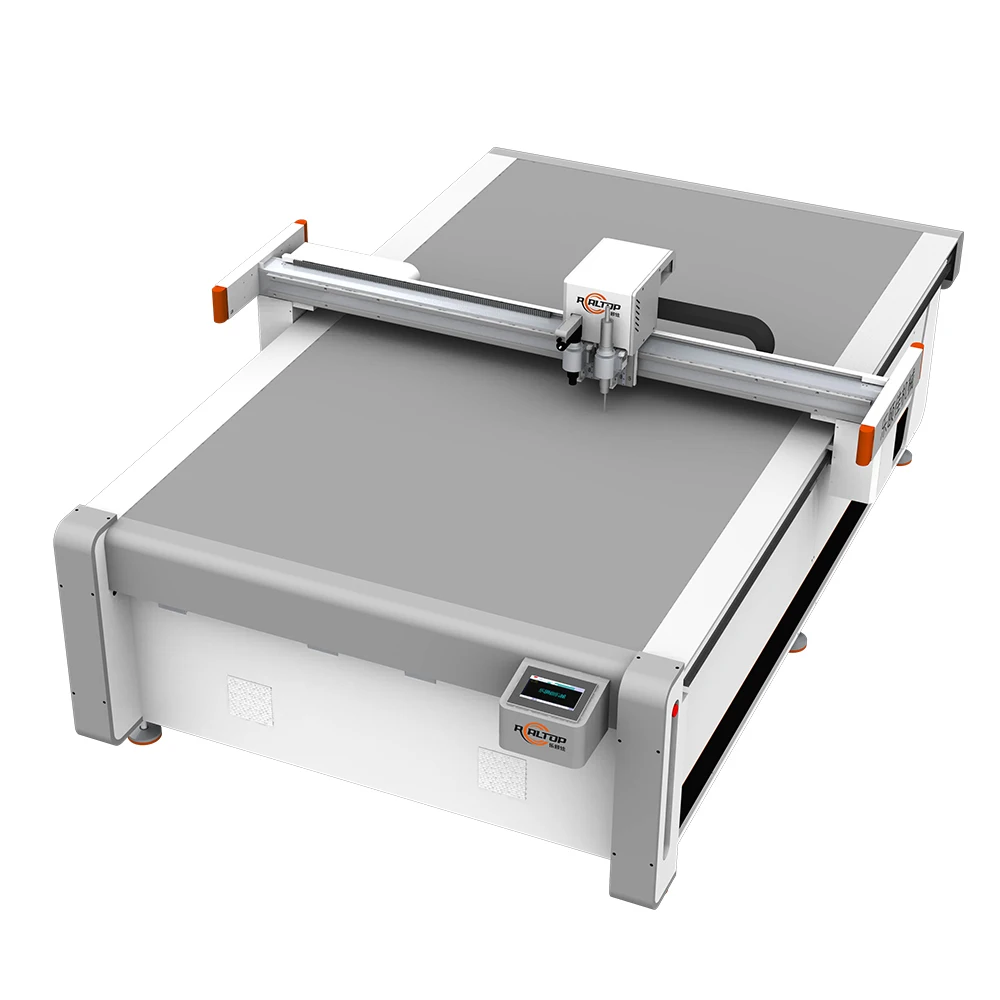
Zoned Vacuum Adsorption — The aluminum honeycomb platform on the RT-D2516 / RT-S2516 uses segmented suction areas to hold small carton flaps and nested sticker sheets flat, preventing material lift during high-speed oscillating knife passes.
Technical Specifications
| Parameter | Value |
|---|---|
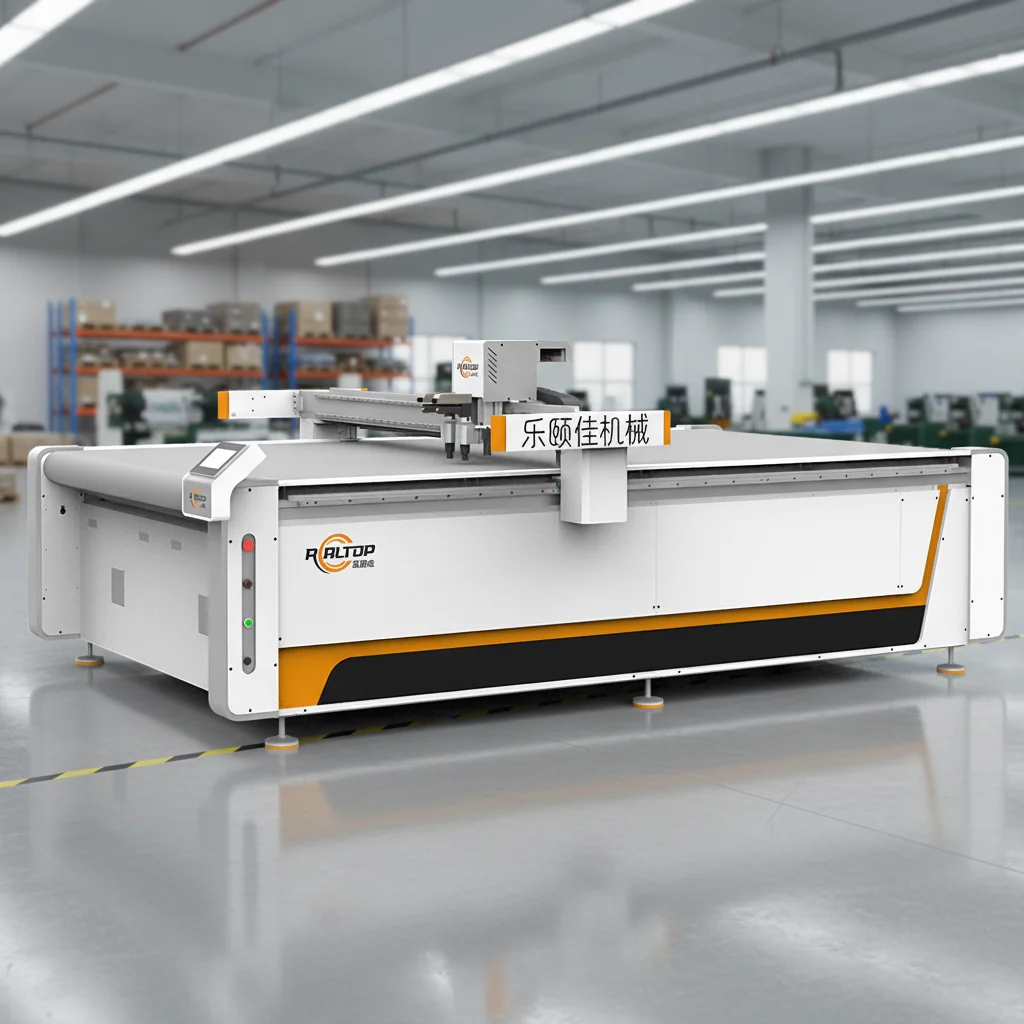
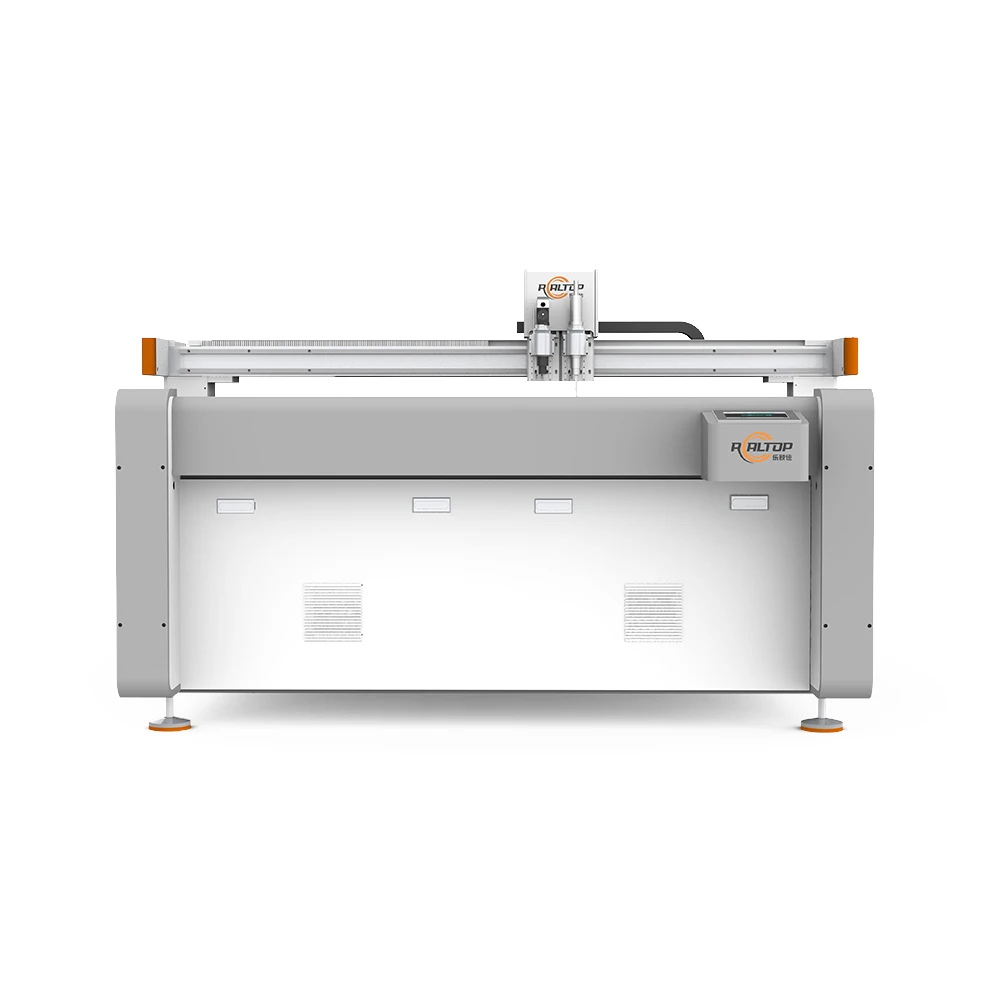
| Product Type | CNC Oscillating Knife Digital Cutting Table |
| Model | RT-D2516 / RT-S2516 |
| Working Area | 2500 × 1600 mm |
| Machine Size (Overall) | 3450 × 2300 × 1250 mm |
| Cutting Tools | Oscillating knife, creasing tool, kiss-cut knife, round punch |
| Fixing Method | Vacuum system (aluminum alloy honeycomb structure) |
| Rated Power | 9 kW |
| Cutting Thickness | ≤ 18 mm (basis not stated in source — confirm material type and density) |
| Profile Format | DXF, OLT, PDF, AI |
| Data Transfer | Ethernet port |
| Repeated Accuracy | < 0.05 mm |
| Voltage | 380 V |
| Servo Motor | Dongling servo (Delta servo available as alternative configuration) |
| Safety Device | Infrared sensors, emergency stop |
| Frame Structure | Welded thick square seamless steel, high-temperature treated |
| Guide Rail | Imported straight-line square guide |
| Transmission | Rack transmission |
| Language Options | English, Russian, Italian, Chinese (customizable) |
| Warranty | 1 year (excluding felt and knife blades) |
| Delivery Time | < 30 working days |
Application Suitability
| Application | Material or Output |
|---|---|
| Carton sample making and structural prototyping | Corrugated board (E, B, C flute), greyboard, solid bleached sulfate |
| Short-run folding carton production | Coated and uncoated paperboard up to working thickness limit |
| Sticker and label contour cutting | Printed vinyl, adhesive-backed paper, synthetic label stock |
| Point-of-purchase display components | Foam board, corrugated plastic, lightweight PVC sheet |
| Paper box and gift box packaging | Art card, laminated board, coated folding boxboard |
| Large-format electrical appliance cartons | Double- and triple-wall corrugated with creasing and cutout work |
Why Vacuum Table Zoning Decides the Fate of Small Packaging Parts
Segmented adsorption zones keep nested carton components pinned to the bed where single-zone vacuum cannot reach.
When a packaging sample maker nests dozens of small glue flaps, dust tabs and partition walls onto one sheet, the cutting tool releases each part from the surrounding matrix. A poorly zoned vacuum table leaves the outer regions without enough suction to hold those liberated pieces. The oscillating knife catches a lifted edge, tears the stock, and the entire sheet becomes scrap. I have watched operators on flatbed cutting machines lose an entire morning to this problem before realizing the vacuum layout was the root cause [NEED_CITE: vacuum table zoning principles for digital flatbed cutters]. The RT-D2516 / RT-S2516 addresses this with an aluminum honeycomb platform that segments suction so that even isolated small parts remain flat through the full CNC oscillating knife cutting table for packaging sample making cycle.
Tool Head Logic for the Packaging Workflow
The RT-D2516 / RT-S2516 carries four distinct tool options that map directly to the operations a packaging sample room performs daily. The oscillating knife handles through-cuts on corrugated and solid board, producing clean edges on flute profiles without crushing the internal structure. The creasing tool scores fold lines at controlled depth so that carton blanks fold precisely without cracking the outer liner. A kiss-cut knife option sits just above the backing paper, cutting the face stock of sticker sheets while leaving the release liner intact — critical for label converters who cannot tolerate laser-burned edges. The round punch produces registration holes or euro-slot hangers in one stroke, eliminating secondary operations.
Bed Size Matched to Standard Packaging Formats
Most packaging board suppliers ship sheets that fall within or close to the 2500 × 1600 mm working envelope. This means a carton sample maker can load a full sheet, run the nesting software, and cut an entire prototype set — or a short-run batch — without guillotine trimming to fit a smaller bed. The rack-and-pinion drive with imported linear square guide rails maintains the < 0.05 mm repeatability across this full travel, which matters when creasing lines must align with cut edges on both sides of a large carton blank [NEED_CITE: rack-and-pinion accuracy retention over long-format CNC beds].
Reading the Specs That Actually Matter in Production
The ≤ 18 mm cutting thickness figure is a starting point, not a guarantee — actual depth capability depends on board density, flute type, and whether the material is laminated. A dense greyboard at 18 mm behaves very differently from an 18 mm triple-wall corrugated sheet, so sample testing on the buyer’s own stock is the only reliable verification. The 9 kW rated power covers the servo drives, vacuum pump and oscillating head together; buyers should confirm that their workshop circuit can supply a dedicated 380 V line with adequate breaker capacity. The listed servo options — Dongling standard with Delta as an alternative — affect acceleration and deceleration behaviour on tight carton geometries, and the choice should be confirmed in writing before production begins. Software compatibility with DXF, AI, PDF and OLT formats covers the common output from packaging CAD systems, but nesting workflow integration should be tested with the buyer’s actual file exports to avoid import failures mid-job.
The Hidden Cost of Choosing the Wrong Tool Head
Selecting an oscillating knife for kiss-cut work on label stock produces ragged edges because the blade penetrates the backing paper. Conversely, using a drag knife on thick corrugated board creates torn flute edges rather than clean cuts. I have seen sample rooms commit to a single-tool configuration to reduce initial outlay, only to discover that their creasing work requires manual scoring with a separate hand tool — adding time and inconsistency to every carton prototype [NEED_CITE: tool head selection errors in digital packaging sample making]. The multi-tool carriage on the RT-D2516 / RT-S2516 avoids this by allowing tool changes within the same job file, so cutting, creasing and punching occur in one uninterrupted cycle.
What Distinguishes This Source for Packaging Cutting Equipment
In-house design and production cover both knife and laser cutting technologies, so the recommendation for corrugated board and sticker stock correctly points to oscillating knife rather than forcing a laser process onto materials that char or delaminate. Tool head and table configuration are specified per material and production volume rather than sold as a fixed package. CCD camera positioning is available for printed contour work on label and sticker sheets, confirmed before order rather than assumed. Software compatibility with the buyer’s nesting workflow is verified during the sample-cutting stage. Voltage, plug type and control language are documented and confirmed in writing before the machine enters production, eliminating on-site surprises during commissioning [NEED_CITE: equipment export documentation standards for CNC machinery].
Documentation & Verification
- Machine specification sheet listing confirmed tool heads and vacuum zoning layout for the RT-D2516 / RT-S2516
- Electrical schematic with 380 V circuit requirements and servo motor designation confirmed in writing
- Sample cutting report on buyer’s own corrugated board or sticker stock showing edge quality and creasing depth
- Tool head and table configuration list matching the agreed packaging workflow
- Software licence and file format compatibility note covering DXF, AI, PDF and OLT imports
- Packing photographs taken before crate closure showing bed surface and tool carriage condition
Installation, Commissioning & Support
- Dedicated 380 V circuit with appropriate breaker capacity to handle the 9 kW rated power draw of the RT-D2516 / RT-S2516
- Level floor area of at least 3450 × 2300 mm with clearance for operator access on three sides
- Vacuum pump connection verified and aluminum honeycomb platform suction zones tested before first production run
- Oscillating knife, creasing wheel and kiss-cut blade calibrated against buyer’s actual board stock during on-site commissioning
- Operator training covering Ethernet file transfer, nesting import from DXF or AI files, and tool change procedures
- Spare oscillating blades (10 pieces supplied) inventoried and reorder lead times confirmed with local distributor
Before You Request a Quotation
Share the specific board types, flute profiles and thicknesses you run most often, along with the typical sheet size and the smallest part dimension in your nested layouts. Confirm your workshop voltage and frequency, preferred control language, and whether your existing CAD system exports in DXF, AI or another listed format. If your work includes printed sticker contour cutting, specify whether CCD camera positioning is needed so that the correct configuration is quoted from the start.
Frequently Asked Questions
Q: How is cutting thickness verified for my specific board material and flute type?
A: The ≤ 18 mm specification is a general reference. We run sample cuts on your actual board stock — recording flute type, grammage and density — to confirm achievable cutting depth, edge quality and creasing accuracy before any order is placed. A written sample cutting report accompanies the quotation so you have a documented baseline.
Q: Which tool heads do I actually need for my packaging workflow?
A: Carton sample making typically requires the oscillating knife for through-cuts and the creasing tool for fold lines. If you also produce stickers or labels, the kiss-cut knife becomes necessary. The round punch is added when your designs include euro-slots or registration holes. We recommend only the tools your production demands.
Q: Is CCD camera contour recognition available on this model?
A: CCD camera positioning can be configured on the RT-D2516 / RT-S2516 for printed sticker and label contour cutting. This option must be confirmed during the quotation stage so the camera mount, lighting and software module are included. We test recognition speed on your printed sheets before shipment.
Q: How does vacuum table zoning handle small packaging parts?
A: The aluminum honeycomb platform divides suction into segments so that isolated small flaps and nested sticker components remain held even after surrounding material is cut away. We confirm zone coverage against your smallest typical part dimension during the specification stage to prevent material lift during cutting.
Q: What file formats are confirmed compatible with my design workflow?
A: The system accepts DXF, OLT, PDF and AI formats via Ethernet transfer. Before order, we test import of your actual design files — including nesting layouts from your CAD software — to verify that line weights, crease markings and layer assignments translate correctly without manual rework.




商品评价
Clear filtersThere are no reviews yet.