




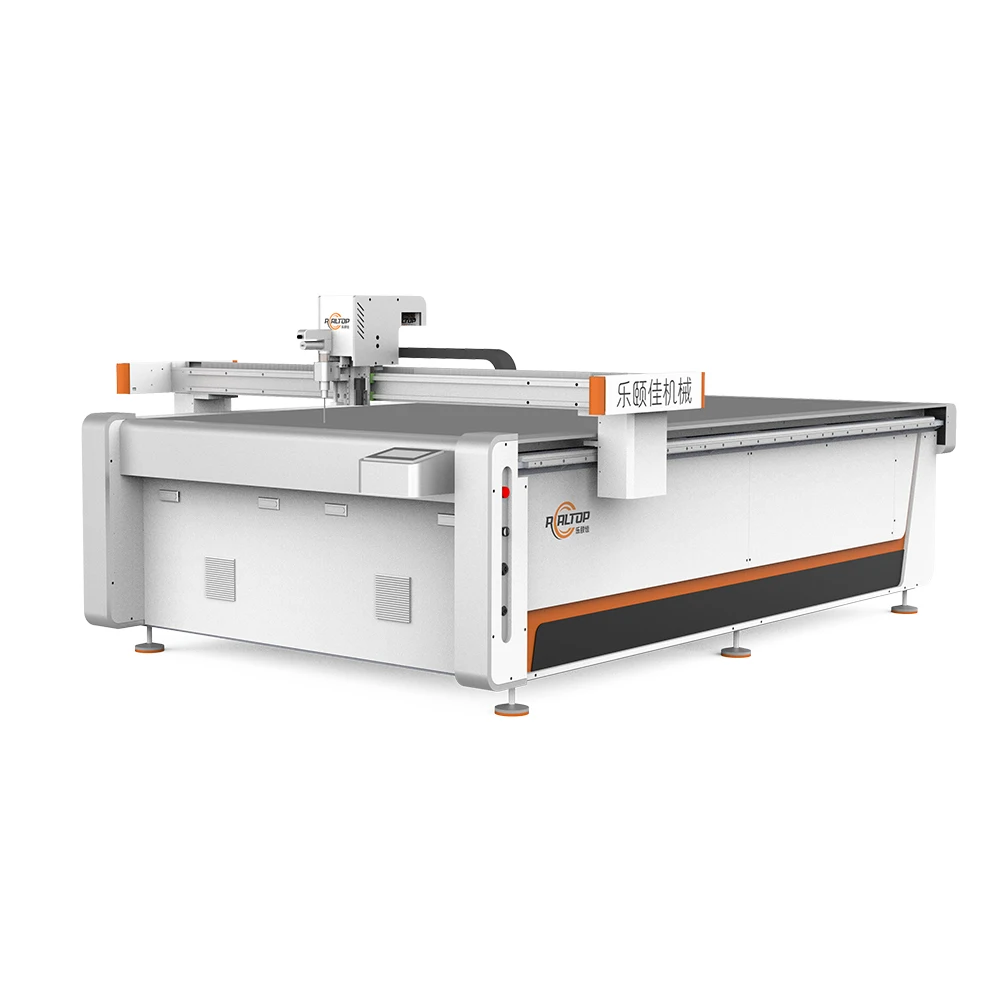
Cutting Method Matched to Material — Tool head and vacuum table zoning configured per composite formulation, so rubber and layered materials hold flat through the full cut path.
Technical Specifications
| Parameter | Value |
|---|---|
| Model | RT-D2516/RT-S2516 |
| Product Type | CNC Oscillating Knife Cutting Machine |
| Working Area | 1600 × 2500 mm |
| Machine Size | 3450 × 2300 × 1250 mm |
| Rated Power | 9 kW |
| Vacuum Pump | 7.5 kW |
| Working Table | Flat vacuum table |
| Tool Head | Swiss imported knife with vibration full cutting, vibration half cutting, and cursor location |
| Translational Velocity | 800–1200 mm/s |
| Cutting Speed | 200–800 mm/s (basis not stated in source — varies by material, thickness, and tool path complexity) |
| Cutting Thickness | Varies by material (confirm with sample test on actual composite stock) |
| Repeated Accuracy | ≤ 0.1 mm |
| Transmission System | Digital servo motor, linear guide, synchronous belt, ball screw (imported) |
| Servo Motor | Japanese Yaskawa |
| Linear Rail | Taiwan Hiwin |
| Conveyor Belt | Germany imported, auto-feeding equipped |
| Safety Device | Infrared sensors |
| Instruction System | HP-GL compatible format |
| Voltage | 380V ± 10% |
| Standards | CE declaration |
Application Suitability
| Application | Material or Output |
|---|---|
| Automotive gasket production | Rubber, fiber-reinforced elastomers, PTFE, ETFE |
| Composite panel cutting | Carbon fiber prepreg, fiberglass mat, honeycomb core |
| Industrial foam fabrication | PU, EVA, XPE, sponge composite leather |
| Signage and packaging | PVC, acrylic board, corrugated paper, cardboard |
| Garment and footwear | Leather, non-woven fabrics, garment cloth, carpet |
| Sealing and insulation | Silicon, soft glass, rubber sheet, gasket material |
Why Your Gasket Material Cuts Nothing Like the Demo Sample
A rubber sheet that looks identical on the spec sheet can behave completely differently under the knife once a fiber reinforcement layer is introduced.
I spent years around workshops in the Pearl River Delta watching buyers sign purchase orders after a clean demo cut on standard nitrile rubber. Then their production stock arrives — the one loaded with aramid or glass fiber for pressure resistance — and the oscillating knife chews through blade sets while leaving ragged, delaminated edges. The CNC oscillating knife cutting machine production line you evaluate must be validated against your exact formulation, not a catalog-grade sample pulled from a distributor’s shelf. Material density, shore hardness, and internal reinforcement all change how the blade engages, and those variables rarely appear on a technical data sheet [NEED_CITE: material variability in composite gasket manufacturing].
Knife Behavior Across Composite Formulations
A Swiss imported oscillating knife handles homogeneous elastomers cleanly because the vibration frequency lets the blade slice rather than tear. When the same blade meets a rubber sheet with an embedded fiber scrim, the oscillation must overcome both the elastic matrix and the tensile fibers simultaneously. The CNC oscillating knife cutting machine production line configured for this work needs a tool head that switches between full-cut and half-cut vibration modes, so operators can score a kiss-cut on a laminated composite without punching through the release liner underneath.
Holding Small Composite Parts Flat on the Table
Vacuum hold-down becomes the limiting factor once you cut parts smaller than the table zone they occupy. A 1600 × 2500 mm flat vacuum table with undivided suction will lose grip on gasket blanks the moment the knife completes a closed contour and atmospheric pressure equalizes. Zoning the vacuum surface into independently valved sections lets the operator match suction area to the nesting layout, preventing the lift-and-drift that destroys edge accuracy on thin composite sheets [NEED_CITE: vacuum table zoning practices in flatbed digital cutting].
Reading the Spec Sheet Against Real Production Conditions
Translational velocity listed at 800–1200 mm/s describes head travel on empty straight paths, not the cutting speed through actual composite stock. The 200–800 mm/s cutting speed range is material-dependent: a 3 mm silicone sheet may allow the upper end while a 10 mm fiber-reinforced rubber demands the lower. Repeated accuracy at ≤ 0.1 mm is achievable when the Taiwan Hiwin linear rails and Yaskawa digital servos are paired with a rigid frame, but thermal expansion in a humid workshop can shift that tolerance across a long shift. The 9 kW rated power must cover both the oscillating head and the 7.5 kW vacuum pump, so confirm your facility’s 380V ± 10% supply has the dedicated circuit capacity before installation.
What Happens When Configuration Is Skipped
Ordering a flatbed knife cutter on working area alone, without matching the tool head to the composite layup, leads to crushed foam cores and delaminated gasket edges that fail pressure testing. A conveyor system without proper tension adjustment feeds wrinkled material into the cutting zone, throwing off CCD contour registration mid-run. Buyers who skip the material-specific sample test often discover the problem only after their first production batch is scrapped [NEED_CITE: cost of material-machine mismatch in composite cutting operations].
Why Source This Machine Here
In-house design covers both knife and laser cutting processes, so the cutting method is selected to match the composite rather than forcing every material through one technology. Tool head and table configuration are specified against your material type and production volume before the order is placed. CCD camera positioning is validated on your printed contour artwork at full translational speed, not just at static alignment. Software file format compatibility is confirmed during the inquiry stage so your existing nesting workflow transfers without reprogramming. Sample cutting runs on your actual composite stock before commitment, giving you a physical report rather than a catalog promise.
Documentation & Verification
- Machine specification sheet listing tool head and vacuum table configuration per your composite material
- Electrical schematic with 380V ± 10% wiring diagram and dedicated circuit requirements
- Sample cutting report produced on your rubber or composite stock with edge quality photographs
- Factory test record documenting repeatability across a full sheet run before dispatch
- Software license with HP-GL format compatibility note for your existing nesting files
- Spare parts list covering Swiss knife blades and conveyor belt wear items
Installation, Commissioning & Support
- Floor space of at least 4.5 × 3.5 m to accommodate the 3450 × 2300 mm footprint with operator clearance
- Dedicated 380V ± 10% circuit rated for 9 kW machine load plus 7.5 kW vacuum pump draw
- Machine ships partially assembled; linear rails and servo drives require on-site alignment verification
- First-run commissioning includes vacuum zoning calibration matched to your typical nesting layout
- Operator training covers oscillating knife blade change, auto-feeding tension, and HP-GL file import
- Wear-item stock includes Swiss knife blades, conveyor belt segments, and vacuum seal strips
What to Include With Your Inquiry
Send the exact composite formulation you run in production, including any fiber reinforcement layers and the shore hardness range. Specify your typical sheet dimensions, daily cutting volume, and whether your nesting files originate from a specific CAD platform. Confirm your workshop voltage and frequency so the electrical package matches local supply standards before build begins.
Frequently Asked Questions
Q: How do I confirm cutting speed matches my actual composite material?
A: Request a sample cutting report run on your specific rubber or composite stock at your required thickness. The report documents the cutting speed, blade type, and edge quality achieved, giving you a production baseline rather than a generic translational velocity figure pulled from a catalog.
Q: What vacuum table zoning do I need for small gasket blanks?
A: Small composite parts require multiple independent vacuum zones so suction remains concentrated where the material still bridges the table surface. Confirm the zoning layout matches your typical nesting pattern so parts stay flat until the final cut path releases them.
Q: Does CCD contour recognition work at full production speed?
A: Static alignment accuracy differs from tracking accuracy at 800–1200 mm/s translational velocity. Ask for a live tracking test on your printed composite sheet to verify the camera maintains registration on production-speed contour cuts without drifting off the printed mark.
Q: Will my existing nesting software files import directly?
A: The instruction system accepts HP-GL compatible format, but nesting workflows vary by platform. Share a sample file set during the inquiry stage so compatibility is verified before the machine ships, avoiding reprogramming delays on your factory floor.




商品评价
Clear filtersThere are no reviews yet.