



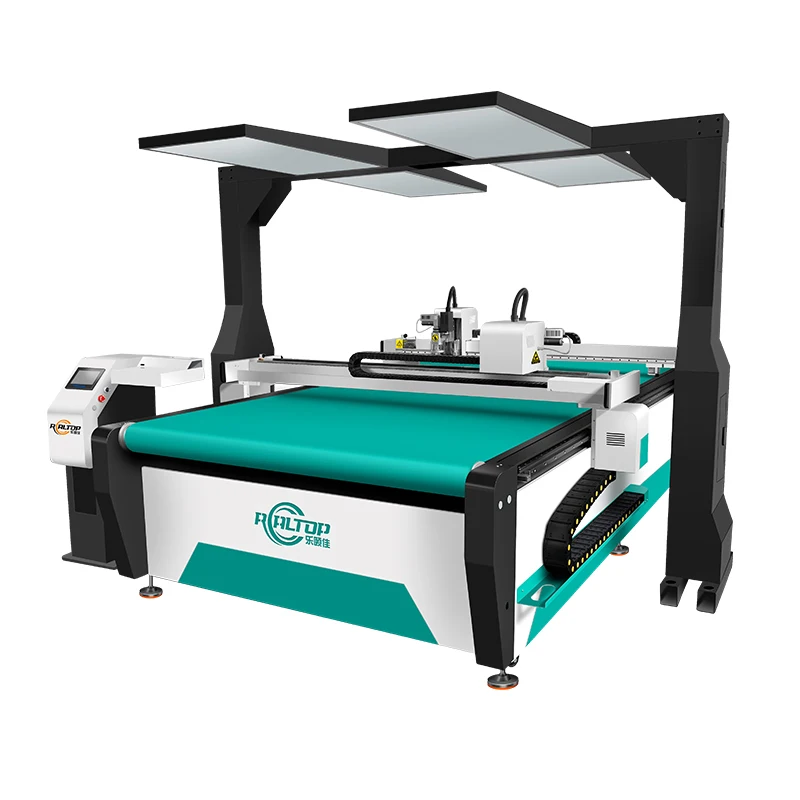
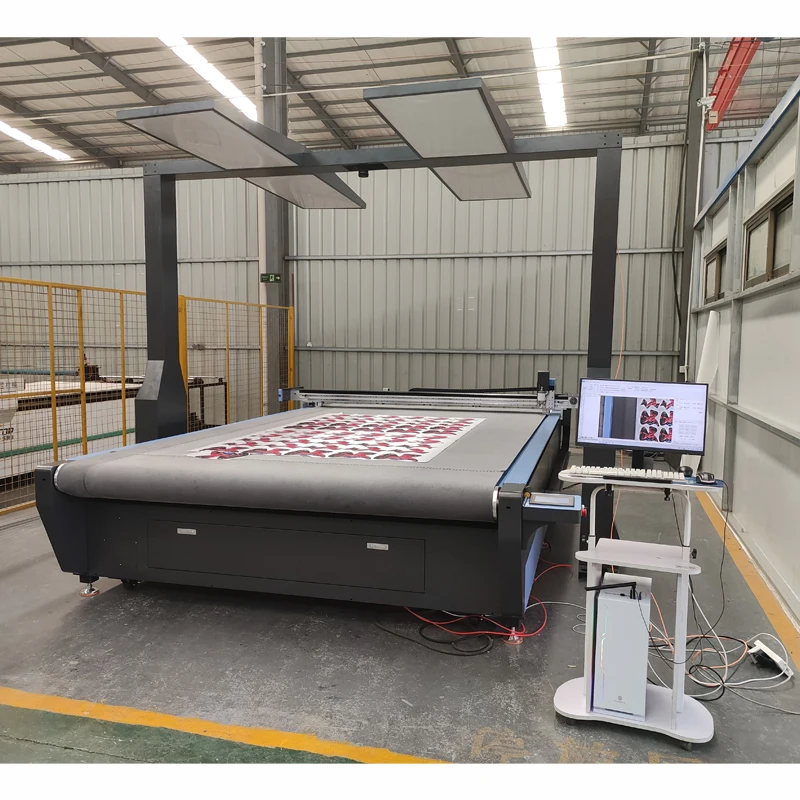
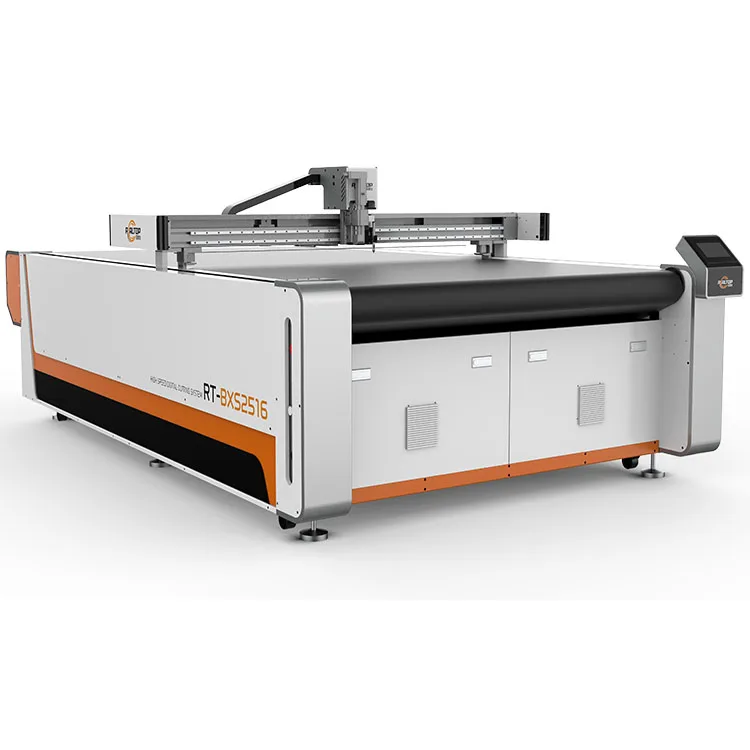
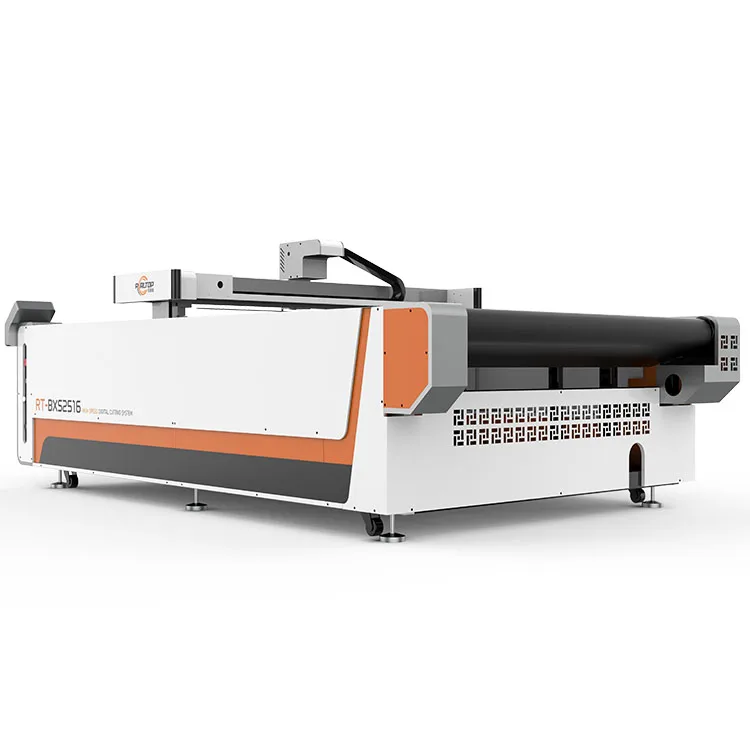
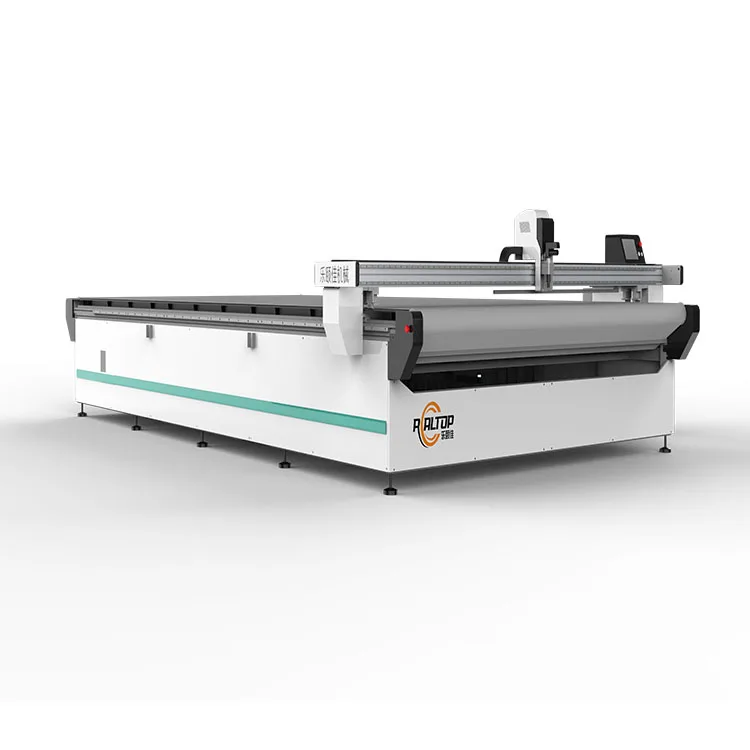
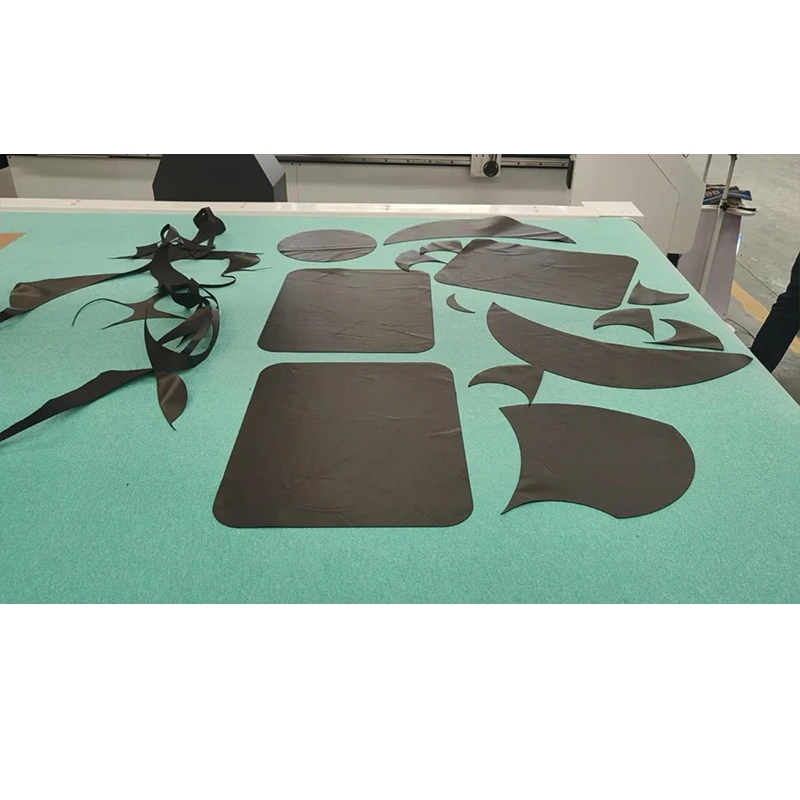

Workflow Integration — sample cutting on the buyer’s material confirms tool head, vacuum zoning and feeding configuration before the CNC oscillating knife cutting machine production line workflow is finalized.
Technical Specifications
| Parameter | Value |
|---|---|
| Model | RT-D2516 / RT-S2516 |
| Product Type | CNC Flatbed Oscillating Knife Cutting Machine |
| Working Area | 1600 × 2500 mm |
| Machine Overall Dimensions | 3450 × 2300 × 1250 mm |
| Rated Power | 9 kW |
| Voltage | 380V ±10% |
| Vacuum Pump | 7.5 kW |
| Table Type | Aluminum alloy flatbed with vacuum adsorption |
| Transmission System | Delta servo motor and drivers, Taiwan Hiwin linear guide, synchronous belt, ball screw |
| Translational Velocity | 800–1200 mm/s |
| Cutting Thickness Range | Up to 80 mm depending on material density and tool head (basis to be confirmed) |
| Repeated Positioning Accuracy | ≤ 0.1 mm |
| Safety Device | Infrared sensors |
| Visual Positioning Options | Small CCD camera mark point positioning, panoramic camera recognition, projection positioning |
| Conveyor / Feeding System | Germany imported conveyor belt with auto feeding |
| Instruction System | HP-GL compatible format; Realtop self-developed software |
| Control Language | English, Russian, Italian, Chinese; additional languages available on request |
| Machine Frame | Hard steel frame structure |
| Standards | CE declaration where applicable; 5 patents technology certification |
Application Suitability
| Application | Material or Output |
|---|---|
| Automotive interior trim and floor mats | Composite materials, synthetic leather, EVA, XPE, sponge composite leather, carpet |
| Garment, footwear and luggage production | Genuine leather, PU, PVC, textile, non-woven fabric, shoe material |
| Packaging and carton sample making | Corrugated cardboard, cardboard, plastic box, film, sticker |
| Gasket and sealing pad fabrication | Rubber, PTFE, ETFE, silicone, fiberglass, gasket material |
| Advertising signage and soft furnishing | PVC, PP, PE, foam board, cloth, soft glass |
Why "Cutting Speed" Means Nothing Without Material Context
Claiming 3–5 times faster than a laser cutter without specifying block format, material type and sheet thickness is a number waiting to disappoint on the shop floor. Translational velocity is not cutting speed — the material, tool head and vacuum hold-down together determine real cycle time.
I have watched production managers quote a cycle time from the brochure, run their first batch of 3 mm synthetic leather, and realize the edge quality forces a secondary trim pass that wipes out the throughput claim. The 800–1200 mm/s figure describes how fast the gantry moves between points, not how fast the knife actually penetrates your material stack [NEED_CITE: cutting speed depends on material density and tool selection]. When a buyer evaluates a CNC oscillating knife cutting machine production line workflow, the only reliable benchmark is a timed sample cut on the actual roll stock destined for the line.
Contour Tracking at Continuous Feeding Speed
Printed contour work exposes the weakest link in any digital cutting setup. Small CCD mark point positioning handles registered sheet-fed jobs where each sheet presents its marks to a stationary camera, while the panoramic camera recognition option addresses roll-fed work where marks must be tracked as material advances across the table. The distinction matters because a system configured only for static mark reading will lose registration once the conveyor belt starts moving at production pace.
For irregular materials like genuine leather, the panoramic recognition system scans the hide contour, identifies surface defects and drives the nesting software to route tool paths around unusable zones. This CNC oscillating knife cutting machine production line workflow integration eliminates the manual hide-marking step that traditionally bottlenecks leather cutting shops.
Feeding the Line Without Stopping the Knife
The Germany imported conveyor belt and auto feeding system exists for one reason: keeping material moving through the cutting zone without an operator manually dragging the next sheet into position. In roll-fed fabric or synthetic leather applications, the conveyor presents fresh material while the vacuum table holds the leading edge flat, and the knife begins cutting before the trailing edge has fully unrolled.
This overlap between feeding and cutting is where real throughput lives, not in the gantry speed figure. The felt belt surface — described as wear-resistant composite fiber with increased tension strength — must survive thousands of knife penetrations without fraying into the vacuum channels [NEED_CITE: felt belt lifespan under continuous knife cutting operations]. When the belt degrades, vacuum pressure drops at the table edges and small cut pieces lift during the return stroke, creating jams that halt the entire CNC oscillating knife cutting machine production line workflow.
Reading the Specs That Actually Affect Your Output
The 9 kW rated power figure covers the complete machine including the 7.5 kW vacuum pump, meaning the cutting head, servos and control draw the remaining capacity. Buyers who only look at cutting head power miss the fact that vacuum generation dominates the electrical load and must be matched to the local supply infrastructure.
Repeated positioning accuracy of ≤ 0.1 mm on Taiwan Hiwin linear guides determines whether nested pieces land consistently within tolerance across a full shift. In gasket and sealing pad work, where a 0.3 mm positional drift causes a bolt hole to misalign with its mating flange, this spec directly governs scrap rate. Delta servo motors and drivers close the positioning loop at the drive end, maintaining synchronization between the X and Y axes during diagonal cuts.
The hard steel frame structure resists the lateral forces generated when a high-power vibrating knife pushes through dense composite material at full depth. A frame that deflects under cutting load produces tapered edges on thick stock — visible when stacking cut gaskets and seeing daylight between the layers. Voltage at 380V ±10% must be confirmed against the destination factory supply before production begins.
What Happens When the Vacuum Zoning Is Wrong for the Job
I have seen small gasket parts lift off the table mid-cut because the vacuum zone was sized for full sheets, leaving the edges of small nested pieces without adequate hold-down. The aluminum alloy vacuum adsorption table must be zoned to match the typical part size in the buyer’s product mix. A table optimized for 1600 × 2500 mm full-sheet cutting can leave small stamping pieces floating when the knife exits the material, producing ragged edges and forcing manual sorting from the belt.
Wrong tool head selection for synthetic leather — using a drag knife calibrated for genuine hide — produces compressed edges that fail downstream quality inspection [NEED_CITE: tool head selection criteria by material type and thickness]. The multifunctional tool head offers Swiss imported oscillating knife, pneumatic knife, drag knife, creasing wheel, V cutting knife and punching options, but the buyer must specify which combination matches their material list before the machine ships.
Sourcing Against the Actual Production Requirement
Tool head and table configuration specified per material and production volume means the RT-D2516/RT-S2516 ships with the knife type, vacuum zoning map and conveyor speed pre-set for the buyer’s confirmed sample material — not a generic factory default.
Sample cutting on the buyer’s own material before commitment provides a cutting report that documents edge quality, achievable thickness and actual cycle time on the specific stock that will run in production. Software compatibility confirmed before order ensures the buyer’s existing HP-GL files and nesting workflow import without manual re-drawing. In-house design and production covering knife tooling means tool path parameters for the specified material are developed internally rather than left to the buyer’s operator to discover by trial and error. Voltage, language and specification customization extends to control interface language and electrical schematic matching the destination market requirements.
Documentation & Verification
- Electrical schematic and voltage confirmation document matching destination factory 380V supply
- Tool head and vacuum table zoning configuration list per specified material and part size
- Sample cutting report on buyer material documenting edge quality and cycle time
- Software licence and HP-GL file format compatibility note before shipment
- Factory test record with repeated positioning accuracy measurement across full working area
Installation, Commissioning & Support
- Dedicated 380V ±10% circuit with capacity exceeding 9 kW total machine load plus vacuum pump inrush
- Level foundation for 3450 × 2300 × 1250 mm footprint with clearance for conveyor feed and discharge
- Taiwan Hiwin rail alignment verification and Delta servo tuning after transport and reassembly
- Vacuum pump commissioning and zone pressure mapping across the 1600 × 2500 mm aluminum table
- Operator training on multifunctional tool head changeover and CCD positioning calibration
- Spare felt belt and knife blade inventory sized to the buyer’s production volume
Before You Request a Quote
Production managers evaluating the RT-D2516/RT-S2516 should submit material type, thickness range, sheet or roll dimensions and typical daily volume. Confirm the destination factory voltage and frequency, the control interface language required and whether your existing nesting software exports HP-GL. If printed contour work is in scope, specify the mark type and minimum mark size so the correct visual positioning system is included.
Frequently Asked Questions
Q: What material and thickness conditions support the stated translational velocity?
A: The 800–1200 mm/s figure describes gantry travel speed, not cutting speed through material. Actual cutting rate depends on material density, thickness and selected tool head. A timed sample cut on your specific stock — such as 3 mm synthetic leather or 5 mm EVA foam — is the only way to confirm achievable cycle time before committing to a production line configuration.
Q: How does the nesting software connect to existing HP-GL workflows?
A: The Realtop self-developed instruction system accepts HP-GL compatible format files directly. If your design team uses third-party nesting software, file format compatibility must be confirmed before order with test file exchange. This avoids discovering import errors after the machine arrives and production is scheduled to begin.
Q: Can the panoramic CCD track marks at full conveyor speed?
A: Panoramic camera recognition is designed for roll-fed work where marks move with the advancing material, while small CCD mark point positioning suits stationary sheet-fed jobs. The correct system depends on your feeding method and mark size. Verification on your printed material at target line speed is part of the sample cutting report.
Q: Will the vacuum table hold small parts during high-speed cutting?
A: Aluminum alloy vacuum adsorption must be zoned to match your typical part size. A configuration optimized for full-sheet work can leave small nested pieces under-secured, causing lift and edge defects. Your part dimension range must be specified so vacuum zones are mapped accordingly before the table is built.
Q: How does the conveyor synchronize with cutting cycles downstream?
A: The Germany imported conveyor belt and auto feeding system presents material continuously, but cycle synchronization depends on your downstream collection method — manual sorting, automated stacking or direct transfer to a sewing line. Confirm the receiving station layout so belt speed and cut discharge timing align with the next operation.



商品评价
Clear filtersThere are no reviews yet.