


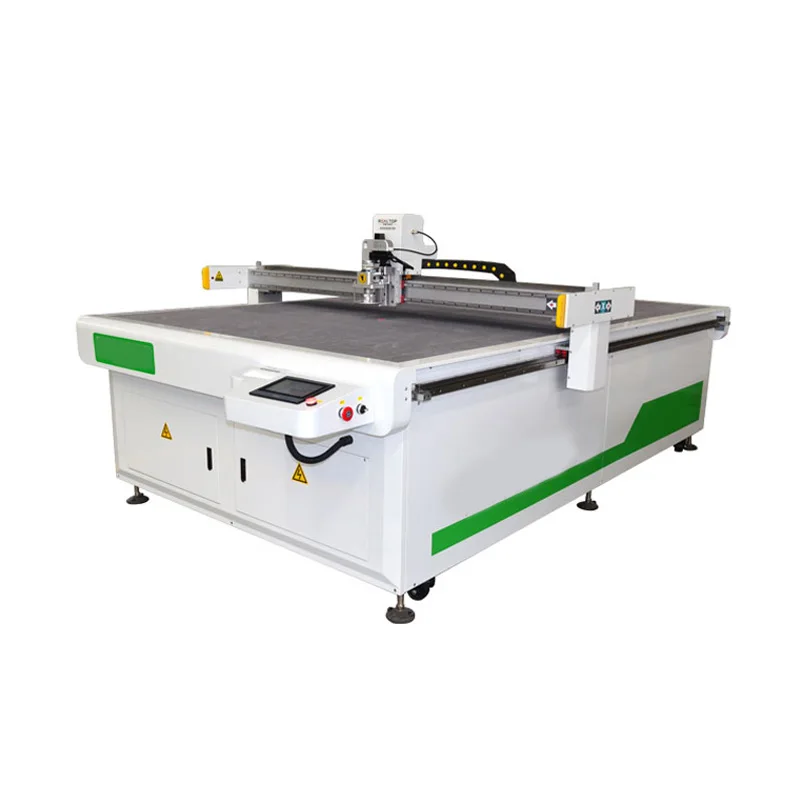

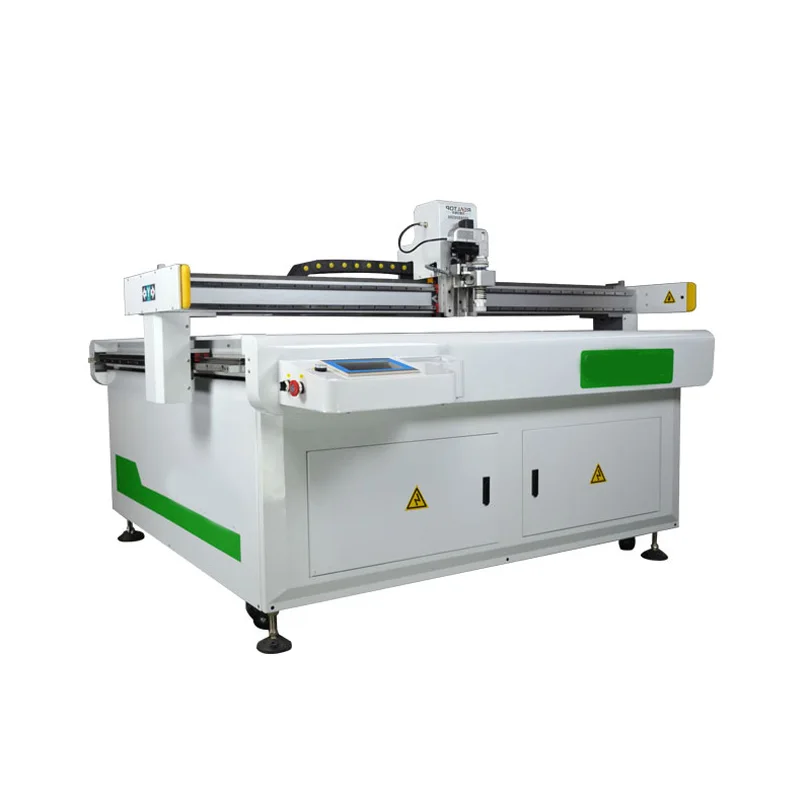

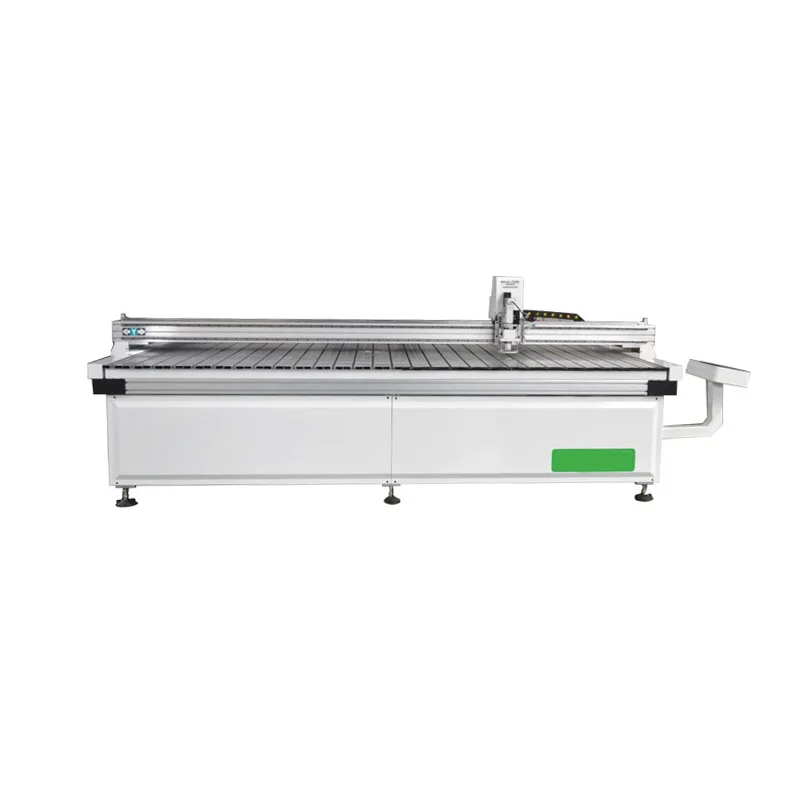


Precision Creasing on Corrugated — sample cuts on the buyer’s actual board grade confirm knife pressure, crease depth and edge finish before shipment.
Technical Specifications
| Parameter | Value |
|---|---|
| Product Type | CNC Digital Carton Sample Cutting Machine |
| Model | RT-D2516/RT-S2516 |
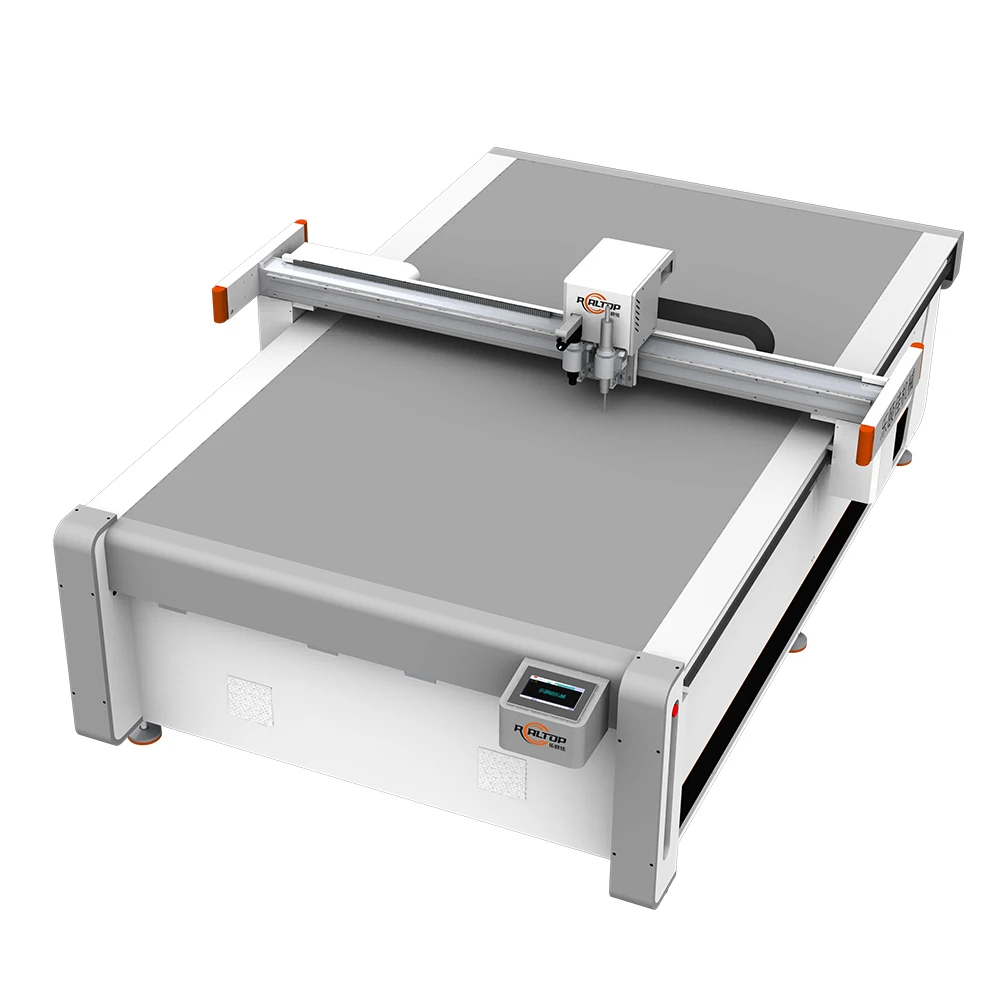
| Working Area | 1600×2500 mm |
| Overall Dimensions (L×W×H) | 3450×2300×1250 mm |
| Rated Power | 9 kW |
| Table Type | Flat working table with 7.5 kW vacuum pump |
| Tool Head | Swiss imported knife with vibration full cutting, half cutting and cursor location |
| Translational Velocity | 800–1200 mm/s |
| Cutting Speed | 200–800 mm/s (varies by material) |
| Repeated Accuracy | ≤0.1 mm |
| Transmission System | Digital servo motor, linear guide, synchronous belt, imported ball screw |
| Servo Motor | Japanese Yaskawa |
| Linear Guide | Taiwan Hiwin rail |
| Conveyor Belt | Germany imported |
| Auto Feeding | Yes |
| Safety Device | Infrared sensors |
| Instruction System | HP-GL compatible format |
| Voltage | 380V ±10% |
Application Suitability
| Application | Material or Output |
|---|---|
| Carton and packaging sample making | Single-face corrugated, double-wall board, grey chipboard, folding carton stock |
| Signage and display production | Foam board, honeycomb board, corrugated plastic, vinyl |
| Gasket and industrial fabrication | Rubber sheet, compressed fibre, PTFE, cork composite |
| Leather and flexible goods sampling | Split leather, synthetic PU, coated textile, sponge composite |
Why the File Format Question Should Come Before the Order
Confirming HP-GL compatibility and nesting workflow integration avoids the most common cause of idle machines on the sample-room floor.
I spent a season in the assembly bay watching machines get crated, shipped, then sat unused because the buyer’s CAD system exported a format the control software could not parse. Packaging houses running structural design on ArtiosCAD or EngView often discover after delivery that the nesting module does not accept their DXF layer structure or that crease-line recognition fails on their file output. The CNC carton sample cutting machine production line workflow depends entirely on file interchange working on day one [NEED_CITE: common CAD-to-CNC file format interoperability issues in packaging prototyping]. Sorting this out at quotation stage — with a sample file from the buyer’s own software — costs nothing; resolving it after commissioning costs production time.
Tool Head Selection for Board Versus Flexible Stock
The Swiss imported oscillating knife on the RT-D2516/RT-S2516 runs full-cut and half-cut modes, which matters because packaging sample making demands both clean through-cuts on contour edges and controlled-depth creases on fold lines. For B-flute or E-flute corrugated, full vibration amplitude clears the flute without crushing; for thin folding carton, half-cut mode scores the surface without penetrating the liner. When the same machine is asked to cut leather or sponge composite for a soft-goods sample run, the vibration frequency and stroke length need adjustment — something configured through the control software rather than a physical tool change.
Vacuum Table Zoning for Small Samples and Full Sheets
The 7.5 kW vacuum pump paired with the flat working table holds lightweight board flat across the 1600×2500 mm surface, but packaging sample rooms frequently cut small structural prototypes that cover only a fraction of the bed. Zoning the vacuum into sections prevents air leakage through uncovered areas, maintaining enough suction to keep a 150×100 mm carton blank from lifting during a high-speed contour pass [NEED_CITE: vacuum zoning principles for flatbed digital cutting of small-format parts]. Without proper zoning, thin corrugated lifts at the edges, the knife drags, and the crease line wanders off register.
Reading the Specs That Matter in Sample Making
Repeated accuracy of ≤0.1 mm directly affects whether crease lines land on the intended score position across multiple prototype iterations — a tolerance drift of even a few tenths of a millimetre accumulates over a long crease path and produces a box that folds off-square. The Japanese Yaskawa servo motors and Taiwan Hiwin linear rails work together to hold this tolerance over the full travel range. Translational velocity of 800–1200 mm/s governs non-cutting moves between features, so faster values reduce dead travel time on complex nest layouts. The HP-GL compatible instruction system means the machine accepts plotter-standard vector paths, which covers the export format of most packaging CAD platforms. Auto feeding via the German-imported conveyor belt lets the machine pull successive sheets without manual registration, relevant when short-run output extends beyond a single sample.
What Happens When Configuration Is Skipped
I recall a carton converter who specified a machine by working area alone, then discovered that the standard knife pressure setting could not penetrate their double-wall BC-flute at production speed. The edges came out with torn liner and crushed fluting — every sample rejected by their client’s packaging engineer. A heavier oscillating knife module and adjusted vacuum zoning resolved the issue, but only after weeks of downtime and a service visit. Matching tool head to board grade and confirming vacuum suction at the actual sheet size are both configuration decisions that belong in the quotation, not in the troubleshooting log [NEED_CITE: oscillating knife selection criteria by corrugated flute profile and board density].
What Distinguishes the Build
In-house design and production means the knife cutting system and the vacuum table are engineered as one unit, not sourced separately and bolted together on the floor. The tool head and table configuration list is specified per buyer material, so a packaging house running predominantly E-flute receives a different setup than a gasket fabricator cutting compressed fibre. CCD camera positioning is available for printed contour work where die-cut samples must register to pre-printed graphics. Software licence and file format compatibility are verified before the order is released to production. The CNC carton sample cutting machine production line workflow is validated with the buyer’s own file output during pre-shipment testing.
Documentation & Verification
- Machine specification sheet confirming working area, tool head type and vacuum pump rating
- Electrical schematic and 380V ±10% voltage confirmation matched to buyer site supply
- Sample cutting report on buyer’s own corrugated or carton board with edge and crease photos
- Software licence documentation with HP-GL file format compatibility note
- Tool head and table configuration list detailing knife stroke, vacuum zoning and feeding setup
- Factory test record showing repeated accuracy verification across full travel range
Installation, Commissioning & Support
- Floor space must accommodate 3450×2300 mm footprint with clearance for sheet loading on the 2500 mm axis
- Dedicated 380V ±10% three-phase circuit rated for 9 kW continuous draw plus vacuum pump load
- Machine ships on flatbed with vacuum table and gantry assembled; belt conveyor attached on site
- First-run commissioning includes vacuum zoning adjustment, knife depth calibration and servo tuning
- Operator training covers HP-GL file import, nesting layout setup and knife wear inspection intervals
- Spare parts package includes oscillating knife blades, vacuum seals and conveyor belt sections
What to Prepare Before Enquiry
Share the specific board grades and flute profiles you run in sample production, along with typical sheet sizes and the CAD software generating your cut files. If you also cut flexible materials like leather or rubber on the same machine, list those material types and thicknesses. Confirm the voltage and frequency at your facility, and whether your control operators need a specific language on the interface.
Frequently Asked Questions
Q: Which file formats does the control software accept and how does it integrate with existing packaging CAD?
A: The instruction system is HP-GL compatible, which covers vector output from most structural packaging CAD platforms. Before order confirmation, we verify compatibility with your specific software export by running a sample file from your system through the nesting and cutting workflow on the RT-D2516/RT-S2516.
Q: How is vacuum table zoning configured for small carton samples versus full-sheet nesting?
A: The flat working table can be divided into vacuum zones so that suction concentrates under the active cutting area. For small prototypes, closing off unused zones maintains holding force on thin board; for full-sheet nesting, all zones open to distribute suction evenly across the 1600×2500 mm surface.
Q: What tool head is recommended for corrugated board versus flexible packaging materials?
A: The Swiss imported oscillating knife handles both categories with adjustable vibration amplitude. Corrugated board typically requires full-stroke oscillation for clean flute penetration, while leather and sponge composite need reduced stroke and lower downward pressure to avoid material compression.
Q: Is sample cutting on the buyer’s own material available before order commitment?
A: Yes. Buyers are asked to send representative sheets of their actual board grade, flute profile or flexible material. We run sample cuts, document edge quality and crease depth, and share the cutting report before the quotation is finalized.




商品评价
Clear filtersThere are no reviews yet.