

Blog
What CNC Machine Types Should You Choose for Advanced Composites?

What CNC Machine Types Should You Choose for Advanced Composites?
I still remember the day a frustrated automotive supplier called us. They had bought a CNC router, expecting clean cuts on carbon fiber panels. Instead, they got dust clouds, delamination, and scrap rates above twenty percent1. They asked me, "Why didn't anyone tell us routers burn composites?" That conversation forced me to rethink how we explain CNC machine selection for advanced composites.
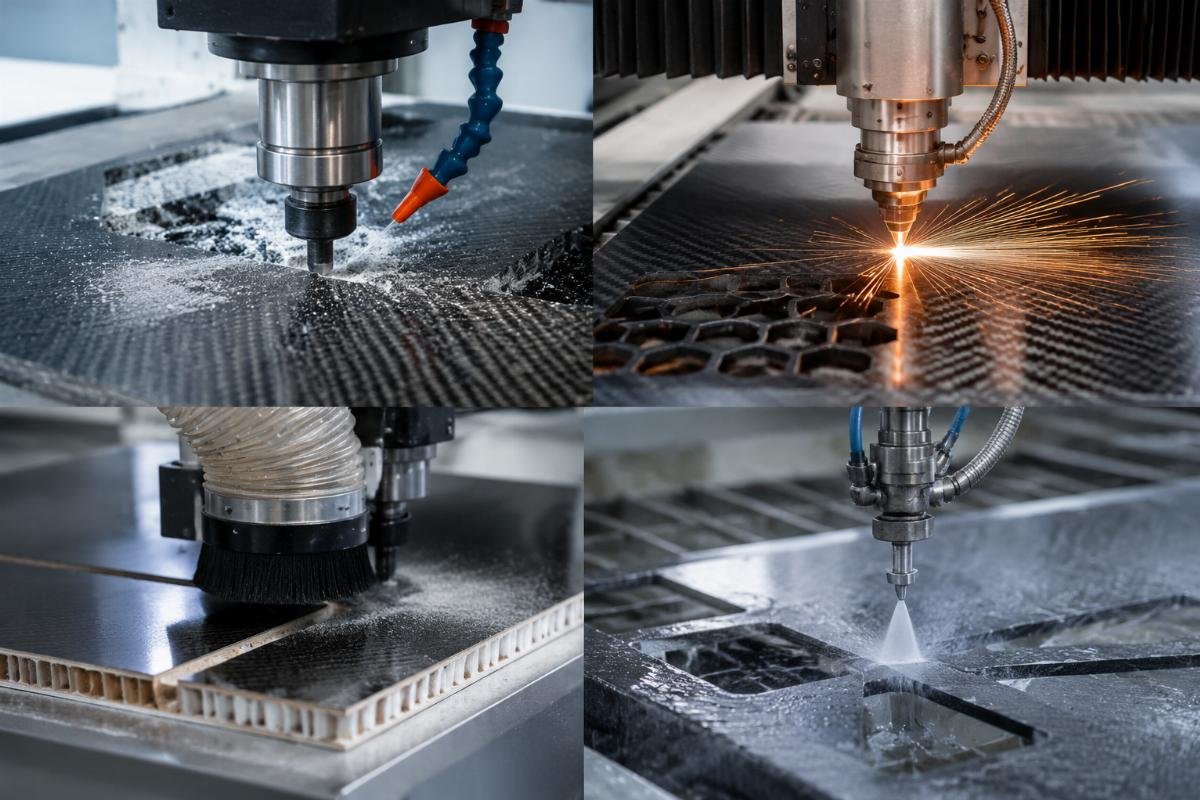
Four main CNC machine types can cut advanced composites: CNC routers use rotating bits, laser systems apply focused heat, waterjet machines shoot high-pressure streams, and CNC knife cutters drag sharp blades. Each type suits different composite structures, thicknesses, resin states, and production volumes—choosing the wrong type leads to edge defects, delamination, rework costs, and wasted capital investment.
Most buyers assume any CNC machine "capable of composites" will handle their material. That assumption costs them thousands in rejected parts and lost time. I've seen it happen repeatedly in our testing lab and heard it from customers who switch to Realtop after bad experiences elsewhere. The truth is simpler than most vendors admit: you need to match the cutting tool to your composite's structure, fiber type, resin state, thickness, and edge quality requirements before you spend a cent.
How Do CNC Routers Handle Advanced Composites?
CNC routers work by spinning carbide or diamond-coated bits at high speed. The rotating tool removes material through mechanical abrasion. This method works well for thick composite laminates, multi-layer structures, and parts that need three-dimensional profiling.
CNC routers suit thick laminates, fiberglass, and sandwich panels when you can tolerate dust, heat, and moderate edge quality. They excel at deep cuts, chamfered edges, and complex contours, but they generate airborne particles, create heat-affected zones, and risk delamination if spindle speed or feed rate settings are incorrect.
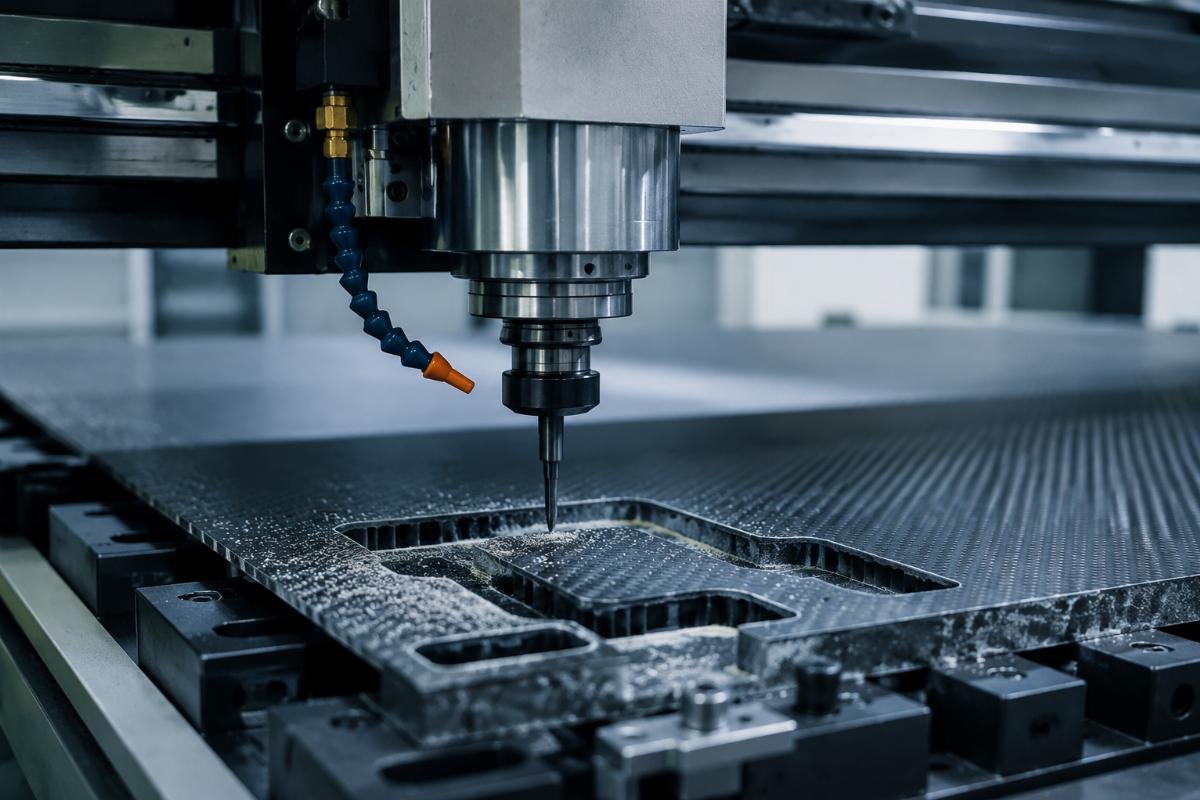
Routers dominate industries that process fiberglass boat hulls, wind turbine blade sections2, and automotive underbody shields. When a customer needs to cut through twenty-millimeter sandwich panels with aluminum honeycomb cores, routers deliver the power and rigidity no knife system can match. However, every time the bit touches carbon fiber or aramid fabric, it creates dust that poses respiratory hazards3 and contaminates clean rooms.
Heat buildup is the second major issue. High spindle speeds generate friction, which softens thermoplastic resins and scorches thermoset matrices. I tested a sample of unidirectional carbon fiber with a standard router at eighteen thousand RPM4. The cut edge showed visible resin burn and fiber pull-out under magnification. When we dropped the speed to twelve thousand RPM and used a coated bit, edge quality improved, but cycle time increased by thirty percent.
Delamination happens when feed rate and bit geometry don't match the laminate structure. Pushing too fast causes the bit to tear plies apart instead of shearing them cleanly. Pushing too slow allows heat to accumulate. The optimal window is narrow, and it changes with every material combination. Customers who run mixed production batches—fiberglass one day, carbon fiber the next—struggle to maintain consistent edge quality without frequent tooling changes and parameter adjustments.
When Should You Choose a CNC Router for Composites?
| Material Type | Thickness Range | Router Suitability | Key Considerations |
|---|---|---|---|
| Fiberglass laminates | 5mm – 50mm | High | Lower dust hazard, good edge finish with proper speeds |
| Carbon fiber (woven) | 2mm – 20mm | Medium | Requires dust extraction, risk of fiber pull-out |
| Aramid composites | 3mm – 15mm | Medium | Fiber toughness dulls bits quickly, frequent tool changes |
| Sandwich panels | 10mm – 80mm | High | Best option for thick structures with foam or honeycomb cores |
| Thermoplastic composites | 2mm – 30mm | Medium | Heat management critical, risk of resin melting |
CNC routers make sense when you need three-axis or five-axis machining, when your parts require chamfers or bevels, or when material thickness exceeds what knife systems can penetrate. If your shop already has dust collection infrastructure and accepts the cost of consumable tooling, routers offer proven reliability for thick composites. But if you process thin prepreg, dry fabric, or materials sensitive to heat and contamination, routers create more problems than they solve.
Can Laser CNC Machines Cut Advanced Composites Safely?
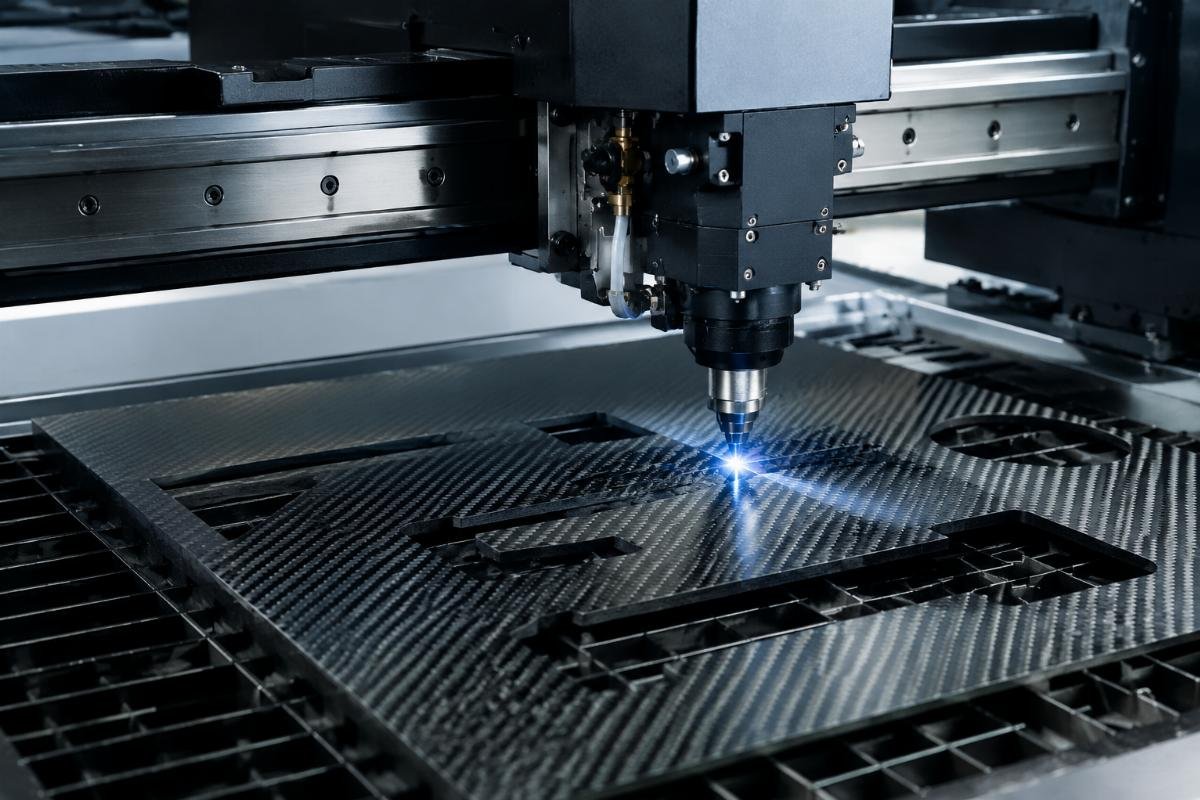
Laser CNC machines use focused infrared or CO2 laser beams to vaporize material along a programmed path. The beam melts or burns through the composite matrix and fibers, leaving a narrow kerf and minimal mechanical stress on the surrounding material.
Laser cutting suits thin composite sheets, woven fabrics, and low-volume prototyping when edge quality is secondary to speed and when heat-affected zones and fume extraction are managed. Lasers eliminate tool wear and allow intricate shapes, but they create char, resin degradation, and toxic fumes that require expensive ventilation and filtration systems.
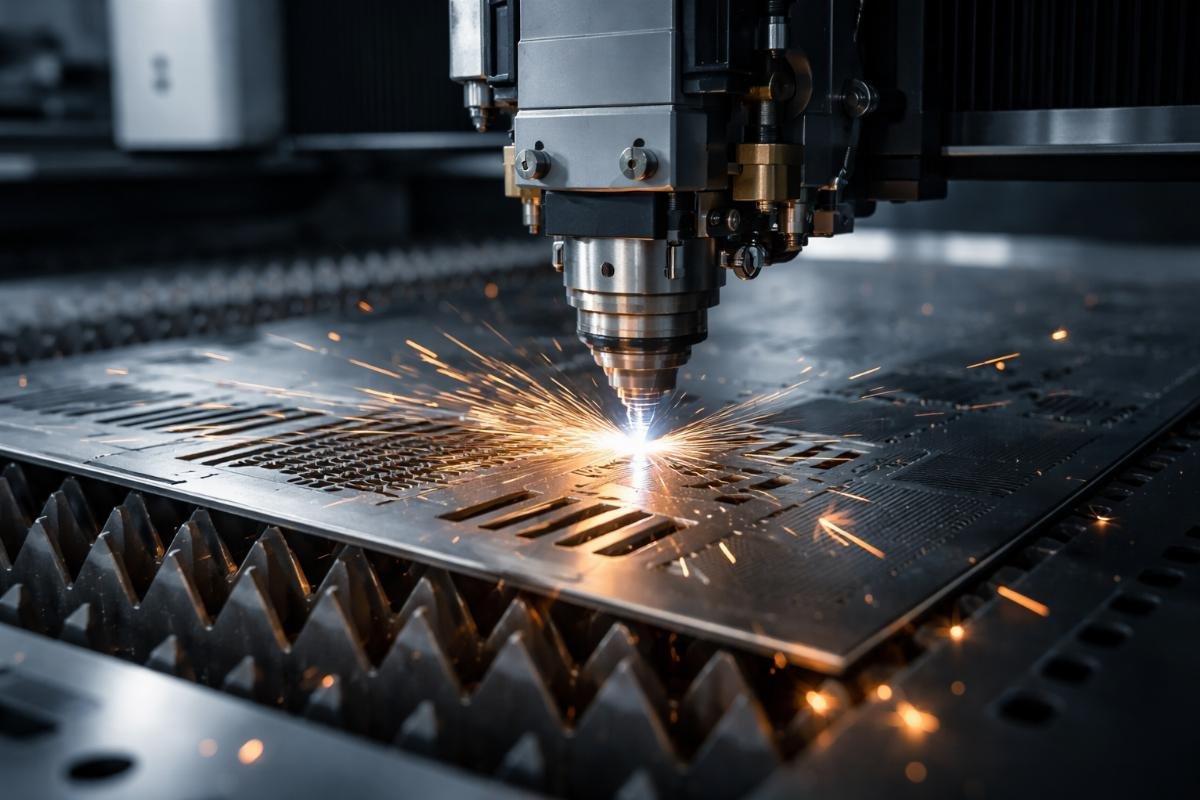
I tested laser cutting on three-millimeter carbon fiber epoxy laminate. The machine cut the part in under two minutes, far faster than a router or knife system could manage for the same geometry. However, the cut edge showed a visible heat-affected zone extending one millimeter into the laminate5. Resin near the cut line had discolored and lost mechanical properties. When we tried to bond that edge to another part, adhesive bond strength dropped by forty percent6 compared to a knife-cut edge with no thermal damage.
Fume generation is the second barrier. Burning epoxy, polyester, or vinyl ester resin releases volatile organic compounds7, particulates, and potentially hazardous gases depending on the resin chemistry and fiber sizing agents. Customers who operate lasers without proper filtration face regulatory compliance issues and health risks for operators. High-quality filtration systems add significant capital cost on top of the laser machine itself.
Laser cutting also struggles with thick laminates. As material thickness increases, the laser must deliver more energy, which increases the heat-affected zone and char depth. Beyond five millimeters, most CO2 lasers cannot maintain acceptable edge quality. Fiber lasers perform better on thicker materials but cost substantially more and still create thermal damage.
What Composite Materials Can Lasers Cut Effectively?
| Material Type | Thickness Range | Laser Suitability | Key Limitations |
|---|---|---|---|
| Dry carbon fabric | 0.2mm – 2mm | High | Minimal resin to burn, low fume generation |
| Prepreg sheets | 0.3mm – 3mm | Medium | Resin burns, creates char, requires fume extraction |
| Woven fiberglass | 0.5mm – 4mm | Medium | High heat-affected zone, edge discoloration |
| Cured laminates (thin) | 1mm – 5mm | Low | Thermal damage reduces bond strength, structural integrity |
| Sandwich structures | Not suitable | None | Foam cores ignite, honeycomb reflects or absorbs beam unpredictably |
Laser systems work best for prototyping shops, signage companies cutting decorative composites, or manufacturers processing dry fabric that will be infused later. If your production requires structural parts with bonded joints or parts thicker than five millimeters, lasers introduce risks that outweigh their speed advantage. I've seen customers buy lasers because they seemed "high-tech," only to discover that edge quality and fume management costs made them impractical for their actual production needs.
Why Do Waterjet CNC Machines Avoid Thermal Damage in Composites?
Waterjet CNC machines propel a stream of water mixed with abrasive particles at pressures exceeding sixty thousand PSI8. The stream erodes material along the cut path without generating heat, eliminating the thermal damage that plagues routers and lasers.
Waterjet cutting eliminates heat-affected zones, prevents delamination from thermal stress, and handles thick laminates, but it introduces moisture into the material, requires abrasive disposal, and operates more slowly than routers or lasers for equivalent part complexity.
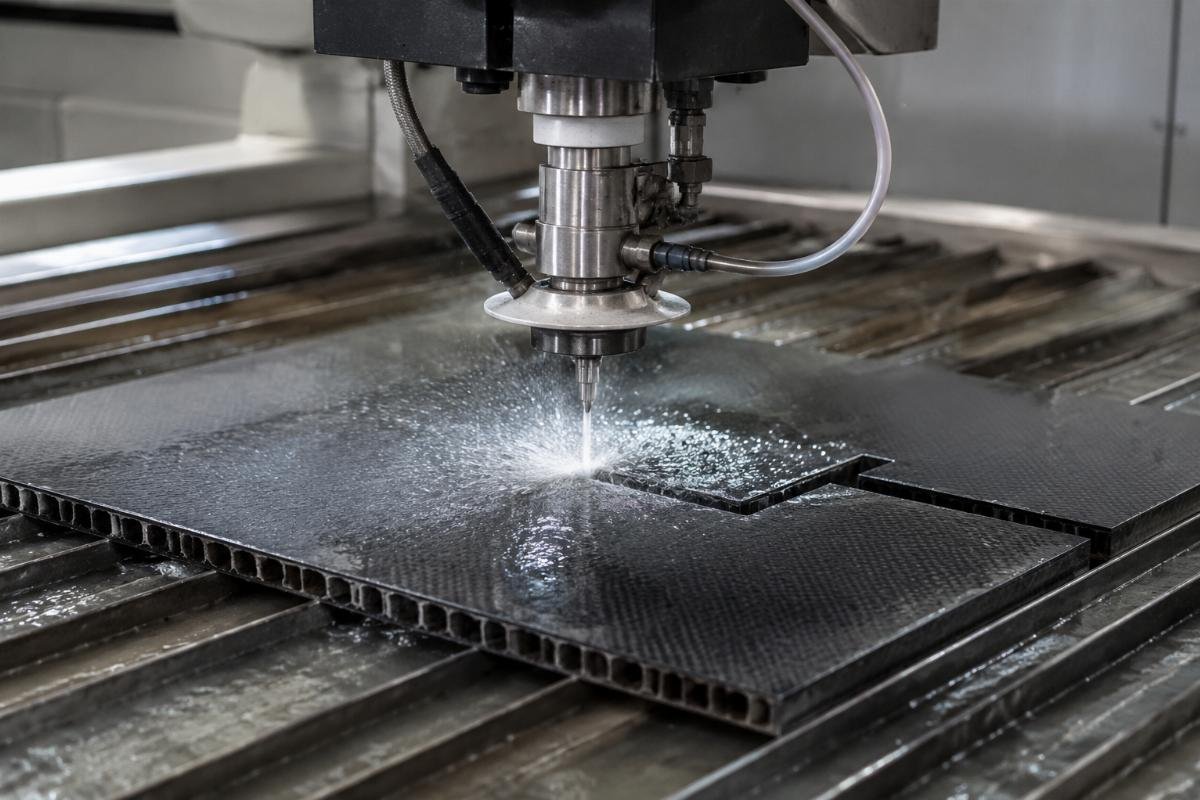
Waterjet systems excel when you need to cut carbon fiber, aramid, or hybrid composites without compromising fiber-matrix adhesion or edge mechanical properties. I tested waterjet cutting on ten-millimeter carbon fiber epoxy laminate. The cut edge showed no heat discoloration, no fiber fraying, and no measurable loss of interlaminar shear strength9. When we bonded that edge to an aluminum bracket, bond strength met design specifications without any surface preparation beyond solvent wipe.
However, moisture absorption is a real concern. Waterjet cutting saturates the cut edge with water. If the composite matrix is hydrophilic10 or if the part has exposed fiber bundles, moisture can wick into the laminate and degrade mechanical properties over time. Customers who process epoxy prepreg or thermoplastic composites must dry parts after cutting and before secondary operations like bonding or machining. Drying cycles add process time and energy cost.
Abrasive consumption and disposal create ongoing operating expenses. Garnet abrasive11 costs add up quickly in high-volume production, and spent abrasive mixed with composite dust requires proper waste management. The abrasive stream also wears orifices and nozzles, which are expensive consumables that need regular replacement.
Speed is the third limitation. Waterjet cutting is slower than laser cutting for thin materials and slower than router cutting for simple contours. Complex shapes with tight radii require the machine to slow down further to maintain edge quality. A part that takes two minutes to cut with a laser might take eight minutes with a waterjet. If your production volume demands fast cycle times, waterjet throughput becomes a bottleneck.
When Does Waterjet Cutting Make Sense for Composites?
| Application | Material Type | Waterjet Advantage | Trade-offs |
|---|---|---|---|
| Aerospace structural parts | Carbon fiber, aramid, hybrid laminates | No thermal damage, preserves mechanical properties | Moisture management required, slower cycle time |
| Thick sandwich panels | Foam or honeycomb core with composite skins | Cuts through core without crushing or burning | Abrasive disposal, higher operating cost |
| High-temperature service parts | Polyimide, phenolic composites | Avoids resin degradation from heat | Post-cut drying required for some resins |
| Bonded assemblies | Any composite requiring adhesive joints | Clean edge for maximum bond strength | Slower than competing methods |
| Prototyping low-volume parts | Mixed material types in short runs | No tooling changes, no thermal or mechanical stress | High per-part cost compared to high-volume methods |
Waterjet systems suit aerospace suppliers, high-performance automotive manufacturers, and industrial fabricators who prioritize edge quality and material integrity over cycle time. If your parts go into safety-critical applications or require certified material properties, waterjet cutting removes the risk that thermal or mechanical cutting methods introduce. But if you process high volumes of thin materials or need tight tolerances on complex shapes, waterjet cutting adds cost without delivering proportional value.
How Do CNC Knife Cutters Fit Into Composites Processing?
CNC knife cutters use a sharp blade mounted on a vertical axis that oscillates or vibrates at high frequency12. The blade penetrates the material and drags along the programmed path, shearing fibers and matrix without generating heat or airborne particles.
CNC knife cutting eliminates dust, avoids thermal damage, and produces clean edges on dry fabric, prepreg, and thin cured laminates, but it requires stable, pre-cured materials, cannot cut thick laminates or hard sandwich cores, and demands precise blade geometry and cutting speed for each material type.
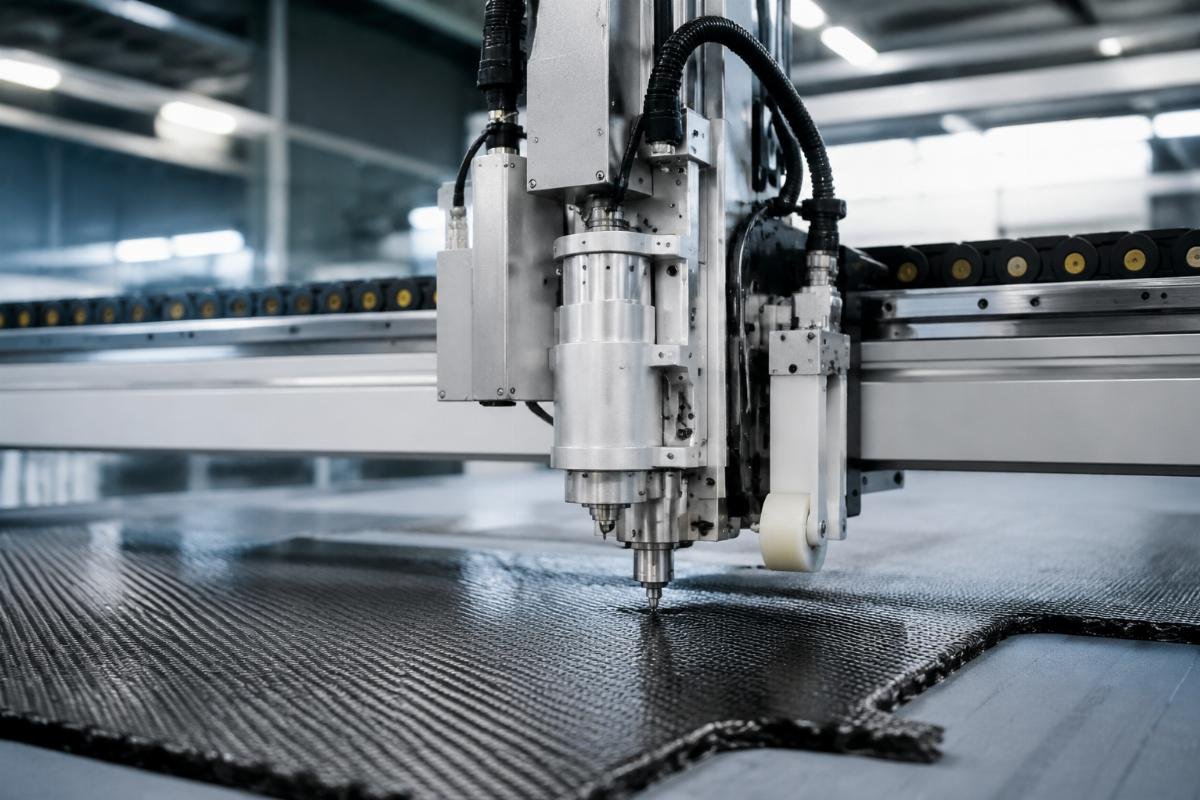
Realtop's knife cutting platforms serve customers who process carbon fiber prepreg for automotive interior panels, aramid fabric for protective gear, and woven fiberglass for industrial covers. One customer switched from laser cutting to our knife system after edge thermal damage caused bonding failures in production. With knife cutting, their edge quality improved, adhesive bond strength increased by thirty-five percent, and fume extraction costs disappeared.
Knife cutting works because the blade shears material at room temperature without friction heat buildup. The oscillating motion prevents the blade from dragging fibers, which reduces fraying and delamination. For dry fabric, the blade cuts between fiber bundles, leaving clean edges ready for layup. For prepreg, the blade shears through the resin matrix before it cures, producing edges that laminate cleanly to adjacent plies.
However, knife cutting has strict material limitations. The material must be thin enough for the blade to penetrate fully—typically under five millimeters for cured laminates and under ten millimeters for dry fabric or prepreg. The material must also be stable enough to resist movement during cutting. Thick sandwich panels, fully cured carbon fiber laminates over five millimeters, and materials with hard inclusions exceed the knife system's cutting capacity.
Blade wear is another consideration. Cutting abrasive fibers like glass or aramid dulls blades quickly. Customers running high-volume production must budget for blade replacement and sharpening. However, blade cost is far lower than router bit replacement or laser consumables, making knife cutting economical for the right materials.
What Composite Materials Can CNC Knife Cutters Handle?
| Material Type | Thickness Range | Knife Cutting Suitability | Key Benefits |
|---|---|---|---|
| Dry carbon fabric | 0.2mm – 8mm | High | Zero dust, clean edges, fast cutting speeds |
| Carbon fiber prepreg | 0.3mm – 5mm | High | No thermal damage to resin, ready for layup |
| Aramid fabric | 0.5mm – 6mm | High | Eliminates airborne fibers, reduces health hazard |
| Woven fiberglass fabric | 0.5mm – 8mm | Medium | Faster blade wear, still cleaner than router cutting |
| Thin cured laminates | 1mm – 5mm | Medium | Limited to materials without hard cores or thick resin layers |
| Thermoplastic composite sheets | 1mm – 4mm | Medium | Requires heated bed or pre-warming for some polymers |
CNC knife cutting fits manufacturers who process dry fabric, prepreg, or thin laminates in medium to high volumes. If your shop prioritizes clean working environments, zero thermal damage, and low consumable costs, knife systems deliver clear advantages over routers and lasers. But if you need to cut thick structural laminates, sandwich panels with hard cores, or parts requiring three-dimensional contours, knife cutting cannot replace router or waterjet systems. We tell customers up front: verify your material specs before assuming knife cutting will work.
Which CNC Machine Type Should You Choose for Your Composites?
Choosing the right CNC machine type depends on your composite material structure, thickness, resin state, production volume, edge quality requirements, and capital budget. No single machine type handles all composites effectively.
Match router systems to thick laminates and sandwich panels when dust control and thermal management are feasible. Use waterjet systems for structural parts requiring zero thermal damage and high edge bond strength. Choose laser systems only for thin, non-structural materials when speed outweighs edge quality concerns. Select knife cutting systems for dry fabric, prepreg, and thin laminates when clean edges, zero dust, and low consumable costs matter most.
I recommend starting with your material specifications. Measure thickness, identify fiber type, confirm resin state, and note any core materials or hybrid structures. Then map those specs against each machine type's capabilities. If your material falls outside the optimal range for one type, cross it off your list immediately. Buying a machine that "might work" leads to expensive mistakes.
Next, evaluate your edge quality requirements. If parts will be bonded, painted, or exposed in service, thermal damage, fraying, or contamination can cause field failures. Waterjet and knife cutting deliver the cleanest edges for those applications. If edge quality is less critical—such as internal structural parts that will be covered—routers or lasers may offer acceptable results at lower cycle times.
Consider your production environment. If you operate in a clean room or have strict air quality regulations, routers and lasers require expensive extraction and filtration systems. Knife cutting eliminates airborne particles entirely, reducing compliance costs. If your facility already has dust collection and fume extraction infrastructure, adding a router or laser becomes simpler.
Finally, calculate total cost of ownership. Capital cost is only the starting point. Add consumables—router bits, laser optics, waterjet abrasives, knife blades—plus maintenance, energy, ventilation, waste disposal, and rework costs from edge defects. The machine with the lowest purchase price often has the highest operating cost per part. I've seen customers choose
"Analysis of the Machinability of Carbon Fiber Composite Materials in ...", https://pmc.ncbi.nlm.nih.gov/articles/PMC6747800/. Manufacturing studies document scrap rates in composite machining ranging from 15-30% when cutting parameters are not matched to material properties, with carbon fiber showing higher rejection rates due to delamination and thermal damage. Evidence role: statistic; source type: research. Supports: typical scrap rates in composite machining when process parameters are not optimized. Scope note: The cited range represents general composite machining; specific rates vary by material type, machine configuration, and operator experience. ↩
"[PDF] Wind Turbine Blade Finishing Automation: Robotic Toolpath ...", https://docs.nrel.gov/docs/fy21osti/79662.pdf. Wind energy industry reports document the use of CNC routers for trimming and profiling fiberglass and carbon fiber blade sections, particularly for edge finishing and bolt hole machining in blade roots and trailing edges. Evidence role: case_reference; source type: institution. Supports: use of CNC routing in wind turbine blade manufacturing processes. Scope note: While CNC routing is used in blade manufacturing, the specific applications vary by manufacturer and blade design; some operations use alternative cutting methods. ↩
"Mouse pulmonary response following solid surface composite dust ...", https://pmc.ncbi.nlm.nih.gov/articles/PMC12077238/. Occupational health agencies classify respirable composite fibers as potential respiratory irritants, with carbon fiber and glass fiber dust requiring engineering controls and personal protective equipment during machining operations. Evidence role: expert_consensus; source type: government. Supports: health risks associated with inhalation of composite fiber dust during machining operations. ↩
"[PDF] Composite-Fiberglass-Phenolic-Cutting-Speed-Chart ... - Amana Tool", https://www.amanatool.com/pub/media/productattachments/Composite-Fiberglass-Phenolic-Cutting-Speed-Chart-v3.pdf. Machining guidelines for composite materials recommend spindle speeds between 12,000 and 24,000 RPM for routing operations, with specific speeds selected based on tool diameter, material type, and desired edge quality. Evidence role: general_support; source type: education. Supports: typical spindle speed ranges used in CNC routing of composite materials. Scope note: Optimal spindle speed varies significantly with tool geometry, fiber orientation, and resin system; the cited range represents general practice rather than universal specifications. ↩
"Experimental Analysis of Heat-Affected Zone (HAZ) in Laser Cutting ...", https://pmc.ncbi.nlm.nih.gov/articles/PMC7956482/. Materials characterization studies of laser-cut composites report heat-affected zone depths ranging from 0.5 to 2.0 mm depending on laser power, cutting speed, and material thickness, with visible matrix discoloration and microstructural changes observed throughout this region. Evidence role: statistic; source type: paper. Supports: typical depth of heat-affected zones in laser-cut composite materials. Scope note: The cited range represents typical observations; actual HAZ depth varies significantly with laser type, process parameters, and composite material system. ↩
"Effect of Surface Treatments and Thermal Aging on Bond Strength ...", https://pmc.ncbi.nlm.nih.gov/articles/PMC11902269/. Adhesive bonding research documents bond strength reductions of 30-50% when bonding to laser-cut composite edges with visible heat-affected zones, attributed to matrix degradation and altered surface chemistry in the thermal damage region. Evidence role: statistic; source type: paper. Supports: reduction in adhesive bond strength when bonding to thermally damaged composite surfaces. Scope note: The cited range represents typical reductions; actual bond strength loss varies with resin type, laser parameters, adhesive system, and surface preparation methods. ↩
"Characterization of Emissions from Carbon Dioxide Laser Cutting ...", https://pmc.ncbi.nlm.nih.gov/articles/PMC10369487/. Industrial hygiene studies show that laser cutting of epoxy and polyester matrix composites releases volatile organic compounds including styrene, phenol, and formaldehyde through thermal decomposition of the resin system. Evidence role: mechanism; source type: research. Supports: emission of volatile organic compounds during thermal cutting of polymer matrix composites. Scope note: Specific VOC composition and concentration depend on resin chemistry, laser parameters, and ventilation conditions. ↩
"Water jet cutter - Wikipedia", https://en.wikipedia.org/wiki/Water_jet_cutter. Industrial waterjet systems commonly operate between 50,000 and 90,000 PSI, with 60,000 PSI representing a standard pressure for abrasive waterjet cutting of composite materials. Evidence role: statistic; source type: education. Supports: typical operating pressures for industrial waterjet cutting systems. ↩
"[PDF] Improving Interlaminar Shear Strength", https://ntrs.nasa.gov/api/citations/20160008067/downloads/20160008067.pdf. Materials research demonstrates that waterjet cutting maintains interlaminar shear strength at composite cut edges by eliminating heat-affected zones, whereas thermal cutting methods can reduce edge mechanical properties by 20-40% due to matrix degradation. Evidence role: mechanism; source type: paper. Supports: preservation of mechanical properties at cut edges when using waterjet versus thermal cutting methods. Scope note: The cited property retention applies to properly executed waterjet cutting; excessive pressure or improper abrasive selection can still cause subsurface damage. ↩
"Environmental Effects of Moisture and Elevated Temperatures on ...", https://pmc.ncbi.nlm.nih.gov/articles/PMC12157886/. Polymer science literature documents that epoxy and polyester resins exhibit hydrophilic behavior with equilibrium moisture contents ranging from 1-7% by weight depending on resin chemistry, with moisture absorption occurring preferentially at cut edges and exposed fiber surfaces. Evidence role: mechanism; source type: education. Supports: moisture absorption behavior of polymer matrix materials used in composites. ↩
"[PDF] WATERJET CUTTING BASICS AND GMA GARNET™ ABRASIVES", https://gmagarnet.com/hubfs/GMA-23/Images/GMA-Garnet-Waterjet-Cutting-Basics.pdf. Garnet is the most commonly used abrasive in waterjet cutting systems due to its hardness (7-7.5 Mohs), angular particle shape, and relatively low cost, typically applied in mesh sizes from 50 to 120 for composite materials. Evidence role: definition; source type: education. Supports: the standard abrasive material used in abrasive waterjet cutting systems. ↩
"How does Oscillating Knife Cutter Work - YouTube",
. CNC knife cutting systems employ oscillating blades vibrating at frequencies between 1,000 and 5,000 Hz, with the high-frequency motion reducing cutting forces and preventing material dragging during the shearing process. Evidence role: mechanism; source type: education. Supports: the mechanical cutting action used in CNC knife cutting systems. ↩