

Blog
What Does CNC Stand For and Does It Apply to Fabric Cutting?

What Does CNC Stand For and Does It Apply to Fabric Cutting?
If you searched "CNC" while comparing fabric or leather cutting machines, you probably wondered whether this term even applies to your industry. Most people associate CNC with metal machining shops, not flexible material processing.
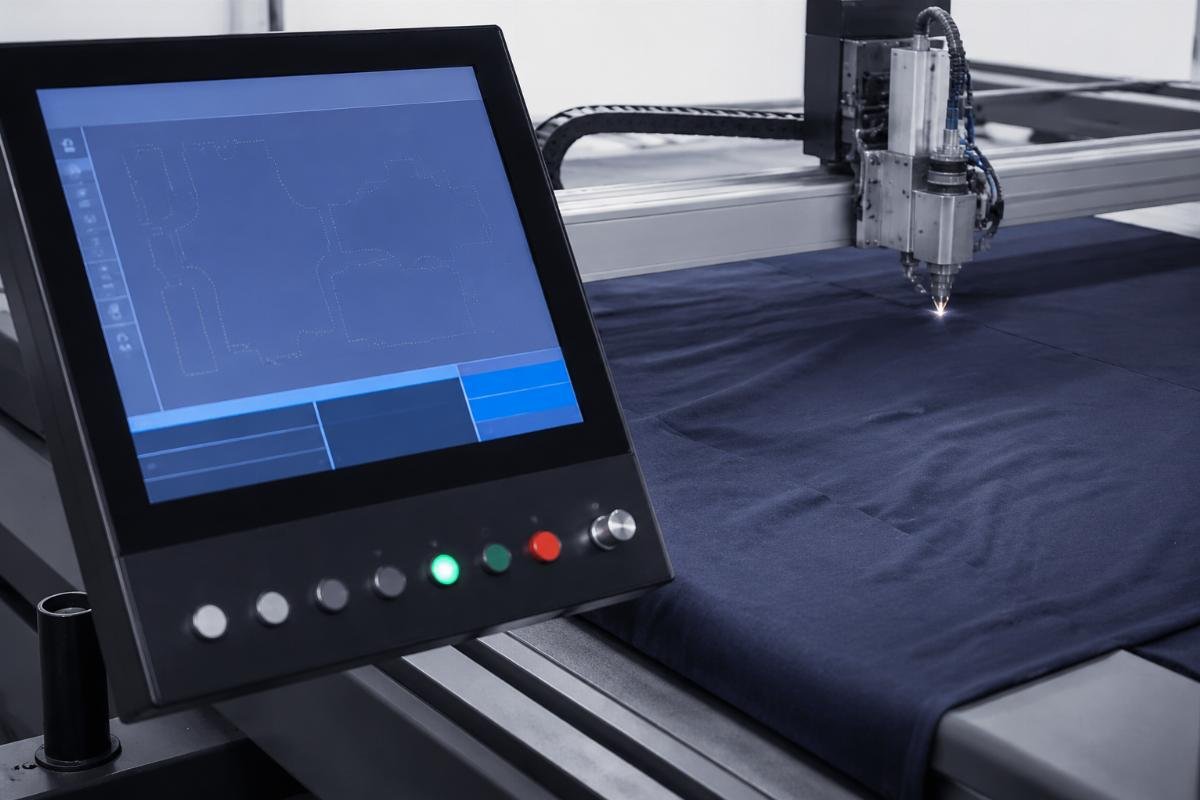
CNC stands for Computer Numerical Control—a method where software controls cutting paths instead of manual operation.1 The confusion happens because CNC describes the control system, not the cutting tool itself. Your real question should be: does my production need programmable control, and which cutting tool works with my material?
Understanding this difference helps you avoid buying the wrong equipment category. Many buyers confuse cutting methods with control systems, leading to mismatched investments.
What Does CNC Actually Control in Flexible Material Cutting?
CNC confused me when I first joined Realtop because customers used it to mean three different things. Some asked about "CNC cutting" when they meant any automated cutting. Others specified "CNC knife cutting" to distinguish from laser. A third group wanted to know if CNC required programming skills.
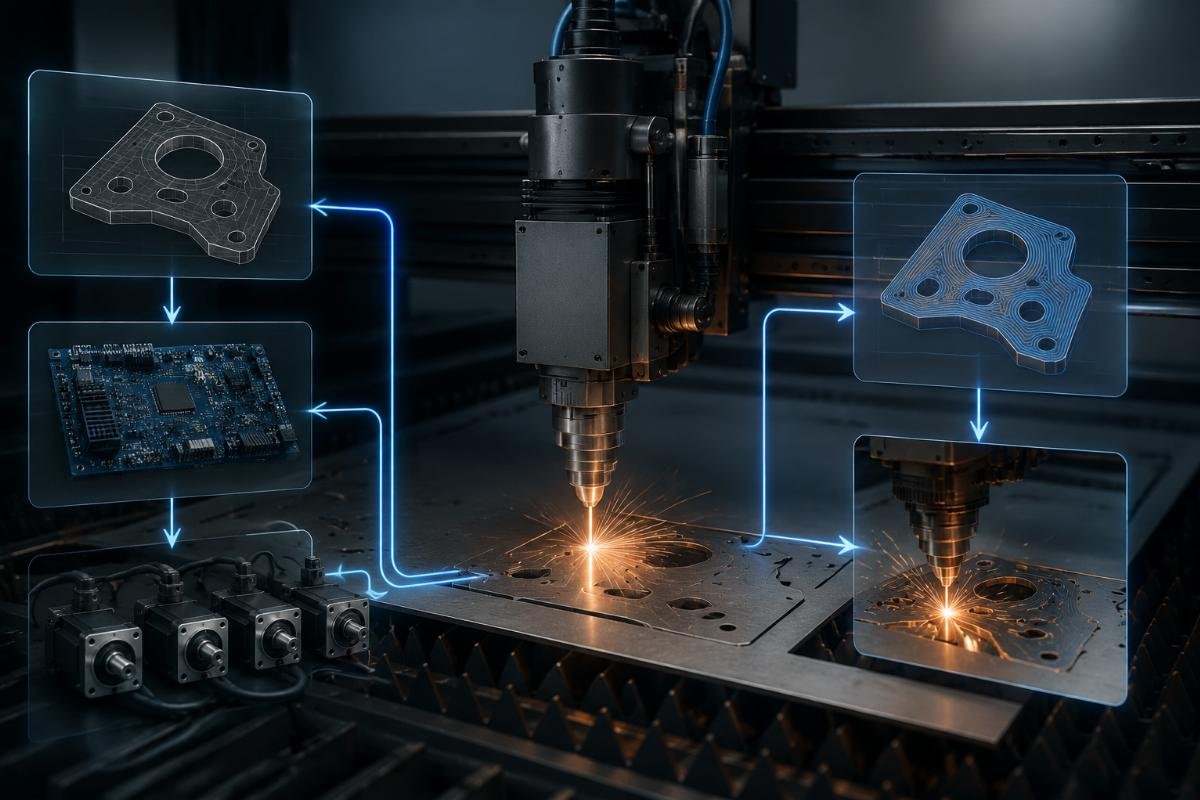
CNC is the brain that tells the cutting tool where to move. It reads your design file and converts it into motor commands—moving the cutting head along programmed paths with repeatability.2 The cutting tool itself can be a knife blade, a laser head, or even a routing bit, but CNC only controls the movement.
Breaking Down the Control vs. Tool Confusion
Most buyers mix up two separate decisions. First, you choose the cutting tool based on your material properties. Fabric tolerates knife cutting but chars under laser heat. Leather handles both methods depending on thickness.3 Gasket materials need knife cutting to avoid edge sealing from laser melting.
Second, you decide whether you need CNC control for that tool. Manual knife cutting works for small shops doing the same pattern repeatedly. CNC control becomes necessary when you run multiple designs per day, need tight nesting to reduce waste, or cut complex curves that manual operators can't replicate consistently.
The table below shows how these decisions connect:
| Material Type | Suitable Tool | When CNC Control Adds Value |
|---|---|---|
| Woven fabric | Knife blade | Design changes weekly, multi-layer cutting |
| Natural leather | Knife or laser | Irregular hide shapes requiring automatic nesting |
| Cardboard packaging | Knife blade | Custom box sizes per order batch |
| Vinyl graphics | Knife blade | Complex contours, frequent pattern switching |
| Technical textiles | Knife blade | Tight tolerances across large production runs |
This separation helps you focus on the real bottleneck in your process. If setup time kills your efficiency, CNC control solves that. If your material burns or melts, you need a different cutting tool regardless of control method.
How Does CNC Knife Cutting Differ From Laser Cutting?
Customers often ask me "CNC or laser" during inquiries, but that question mixes two unrelated factors. Both laser cutters and knife cutters can use CNC control. The actual choice depends on whether your material tolerates heat and whether you need through-cutting versus marking.
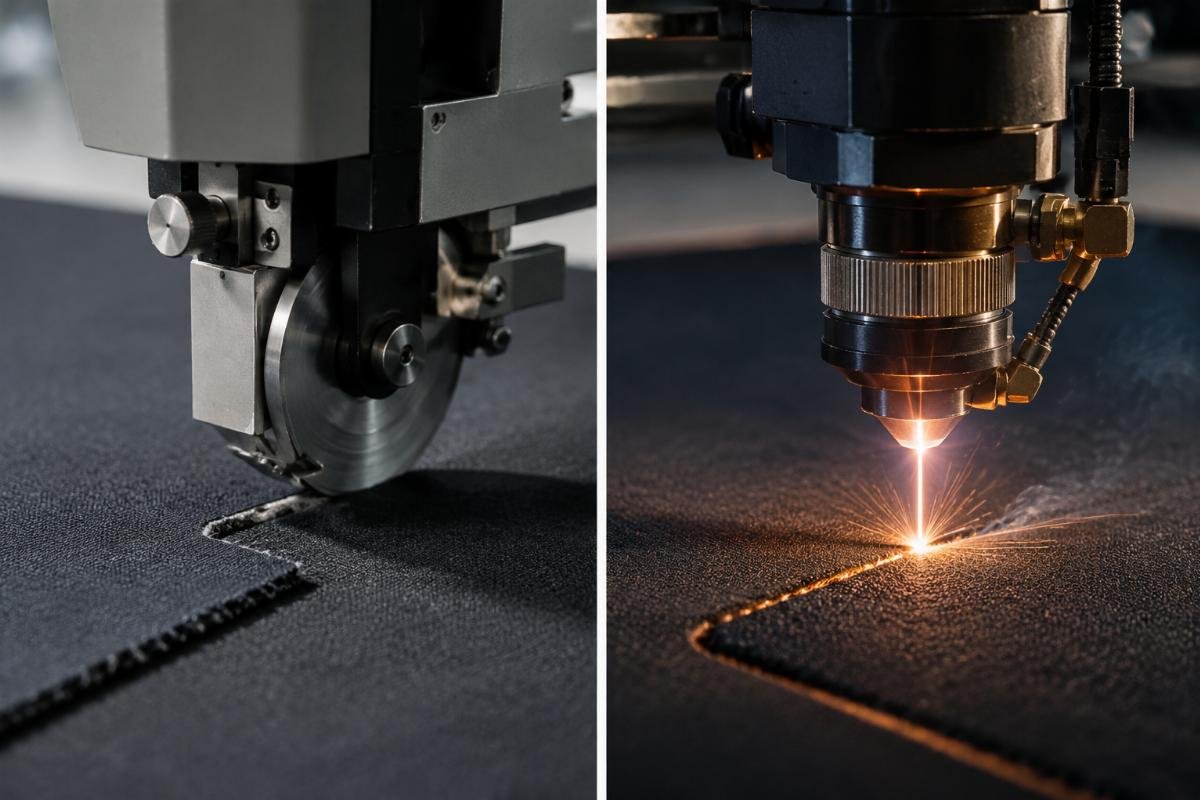
CNC knife cutting uses a reciprocating blade controlled by software to slice through materials without applying heat. Laser cutting uses a focused light beam that melts or vaporizes material along the cut path. CNC simply provides the motion control for either tool—making the real decision about thermal compatibility.
Material Tolerance Drives Tool Selection
I learned this from a packaging buyer who insisted on laser cutting for corrugated cardboard. He assumed laser meant higher precision. After we sent samples, he noticed the edges turned brown and weakened where the beam burned through. Knife cutting left clean edges that maintained fold strength.
Synthetic fabrics with polyester content melt under laser heat, creating hard edges that affect seam quality.4 Natural fabrics like cotton and linen handle laser cutting but produce smoke and require ventilation. Leather develops a polished edge from laser cutting that some furniture makers prefer, but automotive interior suppliers avoid it because the burnt edge weakens stitching points.
The decision matrix looks like this:
Choose CNC knife cutting when:
- Material contains heat-sensitive fibers or coatings
- You need to preserve material flexibility along cut edges
- Multilayer cutting is common in your workflow
- Minimal edge finishing is required after cutting
Choose laser cutting when:
- Material tolerates heat without degradation
- You need to cut and mark in the same operation
- Edge sealing from heat is beneficial (prevents fraying)
- Cutting speed outweighs edge finish concerns
Both methods use CNC control for the same reason—to execute complex paths accurately and repeat them across production batches without operator variation.
Does CNC Mean I Need Programming Skills?
This worry comes up in almost every first meeting with furniture and automotive buyers. They picture someone writing code line by line to move a cutting head. That mental image makes CNC sound like a barrier rather than a tool.
Modern CNC cutting machines import design files directly from CAD software. You draw your pattern in the design program you already use, export it as a standard file format, and the CNC controller converts it automatically. No manual code writing happens in typical flexible material cutting operations.
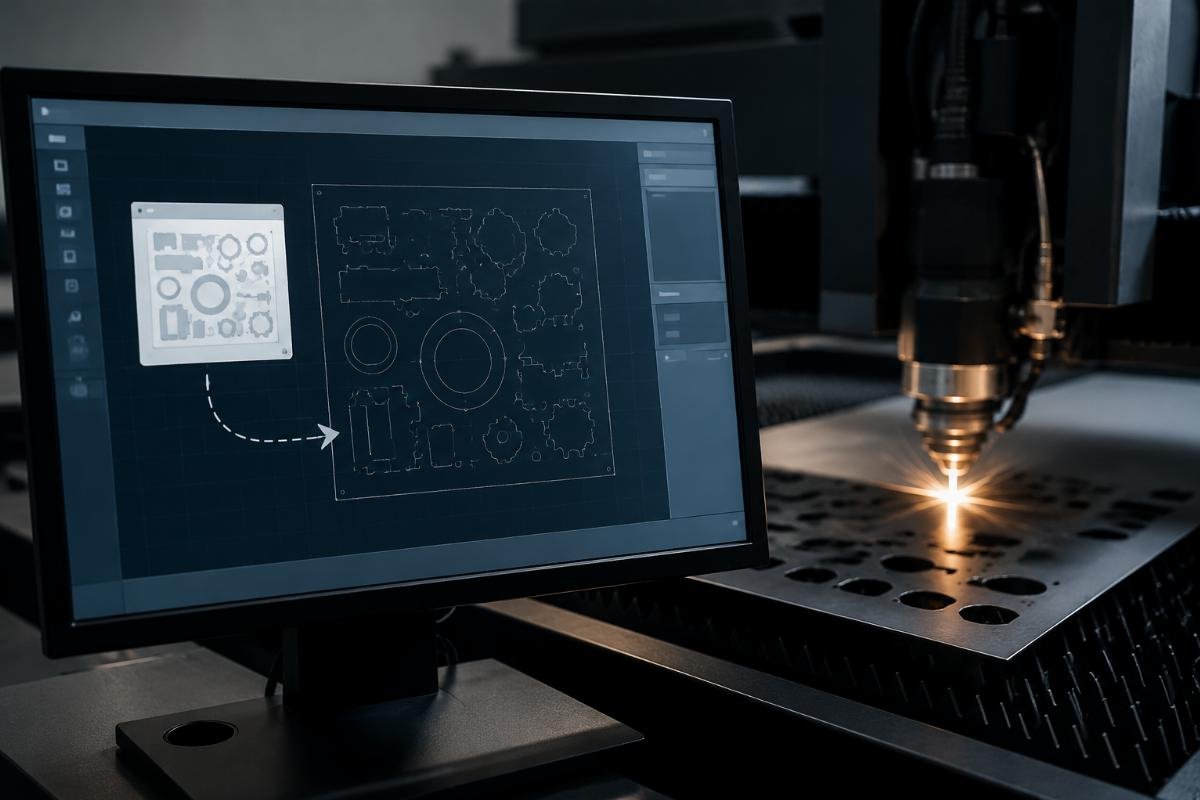
When I demonstrate this to skeptical buyers, I open their existing pattern file, drag it into the cutting software, set material thickness and knife depth, and start cutting. The entire setup takes under five minutes. Their relief is visible because they expected a steep learning curve.
The software handles path optimization automatically. It calculates the most efficient cutting sequence, determines where to start and stop cuts, and adjusts knife angles for sharp corners. Operators focus on loading material and monitoring the process, not on writing movement commands.
When Should You Use Die Cutting Instead of CNC?
Die cutting still dominates high-volume production for good reasons. Customers switching from die to CNC often expect immediate cost savings, but the economics depend entirely on your production pattern.
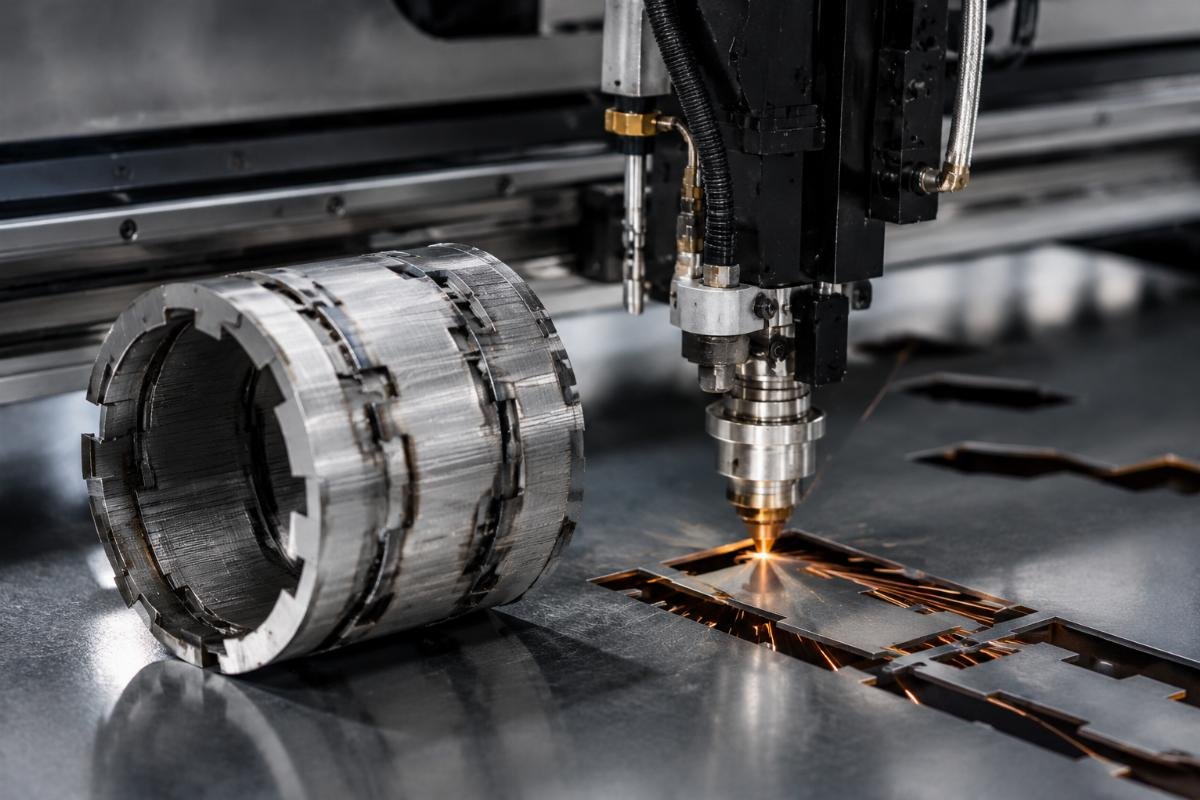
Die cutting uses a metal rule die that stamps through material in a single press action.5 It works best for extremely high volumes of identical shapes where setup cost spreads across millions of pieces. CNC cutting costs more per piece at that volume but eliminates die making entirely.
Volume and Design Variation Create the Breakeven Point
An automotive gasket manufacturer showed me their calculation method. They produce 50,000 pieces per month of about 30 different gasket shapes. Each die costs them roughly $800 and takes two weeks to fabricate.6 Design changes happen quarterly when their customer updates vehicle models.
Switching to CNC knife cutting eliminated die costs but increased cutting time per piece from 2 seconds to 8 seconds.7 Their breakeven analysis showed CNC became cheaper when monthly volume per design dropped below 5,000 pieces, or when design life fell under six months.
The decision framework:
| Production Pattern | Recommended Method | Why |
|---|---|---|
| 100,000+ pieces, same design, one year+ lifespan | Die cutting | Per-piece cost lowest, die investment recovers quickly |
| 10,000-100,000 pieces, design changes quarterly | CNC cutting | Avoids repeated die costs, flexible to design updates |
| Under 10,000 pieces, frequent design variations | CNC cutting | Setup time and zero tooling cost outweigh slower cutting |
| Prototyping and sampling | CNC cutting | No tooling investment for testing phases |
Advertising and packaging buyers typically fall into the third category. They run custom jobs with quantities in the hundreds, making die fabrication economically impossible. CNC control allows them to switch between customer orders in minutes instead of hours required for die changes.
Material Thickness and Complexity Factors
Die cutting struggles with thick materials or intricate internal cutouts. A furniture manufacturer tried die cutting 15mm foam cushion components but found the press force caused material compression that affected final dimensions.8 CNC knife cutting with a drag knife maintained thickness and dimensional accuracy.
Complex patterns with internal voids require separate die components or secondary operations. CNC knife cutting handles these in a single pass because the blade follows the programmed path regardless of pattern complexity. No additional tooling is needed for adding windows, slots, or registration holes to your design.
How Do Buyers Evaluate CNC Cutting Machine Specifications?
The specification sheets we send to buyers contain parameters that don't always translate to real production decisions. Customers fixate on cutting speed numbers without connecting them to their actual bottleneck.
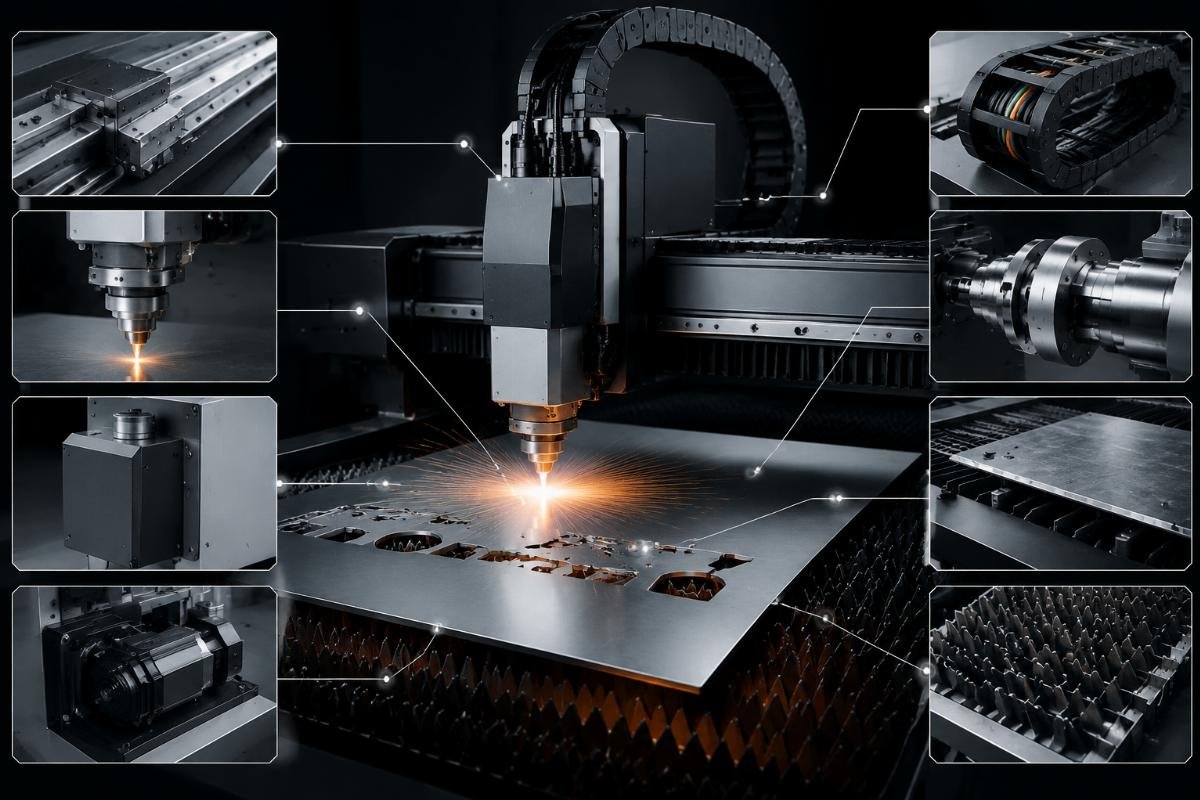
Focus on three specification groups: cutting area dimensions matching your material width, knife depth capacity covering your thickest material with margin, and software compatibility with your existing design files. Speed specifications matter less than setup time and nesting efficiency for most flexible material applications.
Cutting Area Determines Material Utilization
Fabric buyers immediately understand this because they purchase material in standard widths—typically 1.5m or 1.8m. If your CNC cutter has a 1.2m width capacity, you waste edge material or need to make two passes. Leather processors face different constraints because hides come in irregular shapes, requiring flexible placement rather than fixed width accommodation.
Packaging and advertising shops prioritize length over width. They load roll materials and need continuous cutting along the feed direction. A 3m length capacity lets them nest multiple small jobs on a single material load, reducing the frequency of material changes.
I ask buyers to map their typical material sizes against machine dimensions before discussing other specifications. This prevents the common mistake of buying a compact machine for cost savings, then discovering it can't handle standard material widths.
Software Compatibility Prevents Workflow Disruption
This catches buyers off guard because they assume all CAD file formats work universally. A furniture buyer once ordered a machine without checking whether it accepted their existing pattern files. Their design team used a specialized furniture CAD system outputting a proprietary format. Converting files added 15 minutes per pattern and introduced occasional dimension errors.
Standard formats include DXF, AI, PLT, and PDF.9 Most CNC cutting software accepts these directly. Verify compatibility before purchase, especially if your design team uses industry-specific software. Some suppliers offer custom import plugins, but this adds cost and potential support complications.
Pattern nesting features vary significantly between software packages. Basic systems let you manually arrange pieces on the cutting area. Advanced nesting automatically rotates and positions patterns to minimize waste. For expensive materials like leather or technical fabrics, nesting efficiency directly affects your material cost per piece.
Does Your Production Pattern Actually Need CNC Control?
The toughest conversations happen when a buyer clearly doesn't need CNC but assumes automation requires it. A small advertising shop asked about CNC cutting for vinyl lettering because competitors advertised "CNC precision." Their actual volume was under 20 jobs per week with simple geometric shapes.
You need CNC control when design variation, cutting complexity, or production volume makes manual operation impossible to scale. If you run the same ten patterns repeatedly with simple straight cuts, manual cutting with templates often costs less and requires minimal training.10
Signs CNC Control Solves Your Bottleneck
Setup time becomes your constraint when you spend more time positioning templates and marking cut lines than actually cutting. One packaging buyer tracked their process and found 40 minutes of setup for 15 minutes of cutting per job. CNC reduced setup to 5 minutes because the software handled layout automatically.
Design changes cost you money when customers request modifications after you've created templates or dies. An automotive supplier absorbed $3,000 in die revision costs during a single model year. CNC eliminated that expense because design updates just meant loading new files.
Accuracy requirements exceed manual capability when your tolerances fall under 1mm or when you need identical pieces across large batches. Furniture makers cutting fabric for upholstery need consistent dimensions so sewn assemblies fit properly. Manual variation of even 2-3mm creates fitting problems during assembly.11
When Manual Methods Still Make Sense
Low-volume operations with stable designs don't recover the CNC investment cost. A leather goods maker producing 50 bags per month using five standard patterns saw no benefit from CNC because their current cutting method worked efficiently.
Simple geometric shapes don't require programmable control. Straight cuts, circles, and basic rectangles are faster to execute with guided manual tools. CNC setup time exceeds manual cutting time when pattern complexity is low.
Prototyping and sampling can go either way. If you iterate designs frequently, CNC accelerates the testing cycle. If you hand-cut prototypes to evaluate material behavior before committing to production methods, manual cutting maintains flexibility.
What Questions Should You Ask CNC Cutting Suppliers?
Buyers often request quotations without knowing which specifications actually matter for their application. This creates two problems. First, suppliers quote based on assumptions that may not match your needs. Second, you can't evaluate which machine truly fits your production pattern.
Ask suppliers about material compatibility first, then software workflow integration, then service response time. Technical specifications like cutting speed and positioning accuracy matter less than whether the system handles your specific materials and connects to your existing design process.
Material Testing Before Purchase
Request sample cutting of your actual materials, not generic demonstrations. I've seen buyers approve machines based on cutting demo materials, then discover their production materials behaved differently. Fabric with backing layers, leather with uneven thickness, or cardboard with varying density all require different knife settings and cutting speeds.
Ask whether the supplier has experience with your material category. Packaging materials differ from automotive textiles, which differ from furniture fabrics. Each industry has specific edge quality requirements and production volume patterns that affect machine configuration recommendations.
Software Training and File Preparation Support
Find out what training comes with the purchase and whether it covers your design software specifically. Generic CAD training doesn't help if your team uses specialized pattern-making software. Ask if the supplier provides file conversion services during the transition period.
Check whether software updates require annual fees or come free with purchase. Some suppliers bundle ongoing software support, while others charge separately. This affects total cost of ownership significantly over a five-year period.12
Service Response and Parts Availability
CNC cutting becomes your production bottleneck when it breaks down. Ask about local service availability, response time commitments, and parts inventory. International suppliers may offer lower purchase prices but create longer downtime if repairs require shipped components.
Understand the warranty coverage specifics. Does it include on-site service or require shipping the machine back? Are wearing parts like knife blades covered or excluded? What triggers warranty cancellation—such as using third-party consumables?
Conclusion
CNC describes the control system that executes your design files, not the cutting method itself. Your real decisions are: which cutting tool matches my material properties, does my production volume justify programmable control, and can I integrate CNC workflow into my existing design process without disrupting operations?
"Computer numerical control - Wikipedia", https://en.wikipedia.org/wiki/Computer_numerical_control. Computer Numerical Control (CNC) refers to the automated control of machining tools through programmed commands encoded on a storage medium, eliminating the need for manual operation of machine controls. Evidence role: definition; source type: encyclopedia. Supports: the standard definition and function of Computer Numerical Control systems. ↩
"[PDF] Numerical Control Tool Path Generation In A Solid Modeler", https://preserve.lehigh.edu/system/files/derivatives/coverpage/424800.pdf. CNC controllers process design data by converting geometric information into machine-readable instructions (typically G-code), which are then translated into precise motor movements that control tool positioning and feed rates. Evidence role: mechanism; source type: education. Supports: the technical process by which CNC systems interpret design files and generate motion control commands. Scope note: This describes the general CNC process; specific implementation details vary by controller type and manufacturer. ↩
"Laser Cutting of Non-Woven Fabric Using UV Nanosecond Pulsed ...", https://pmc.ncbi.nlm.nih.gov/articles/PMC11596816/. Textile materials exhibit varying thermal degradation thresholds, with synthetic fibers typically melting at 200-300°C and natural fibers charring at higher temperatures, while leather's collagen structure responds differently to thermal cutting based on thickness and tanning method. Evidence role: mechanism; source type: research. Supports: the thermal behavior of fabrics and leather under different cutting methods. Scope note: Specific temperature thresholds and cutting outcomes depend on exact material composition, moisture content, and processing parameters. ↩
"CW CO2 laser cutting of multiple-layer blended fabric - ScienceDirect", https://www.sciencedirect.com/science/article/abs/pii/S0030402623006654. Polyester fibers melt at approximately 260°C, and laser cutting creates a thermally fused edge through localized melting and resolidification, which can increase edge stiffness and potentially affect sewability depending on seam allowance and stitch type. Evidence role: mechanism; source type: research. Supports: the melting behavior of polyester under laser cutting and resulting edge characteristics. Scope note: Edge quality effects vary with laser power settings, cutting speed, and specific polyester blend composition. ↩
"Die cutting (web)", https://en.wikipedia.org/wiki/Die_cutting_(web). Die cutting is a fabrication process that uses shaped steel rule dies mounted on a press to cut through sheet materials in a single stamping operation, enabling high-speed production of consistent shapes. Evidence role: definition; source type: education. Supports: the basic mechanism and definition of die cutting processes. ↩
"Precision Steel Rule Die Manufacturer - Manual & CNC - Alibaba.com", https://www.alibaba.com/showroom/steel-rule-die-manufacturer.html. Custom steel rule die costs typically range from $500 to $3,000 depending on complexity, size, and tolerance requirements, with fabrication lead times varying from several days to several weeks based on die complexity and manufacturer capacity. Evidence role: case_reference; source type: other. Supports: typical cost ranges and lead times for custom die fabrication. Scope note: The cited $800 cost and two-week timeline represent one specific case; actual costs and timelines vary significantly based on die specifications, manufacturer, and order volume. ↩
"CNC vs Die Cutting | Solo Products, Inc.", https://www.soloproductsandcontainers.com/cnc-vs-die-cutting/?srsltid=AfmBOopYuip6xzacSHZ3QBrS0x9kTIDW9faNbvyABl4pZtxdajXxTcFx. Die cutting presses typically achieve cycle times of 1-5 seconds per piece for simple shapes, while CNC knife cutting systems generally require longer per-piece times due to sequential path following, though exact ratios depend on part complexity, material type, and machine specifications. Evidence role: general_support; source type: other. Supports: the general speed differential between die cutting and CNC cutting methods. Scope note: The specific 2-second versus 8-second comparison represents one case study; actual speed differences vary widely based on part geometry, material properties, and equipment capabilities. ↩
"Advances in the Applications and Studies of Polyurethane Foam for ...", https://pmc.ncbi.nlm.nih.gov/articles/PMC12251857/. Flexible foam materials exhibit viscoelastic compression under die cutting forces, with recovery characteristics dependent on foam density, cell structure, and applied pressure duration, which can result in dimensional variations if cutting parameters are not optimized for the specific foam formulation. Evidence role: mechanism; source type: research. Supports: the compression behavior of foam materials under die cutting pressure. Scope note: The extent of compression and dimensional change varies significantly with foam type, density, and die cutting parameters; the 15mm example represents one specific case. ↩
"CAD File Formats for CNC Machining - MakerVerse", https://www.makerverse.com/resources/cnc-machining-guides/cad-file-formats-for-cnc-machining/. CNC cutting systems commonly support vector-based file formats including DXF (Drawing Exchange Format), AI (Adobe Illustrator), PLT (HPGL plotter format), and PDF, though specific format compatibility varies by controller manufacturer and software version. Evidence role: general_support; source type: education. Supports: commonly supported file formats in CNC cutting applications. Scope note: Format support is not universally standardized across all CNC systems; compatibility should be verified for specific equipment. ↩
"[PDF] A Primer on Breakeven Analysis - Yale School of Management", https://som.yale.edu/sites/default/files/2025-04/A%20Primer%20on%20Breakeven%20Analysis.pdf. For low-complexity, high-repetition cutting operations, manual methods with templates or fixtures can offer lower total cost when production volumes are insufficient to amortize CNC equipment investment and when setup time advantages of automation are minimal. Evidence role: general_support; source type: other. Supports: the economic considerations in choosing between manual and automated cutting for simple, repetitive operations. Scope note: Economic breakeven points depend on labor costs, production volume, pattern complexity, and accuracy requirements; no universal threshold applies across all manufacturing contexts. ↩
"[PDF] WOVEN & KNIT RESIDENTIAL UPHOLSTERY FABRIC ...", https://ahfa.us/downloads/standards/Fabric-Standards-and-Guidelines.pdf. Upholstered furniture assembly typically requires fabric component tolerances within ±2-5mm to ensure proper fit during sewing and assembly, with tighter tolerances needed for pattern-matched fabrics or complex seam configurations. Evidence role: general_support; source type: other. Supports: typical dimensional tolerance requirements in upholstery manufacturing. Scope note: Specific tolerance requirements vary by furniture design, fabric type, and assembly method; the 2-3mm threshold represents a general guideline rather than a universal standard. ↩
"Total Cost of Ownership: CNC Machines - GOWICO", https://gowico.com/blogs/financial-guides/total-cost-of-ownership-cnc-machines?srsltid=AfmBOop1sj7BL_zDgglIay3eBLnKeJSs71BbyQ68Z0ocAXmvXTEjkZIl. Software licensing, updates, and technical support can represent 10-25% of total cost of ownership for CNC equipment over a typical 5-10 year lifecycle, with costs varying based on software complexity, update frequency, and support service levels. Evidence role: general_support; source type: other. Supports: the contribution of software and support costs to total equipment ownership costs. Scope note: Specific cost percentages vary widely by equipment type, manufacturer pricing models, and user support requirements; no industry-standard cost structure exists. ↩